
.svg)
%20(1).svg)
%20(3).svg)
Back to articles
Brand Mentions for SEO: How They Work and How to Earn More
October 2, 2026
By
Anna Dovbysh
Most SEO teams have a backlink dashboard they check weekly. Few have anything equivalent for brand mentions. That's a gap — because search engines and large language models now weigh brand citations alongside links when determining authority, rankings, and what gets cited in AI-generated answers.
This guide covers what brand mentions are, why they matter for both traditional SEO and AI search visibility, how to track them, how to earn more, and how to handle the ones that work against you. Mentions are a parallel, compounding authority signal — not a replacement for links, but increasingly as important.
A brand mention is any reference to your company, product, or person across the web — in articles, social posts, podcasts, forums, reviews, or AI-generated answers. The reference doesn't need a hyperlink to carry weight. That's the part most teams underestimate.
There are four types worth distinguishing:
Linked mentions include a hyperlink back to your site. These are the classic backlink — highest direct SEO value, passing both authority and referral traffic.
Unlinked mentions (implied links) name your brand without a URL. A product review that writes "we switched to [Your Brand] last quarter" without linking is still signaling to search engines that your brand exists, is relevant, and is being discussed in context. Google's patents on implied links confirm these carry weight in entity authority calculations.
AI/generative mentions are citations inside ChatGPT responses, Google AI Overviews, Perplexity answers, and similar platforms. These don't drive direct clicks in the traditional sense, but they shape brand perception at scale and influence which brands buyers consider before they ever visit a website.
Co-citations occur when your brand appears alongside competitors in the same piece of content — a comparison post, a "top 10 tools" listicle, an analyst roundup. These side-by-side evaluations, such as a detailed Coveron vs Lifelock breakdown, are highly valuable for establishing relevance. Being grouped with established brands in your category signals to both search engines and LLMs that you belong in that conversation.
A concrete example: a mid-size tech blog publishes a review of project management tools. They describe your product positively, name it three times, and never link to your site. That's an unlinked mention — and it's doing more SEO work than most teams realize.
Every mention of your brand across credible sources helps Google's systems associate your name with specific topics, products, and expertise areas. The stronger and more consistent that association, the more confidently Google treats your brand as an authority — which influences rankings, featured snippets, and knowledge panel eligibility.
LLMs don't just pull from your website when generating answers. They draw on their training data and real-time retrieval sources — news, Reddit, industry publications, forums. Brands with a strong, consistent mention footprint across these sources appear in AI answers more frequently. Brands with a weak footprint don't, regardless of how well their site is optimized.
Link building takes time and resources. Brand mentions — particularly from digital PR, podcast appearances, and community participation — build trust signals that compound over time without the same friction as earning backlinks from high-authority domains.
When people search for your brand directly, that behavioral signal feeds back into Google's understanding of your authority. More mentions across more surfaces drive more branded searches, which drives more authority, which improves rankings for non-branded terms. It compounds.
Every unlinked mention is a backlink waiting to be converted. A targeted outreach campaign to high-authority sites that have mentioned you without linking is one of the highest ROI link building activities available — because the relationship already exists.
Tracking mentions alongside sentiment and share-of-voice turns brand building from a vanity exercise into a measurable channel. If a PR campaign generates 40 mentions on high-authority sites with predominantly positive sentiment, you can quantify the entity authority and AI visibility impact — not just the link count.
Short answer: no. Backlinks aren't dead, and mentions don't replace them. But they're increasingly a parallel signal that compounds alongside links — and for AI search visibility specifically, mentions are the primary input, not links.
Google's patents on implied links — filed well over a decade ago and expanded since — describe a system that can associate a brand mention with the brand's web presence without a hyperlink being present. The context around the mention (topic, sentiment, co-occurring entities) contributes to how the brand is understood in the knowledge graph.
For LLMs, the mechanism is different but the outcome is similar. During training, models ingest vast quantities of text from the open web. Brands mentioned frequently, in authoritative sources, in positive or neutral context, with consistent entity signals (same name, same category, same attributes) are more likely to surface in generated responses. Real-time retrieval (RAG) layers on top of that — pulling from currently indexed sources like Reddit, news, and high-authority sites when generating answers.
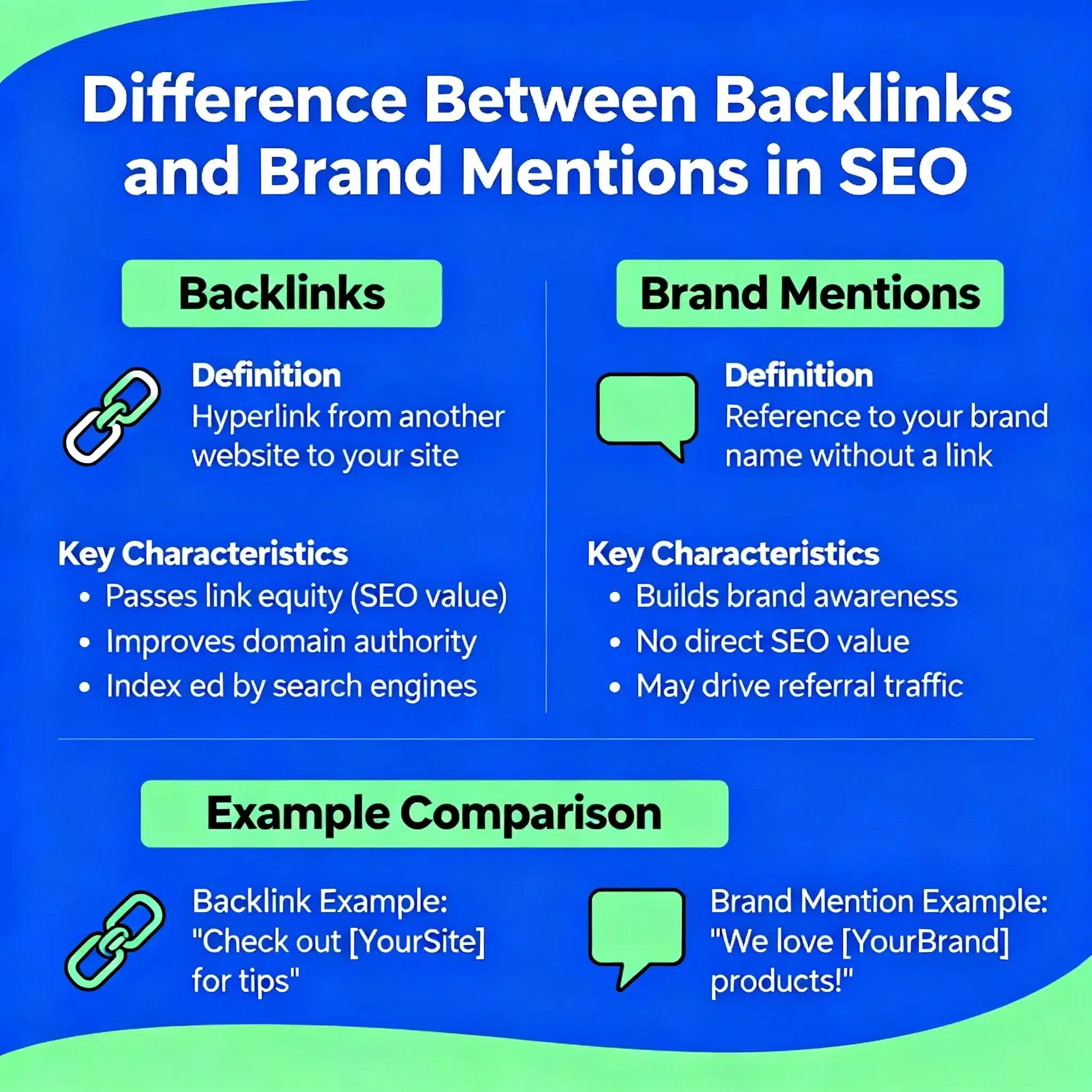
The practical implication: if your brand has strong backlinks but weak off-site mention presence, you may rank well on Google but underperform in AI-generated answers. Both signals matter; they just serve different surfaces.
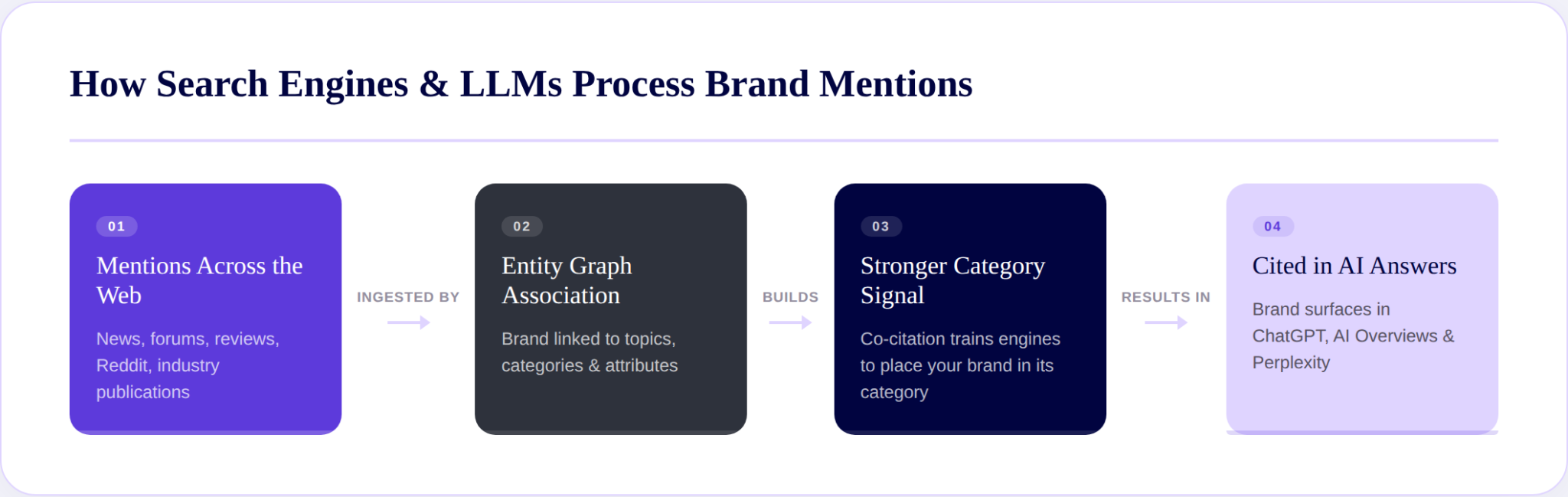
Google's entity graph works by building associations between named entities — brands, people, products, places — and the topics, categories, and attributes they appear alongside across the web. When your brand is consistently mentioned in the context of "project management software" on authoritative sites, Google's systems strengthen that association. When AI Overviews generate a response about project management tools, your brand is more likely to appear.
Co-citation is how engines learn category membership. Appearing alongside Asana, Monday, and Notion in 15 different comparison posts doesn't just generate visibility — it trains both search engines and LLMs to classify your brand in the same category as those established players. This is one of the strongest signals for new or emerging brands trying to establish category authority.
Frequency, recency, and source authority all weight a mention differently. A single mention in the New York Times carries more entity authority than 50 mentions on low-authority blogs. A mention from six months ago carries less freshness signal than one published last week. A cluster of recent, high-authority mentions following a product launch or PR campaign can produce measurable movement in both search rankings and AI citation frequency within weeks.
Sentiment shapes AI descriptions. LLMs don't just track whether your brand is mentioned — they absorb the context around it. If the majority of your mentions describe your product as "complicated to set up" or "expensive for small teams," that framing can appear in how AI answers describe you. Positive and neutral sentiment, consistently, is a GEO input as much as a PR goal.
High-value vs low-value mentions. Not all brand mentions are equal. Mentions from known content farms, AI-generated content mills, or sites with no domain authority contribute little and can occasionally signal spam association. Filter your monitoring data by source authority and prioritize mentions from sites with meaningful readership and indexing history.
What to look for before choosing a tool: real-time or near-real-time alerts, sentiment analysis, source authority filtering, historical data, and — increasingly — coverage of AI-generated mentions alongside traditional web monitoring.
The zero-cost starting point. Google Alerts sends email notifications when your brand name appears in newly indexed content across the web. Setup takes five minutes and covers news, blogs, and some forum content.
The limitations are real: it misses social media, podcasts, paywalled content, and AI-generated mentions entirely. Frequency and deduplication controls are limited. For early-stage brands or teams with no monitoring budget, it's better than nothing — but only just.
Pricing: Free
Best for: Solopreneurs and early-stage brands who want basic coverage before investing in a paid tool.
Ahrefs tracks brand mentions via its Content Explorer and Web Analytics tools, surfacing mentions alongside domain rating, estimated traffic, and link status — which makes it the most useful tool for reclamation workflows. You can filter by DR threshold, date range, and link status (linked vs unlinked) in a single view. Brand Radar also tracks brand visibility across AI platforms including ChatGPT, Perplexity, and Google AI Overviews, using search-backed prompts rather than synthetic queries.
Pricing: From $129/mo (Lite); Brand Radar AI indexes from $199/mo per index
Best for: Teams already using Ahrefs for SEO who want mention tracking, reclamation workflow, and AI visibility in the same platform.
Semrush's Brand Monitoring tool tracks mentions across news, blogs, forums, and social media, and surfaces sentiment scores alongside mention volume and source authority. Combined with its Position Tracking and Backlink Analytics tools, it gives a complete picture of how mention activity correlates with ranking movement over time — useful for proving SEO ROI from PR campaigns.
Pricing: From $139.95/mo (Pro)
Best for: Teams already using Semrush for SEO who want mention tracking and sentiment analysis without adding a separate tool to their stack.

Scrunch monitors how your brand appears in AI-generated responses across ChatGPT, Perplexity, Google AI Overviews, Copilot, and Gemini. Beyond tracking whether your brand is mentioned, it surfaces sentiment and context — how AI describes you, which attributes it associates with your brand, and how that positioning compares to competitors. The Insights feature provides optimization recommendations for improving AI citation frequency, not just monitoring the current state.
Pricing: From $250/mo (Core, 4 engines); Enterprise custom
Best for: Brands actively optimizing for AI search visibility who need prompt-level monitoring, sentiment analysis, and actionable GEO recommendations in one platform.
Profound takes an enterprise approach to AI mention monitoring, tracking brand citations across 10+ AI platforms including ChatGPT, Perplexity, Gemini, Copilot, and Amazon Rufus. The Conversation Explorer feature approximates AI search volume — showing not just whether your brand appears in AI answers, but how large the conversation opportunity is for specific topics. CDN integration tracks actual site visits originating from AI platforms, closing the attribution gap between AI mentions and web traffic.
Pricing: Starter $99/mo (ChatGPT only, 50 prompts); Growth $399/mo (3 engines); Enterprise custom
Best for: Large enterprises with compliance requirements and dedicated analytics functions who need the deepest AI citation dataset available and can justify the entry cost.
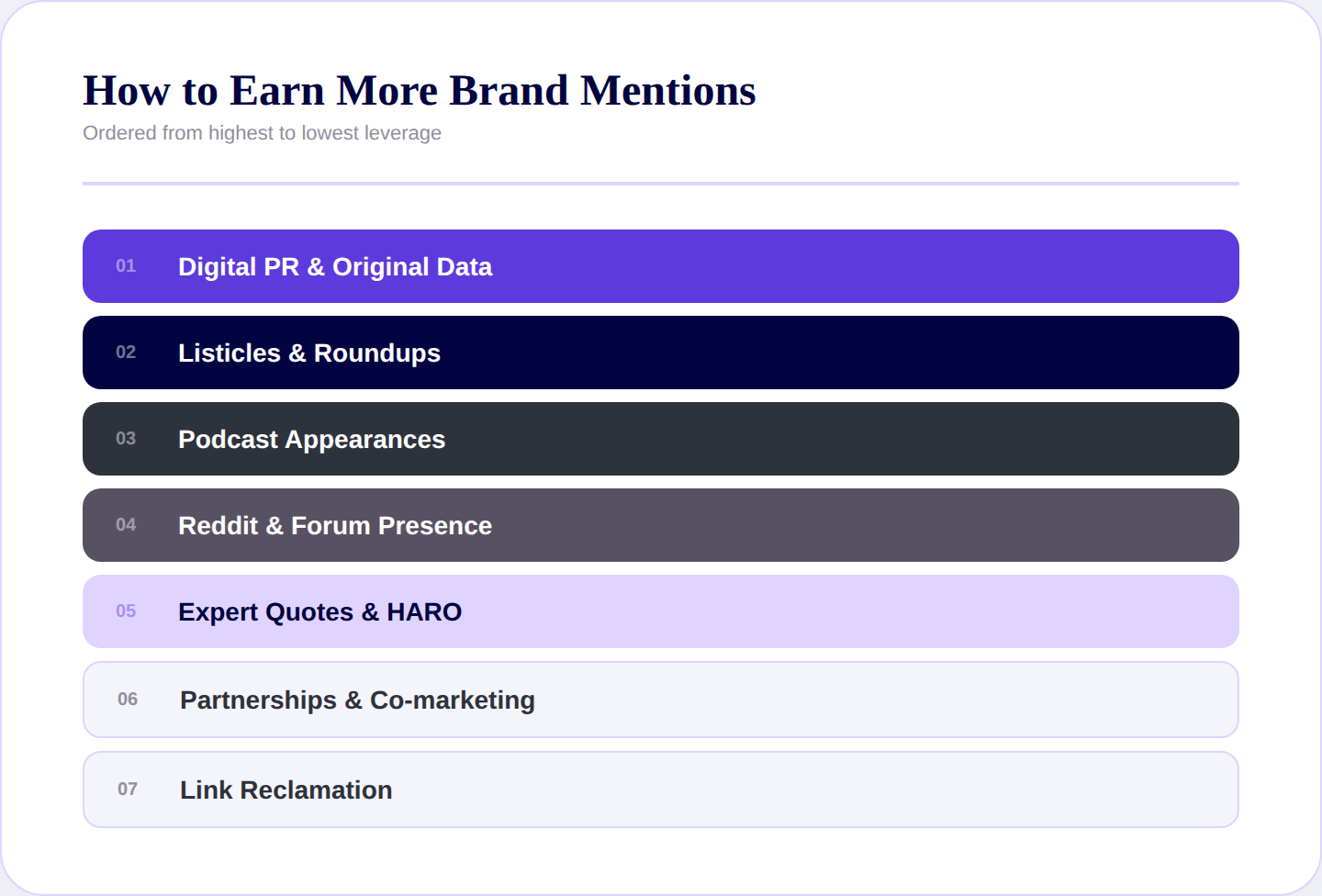
Ordered from highest to lowest leverage for a typical mid-size brand:
Surveys, proprietary studies, and original research attract citations from journalists who need a credible source to reference. A single well-placed study can generate dozens of high-authority linked and unlinked mentions and remains citable for years. This is the highest-leverage mention-generating activity available.
Getting featured in "best of" and "top tools" content generates co-citation alongside established brands and drives AI visibility — these are exactly the formats AI Overviews pull from when answering category comparison queries. Proactively pitch publications that produce this content in your category.
Show notes, transcripts, and episode descriptions generate unlinked mentions on indexed pages that LLMs scrape heavily. A 30-minute guest appearance can produce multiple permanent mention assets on domains you'd never get a backlink from through traditional outreach.
Authentic participation in communities where your buyers ask questions is a direct GEO input. Reddit is the most-cited source across major AI engines — appearing there consistently, in a helpful and non-promotional way, builds the kind of mention footprint that LLMs absorb and reproduce in generated answers.
Journalist features in industry publications and news sites build entity authority on high-DR domains quickly. Tools like Connectively (formerly HARO), Qwoted, and Terkel connect brands with journalists actively seeking sources.
Co-branded content, joint webinars, and cross-promotional campaigns generate co-citation with partners — training engines to associate your brand with theirs and inherit some of their category authority.
The most efficient backlink building strategy available: find existing unlinked mentions of your brand on high-authority sites and reach out to request a link. The editorial relationship already exists. The conversion rate is significantly higher than cold outreach.
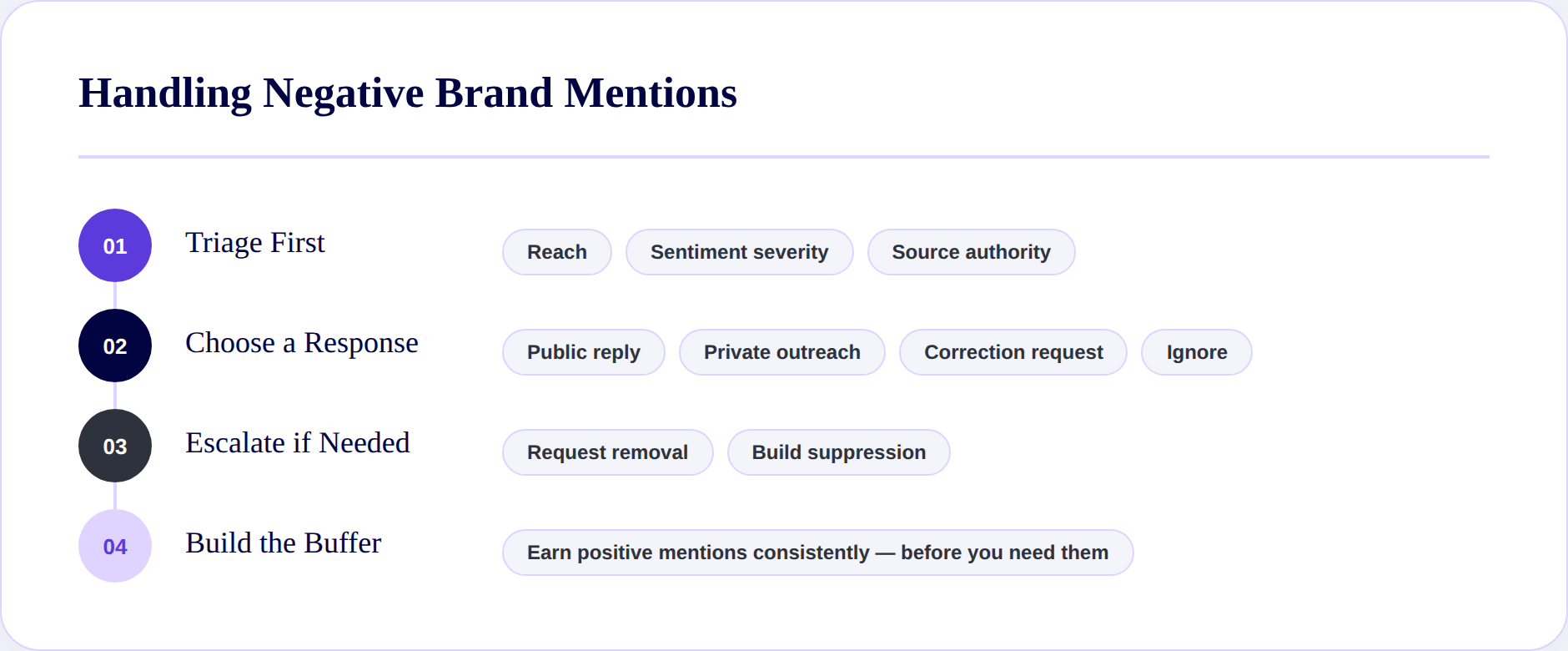
Not every mention works in your favor. A single high-authority negative review, a viral critical thread, or an inaccurate description in an AI-generated answer can shape brand perception at scale — and once embedded in LLM training data, it's difficult to fully reverse.
Triage first. Assess reach (how many people see this), sentiment severity (mildly critical vs actively harmful), and source authority (a low-traffic blog vs a major industry publication). Not every negative mention warrants a response — prioritize by potential impact.
Response options depend on context. A public reply works when the criticism is fair and a factual correction is available. Private outreach to the author works when the relationship is salvageable and the error is genuine. A correction request to the publication works when factual inaccuracies are demonstrable. Ignoring works when the source has negligible authority and responding would amplify it.
Removal vs suppression. Requesting content removal is appropriate for demonstrably false claims, defamatory content, or privacy violations. For subjective negative opinions, suppression — building enough positive, high-authority mentions to push the negative content downa in rankings and AI training signal — is more realistic and more sustainable.
Legal and ethical limits. Never misrepresent your affiliation when requesting corrections, offer compensation for content removal without disclosure, or attempt to manipulate platforms that prohibit such activity. The reputational risk of being caught outweighs any short-term gain.
Build the buffer before you need it. A consistent, proactive mention-earning strategy means that when a negative mention surfaces, it sits in a context of predominantly positive signals — limiting its influence on both search rankings and AI-generated descriptions of your brand.
Yes — brand mentions strengthen entity authority in Google's knowledge graph, build trust signals independent of link equity, and increase the likelihood of being cited in AI Overviews and LLM answers. Linked mentions pass direct link equity. Unlinked mentions contribute to entity authority and brand recognition signals. Both types compound over time as your brand's presence across the web grows.
A product review that writes "we've been using HubSpot for our CRM" without linking to HubSpot's website is an unlinked brand mention. A comparison article that includes your tool in a "top five" list with a hyperlink to your pricing page is a linked mention. A ChatGPT response that recommends your software when answering "what's the best project management tool for remote teams?" is an AI/generative mention.
Start with Google Alerts for basic free coverage of new indexed content. Layer in Ahrefs or Semrush for source authority filtering, sentiment analysis, and reclamation workflow if you're on a paid SEO tool already. Add a dedicated AI monitoring tool — Scrunch AI or Profound — when AI search visibility becomes a priority. In Google Analytics 4, filter referral traffic by LLM sources (chatgpt.com, perplexity.ai) to track AI referral mentions that drive clicks.
The evidence is directional rather than definitive — Google has not publicly confirmed that unlinked mentions directly influence rankings. However, Google's patents on implied links describe a system capable of processing brand signals without hyperlinks, and entity authority built through consistent unlinked mentions correlates with improved rankings and AI citation frequency in independent studies. The safe position: unlinked mentions contribute to entity authority, which influences rankings indirectly, and have documented value for AI visibility directly.
Manually: test your target queries directly in ChatGPT, Perplexity, and Google with AI Overviews enabled and note when your brand surfaces. Systematically: use a dedicated AI monitoring tool. Scrunch AI tracks prompt-level brand mentions across ChatGPT, Perplexity, Gemini, AI Overviews, and Copilot with sentiment analysis. Profound covers 10+ AI platforms with conversation volume estimation. Ahrefs Brand Radar tracks AI visibility using search-backed prompts across six AI platforms. In GA4, filter referral sources for chatgpt.com and perplexity.ai to see AI-driven visits.
It depends on the type. Linked mentions from high-authority domains can influence rankings within days to weeks as Googlebot crawls and processes the new link. Unlinked mentions take longer — weeks to months — as Google's entity systems build and reinforce the association between your brand and its attributed topics. AI visibility impact from mentions varies by platform: LLMs trained on static datasets update infrequently, but real-time retrieval systems like Perplexity and ChatGPT with web search can reflect new mentions within hours of indexing. The compounding effects of a consistent mention strategy are typically visible in branded search volume and AI citation frequency within three to six months.
.webp)
With 10 years of writing experience and a deep interest in SEO, AI, and content management, Anna’s here to break down big ideas and translate them into plain English for readers of all levels. She's got a Master's Degree in International Information and is a lifelong learner of writing and storytelling. Outside of work, she’s on the yoga mat, in a good book, or planning her next adventure with family and friends.
.svg)
.svg)
.svg)
.svg)
.svg)