
.svg)
%20(1).svg)
%20(3).svg)
Back to articles
How to Optimize Content for AI Search (AEO & GEO Guide)
June 25, 2026
By
Irina Maltseva
Traditional SEO got your content ranked. AI search decides whether your brand gets mentioned at all. When someone asks ChatGPT or Perplexity a question your product answers, the system synthesizes a response from sources it trusts — and if your content isn't structured for extraction, you're not in that response. A competitor who made it easy is.
This guide breaks down exactly how to optimize content for AI search in 2026 — from structure and schema to the technical layer AI agents actually read. Practical, tool-backed, no fluff.
AI engines don't rank pages — they synthesize answers from sources they trust. That's a fundamentally different optimization problem from traditional SEO, and treating it the same way produces predictably poor results.
Traditional signals — keyword density, backlinks, meta tags — are still the foundation. Without strong organic rankings, AI citation rates drop significantly. But they don't drive AI citation behavior on their own. The signals that actually move the needle in AI search are different: content clarity, structured data, semantic authority, and how well your pages serve AI agents trying to extract a concise answer.
The stakes are real. Only 8% of users clicked a link when an AI summary was present, compared to 15% without one. Being cited in the AI answer is the new position one — and ranking on page one no longer guarantees you're in it.
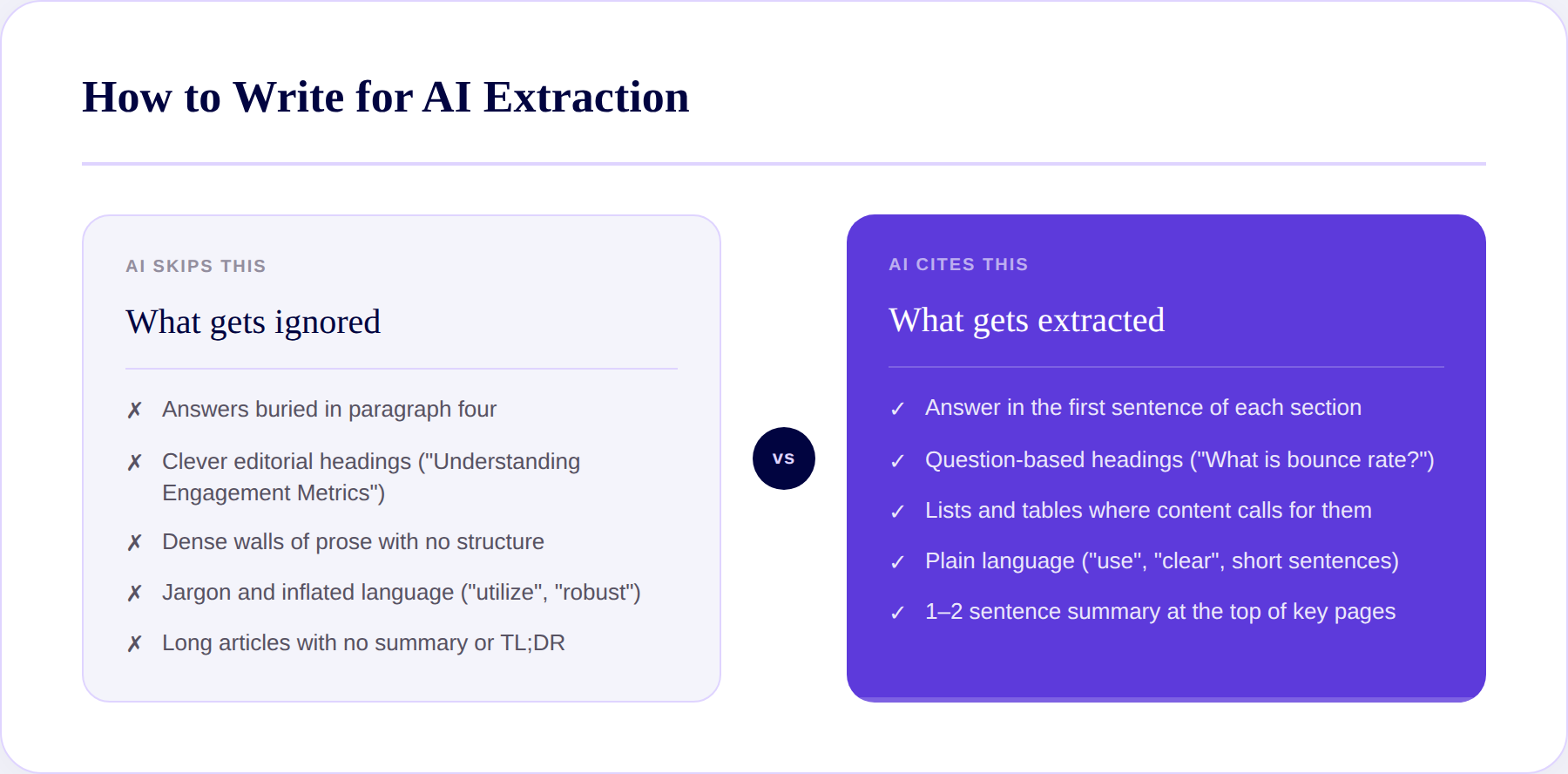
AI systems extract answers, not articles. If the answer to a question isn't surfaced clearly in the first relevant paragraph, the system moves on to a source that made it easier.
Write in modular, answer-first sections — each resolving one specific question in 75–300 words. Use natural-language questions as H2 and H3 headings: "What is bounce rate?" outperforms "Understanding Engagement Metrics" every time, because AI pattern-matches against how users actually phrase queries. Add a direct 1–2 sentence summary at the top of key pages. Use lists and tables where the content genuinely calls for them — not as decoration, but because AI agents parse structured formats more reliably than dense prose.
Plain language over jargon. "Use" beats "utilize." "Clear" beats "robust." The same principle that makes content scannable for humans makes it extractable for AI.
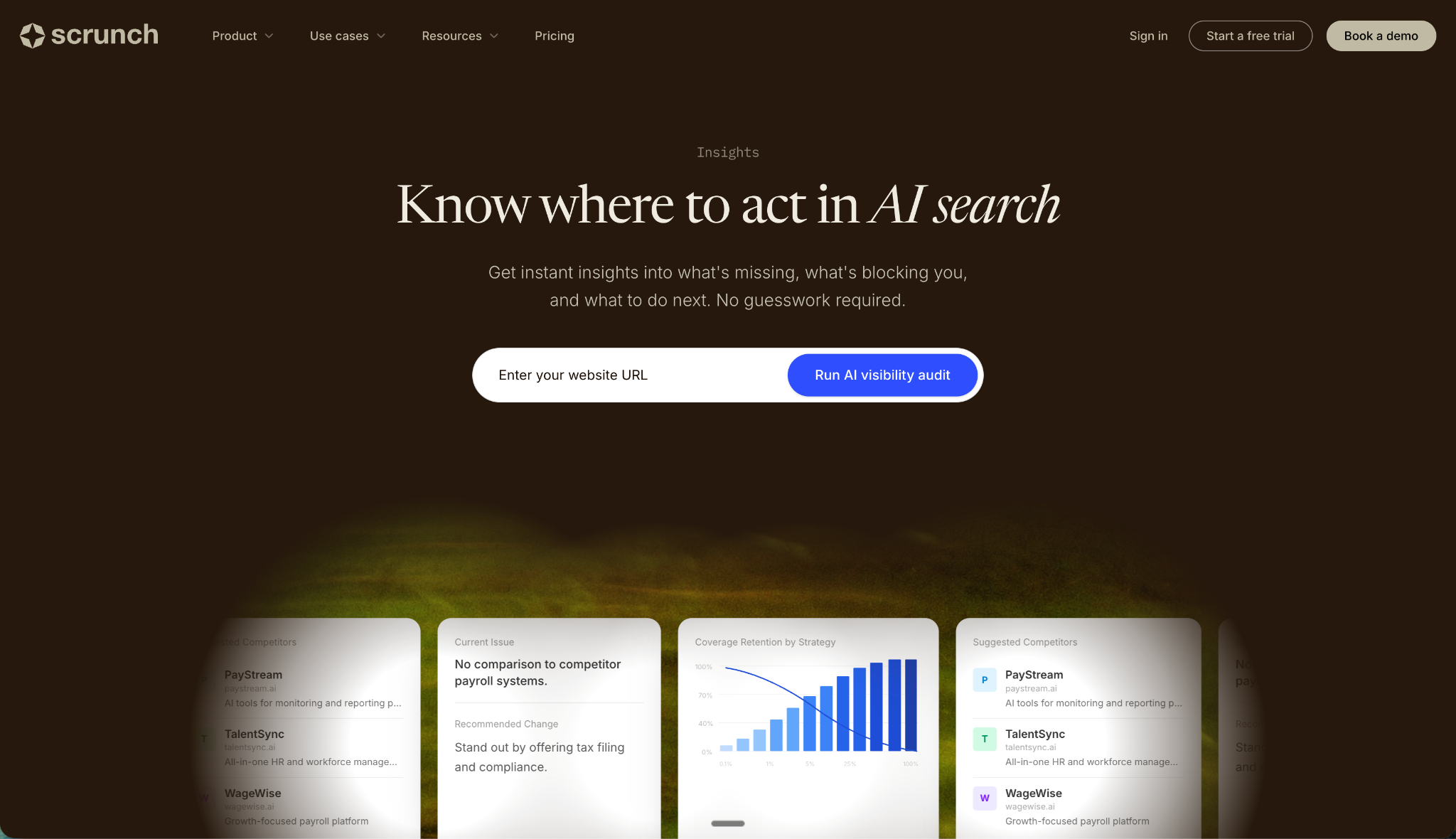
Knowing where to start is half the battle. Scrunch's Insights feature audits your existing pages and surfaces which ones are underperforming with AI agents — flagging structural issues and recommending specific fixes, so you're not guessing which pages to prioritize.
AI models don't just evaluate your page in isolation — they triangulate your reputation across the web. What other sources say about you matters as much as what your own site says.
Show experience and expertise through named authors with verifiable credentials, original data and research, case studies with specific outcomes, and a first-person perspective that can't be found elsewhere. Build authoritativeness by earning citations on third-party sites, LinkedIn, Reddit, and YouTube — platforms AI trains on and cites heavily. Trust signals — consistent business information, a clear About page, accurate contact details, no misleading claims — round out the picture AI uses to assess source credibility.
Reddit is the #1 cited source across every major AI engine, appearing at roughly 40% frequency across LLMs. Community presence on the platforms where your buyers ask questions isn't a nice-to-have — it's a direct input to whether AI recommends you. The challenge is knowing which platforms are actually driving citations in your specific category, which isn't the same for every industry.
Schema tells AI engines what your content means, not just what it says. It's the difference between AI inferring that a block of text might be a FAQ and knowing with certainty that it is — and being able to cite it accordingly.
The highest-impact schema types for AI search optimization are FAQPage (question-and-answer format is exactly what AI extracts), HowTo (step-by-step instructional content), Article and BlogPosting (establishes authorship and publication date — both freshness signals), Organization (builds brand entity recognition), BreadcrumbList (helps AI understand site structure), and Product or Service markup for commercial content.
Two things to get right: make FAQs visible on-page and mark them up — the visible content is what gets cited, schema helps AI find and interpret it. Accordion and expandable FAQs are fine as long as the content is actually rendered in the HTML. Validate everything with Google's Rich Results Test before moving on.
Before you start coding, Scrunch's Site Maps feature diagnoses which pages are blocking AI agents or failing to surface structured data — giving you a prioritized list of where schema will have the most impact rather than applying it uniformly across your entire site.
Most websites are built for humans: heavy JavaScript, layered markup, media-heavy pages. AI agents struggle to extract answers from them — and when extraction fails, the page doesn't get cited regardless of how good the content is.
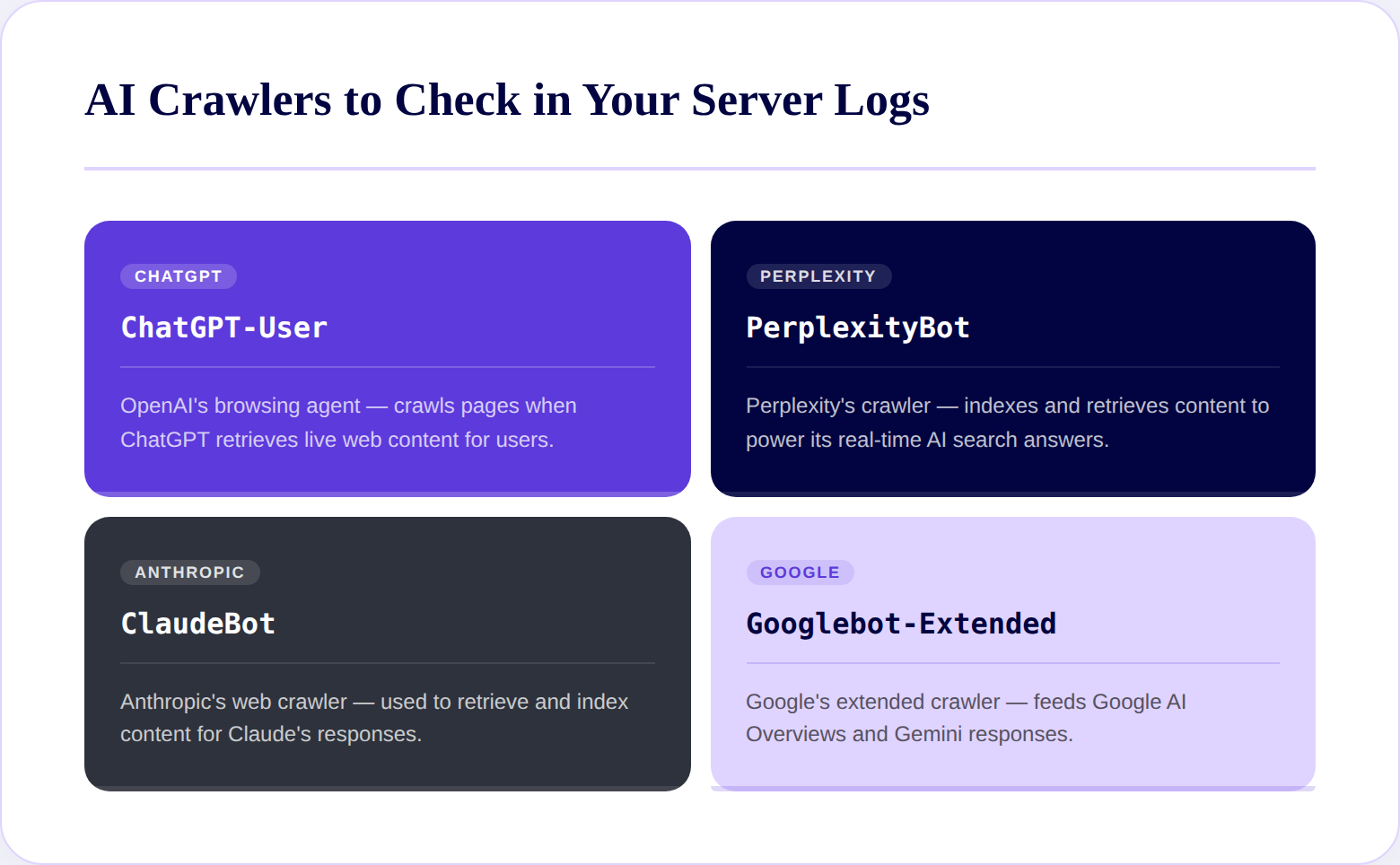
The first question to answer is whether AI crawlers are actually reaching your pages at all. Pull your server logs and look for the agents that matter — ChatGPT-User, PerplexityBot, ClaudeBot, Googlebot-Extended — and check whether they're getting clean responses or hitting errors, redirects, and blocked paths. Many teams assume their content is being read. Most of the time it isn't.
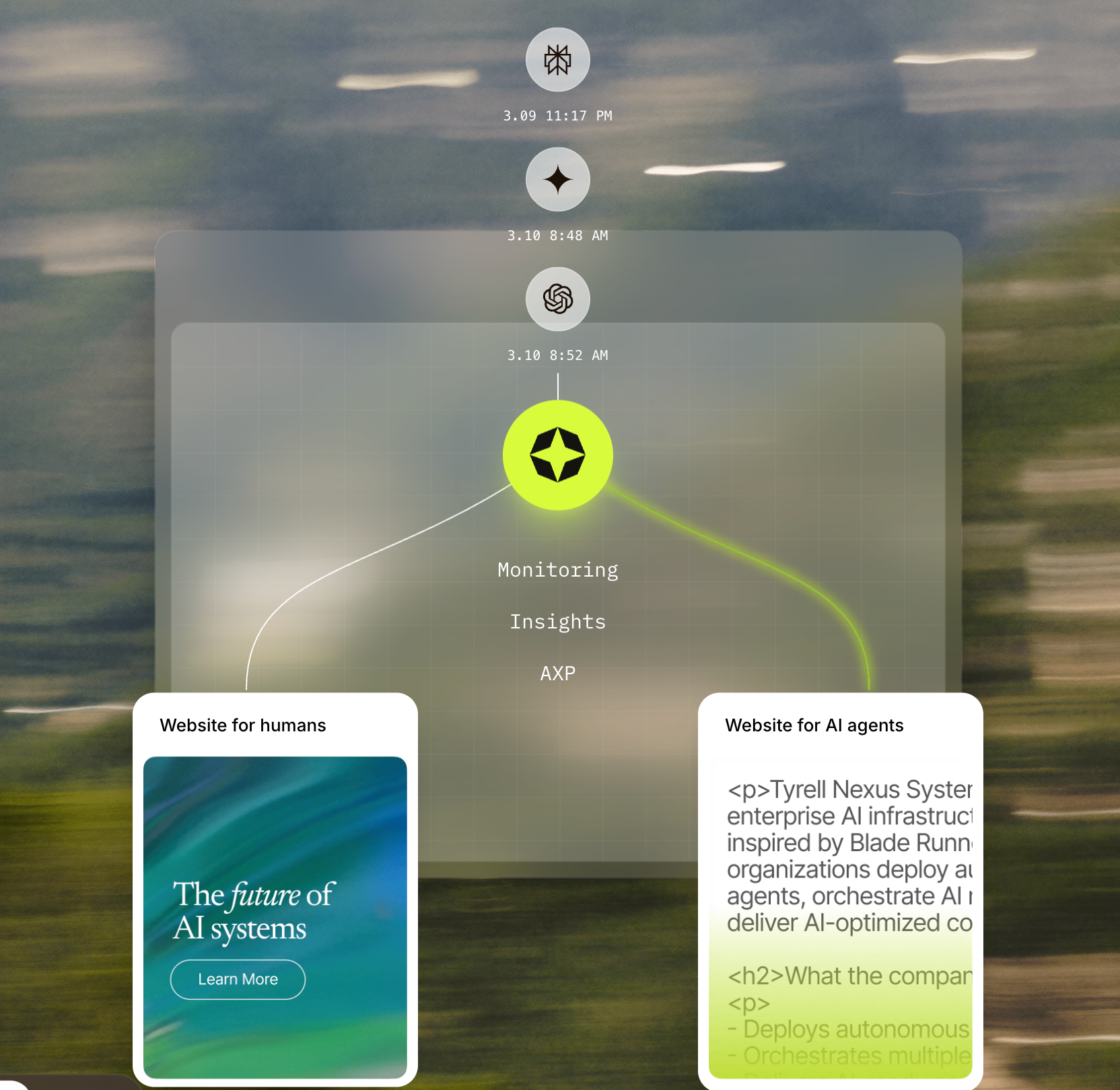
Once you've confirmed access, the priority is simplicity. High-value pages built for visual impact — layered markup, heavy JavaScript, embedded media — tend to be the hardest for AI agents to parse. Clean HTML and fast load times aren't just good practice; they're the baseline for extraction. Consider adding an llms.txt file, an emerging standard that gives LLMs structured guidance about your site's content in the same way robots.txt guides traditional crawlers. The goal is a page that delivers its content cleanly in any environment — visual browser or not.
Scrunch's Agent Experience Platform (AXP) handles this at the infrastructure level. It sits at the CDN layer and automatically serves AI agents a token-light, structured version of your pages — without touching the human-facing site. No developer involvement, no page redesign.
Publishing exclusively on your own domain is a narrow strategy for AI search. AI models pull heavily from Reddit, YouTube, LinkedIn, and Wikipedia — platforms with strong authority signals that your site alone can't replicate.
Repurpose key content across channels: a blog post becomes a LinkedIn article, a Reddit answer in the relevant community, a short YouTube explainer. Consistency across sources reinforces authority — the same expertise appearing in multiple places sends a stronger signal to AI systems than a single well-optimized page. Distributing content widely can increase AI citations by up to 325% compared to publishing on your own site alone.
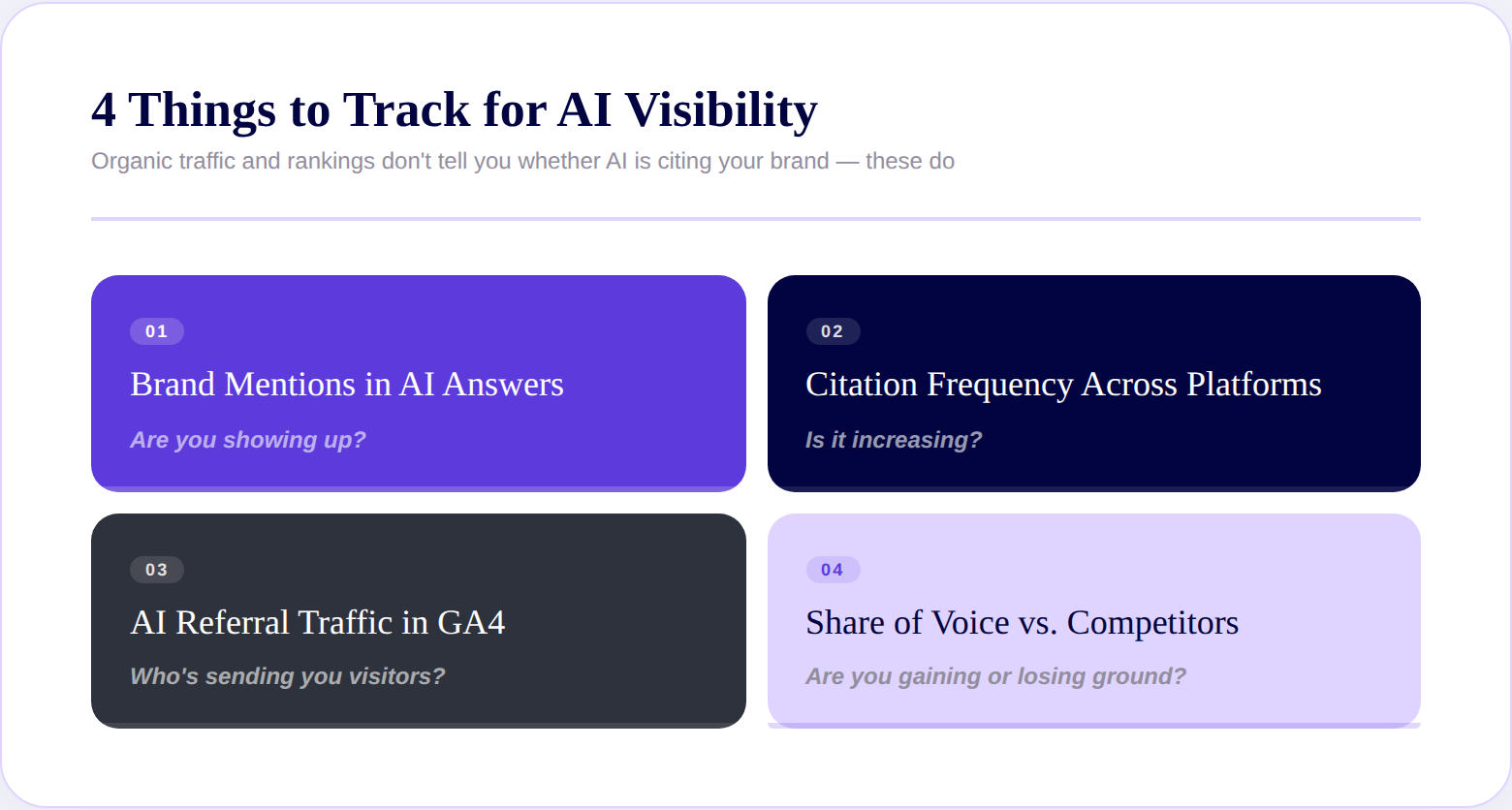
Traditional metrics won't show you AI visibility. Organic traffic and ranking positions are still worth tracking — but they don't tell you whether AI is citing your brand, how often, or in what context.
Track four things: brand mentions in AI-generated answers (are you showing up?), citation frequency across platforms (is it increasing?), AI referral traffic in GA4 (filter by ChatGPT.com, Perplexity.ai, and other LLM sources), and share of voice versus competitors (are you gaining or losing ground?). Set a baseline now. You can't optimize a signal you can't see, and you can't see a signal you're not measuring.
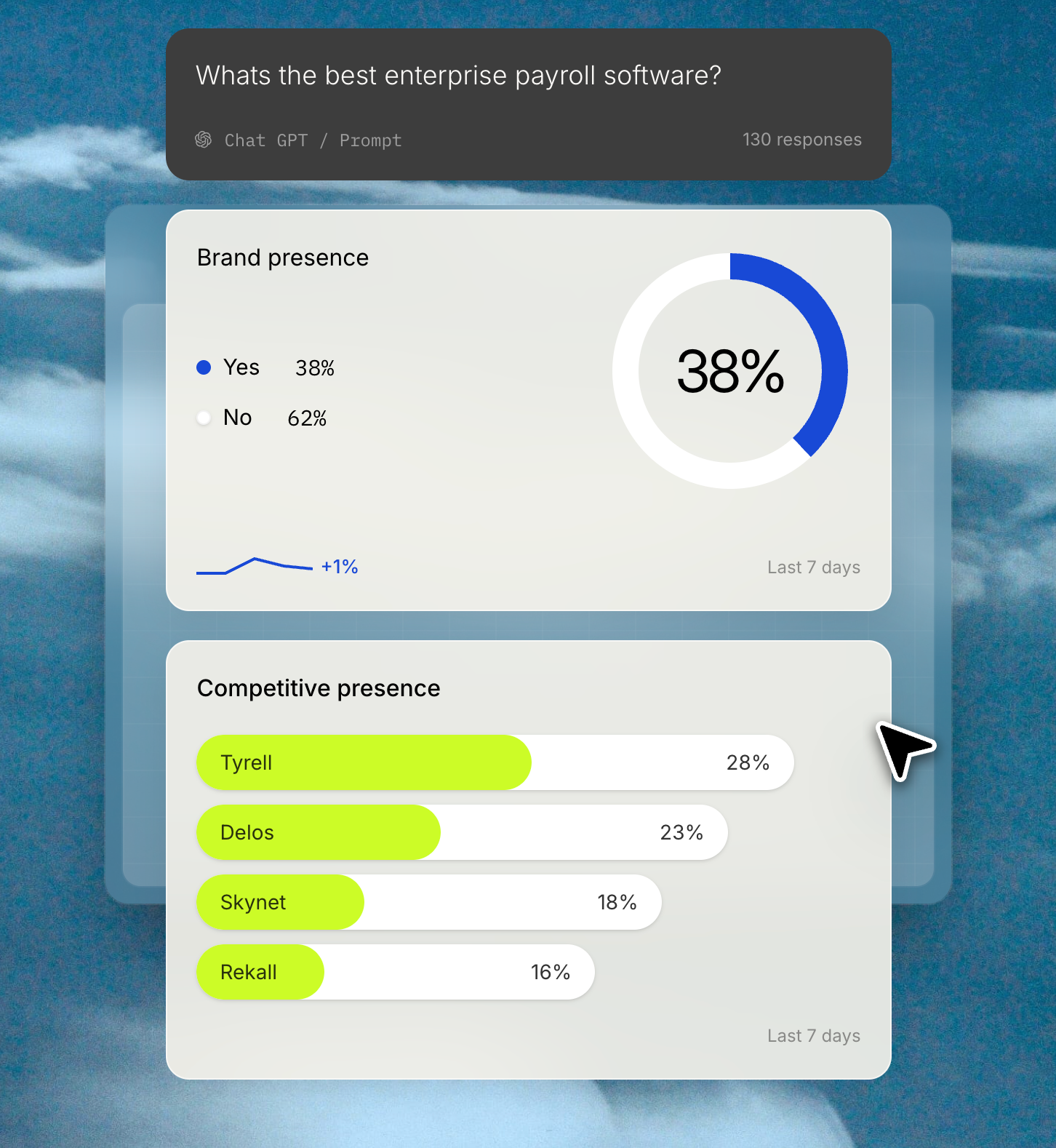
Scrunch consolidates all of this in one dashboard — prompt-level performance, competitive share of voice, GA4 and Looker Studio integration for AI referral data, and trend tracking over time. It's the measurement layer that turns the five steps above from a one-time project into a compounding strategy.
AI search isn't a future problem. Buyers are already getting answers before they click, and most brands aren't in those answers yet. The opportunity is wide open — but the window won't stay that way.
You don't need to do everything at once. Sequence matters:
Scrunch is built for every stage of this — from monitoring how you show up today, to diagnosing what's blocking AI agents on your site, to automatically delivering optimized content to AI platforms via AXP. Start with the free trial and run your first site audit before you do anything else.
Start with structure: write in modular, answer-first sections, use question-based headings, and add schema markup (FAQPage and Organization are the highest priority). Then build your off-site presence on the platforms AI cites most — Reddit, LinkedIn, and YouTube — and fix any technical issues blocking AI agents from crawling your pages cleanly.
If AI is generating inaccurate or unflattering content about your brand, the fix is upstream: improve the source material AI trains on. Publish accurate, well-sourced content on authoritative third-party platforms, correct misinformation where you find it, and build consistent brand signals across the web. Tools like Scrunch track sentiment in AI-generated responses so you can identify and address specific inaccuracies.
The two most common terms are GEO (Generative Engine Optimization) — optimizing content to be cited in AI-generated answers — and AEO (Answer Engine Optimization), which focuses specifically on appearing in direct-answer formats like AI Overviews. Both describe the same core practice: making your content easy for AI systems to extract, trust, and recommend.
Focus on the signals Google's AI Overview system favors: structured content with clear headings and direct answers, FAQPage schema markup, strong E-E-A-T signals (named authors, original data, authoritative citations), and pages that rank in Google's top 10 for the target query. AI Overviews pull from top-ranking pages roughly 76% of the time — traditional SEO is still the foundation.
Start with Google AI Overviews — largest reach, closest overlap with traditional SEO. Then Perplexity for research-focused audiences, ChatGPT for broad consumer and B2B queries, and Gemini as Google's ecosystem expands. Microsoft Copilot matters for enterprise and B2B audiences. Each platform cites different sources with different frequency — multi-platform monitoring (via tools like Scrunch) shows you where your visibility gaps are largest.
Manually: search your target questions in ChatGPT, Perplexity, and Google with AI Overviews enabled, and check whether your brand or content appears. Systematically: use an AI visibility monitoring tool. In Google Analytics 4, filter referral traffic by source to see sessions arriving from ChatGPT.com and Perplexity.ai — this shows AI referral traffic even before you've set up dedicated monitoring.
An Agent Experience Platform (AXP) is infrastructure that sits between your website and AI agents, automatically serving AI crawlers a clean, structured, token-efficient version of your content — without modifying the human-facing experience. It's designed to solve the problem of AI agents struggling to extract answers from JavaScript-heavy, media-rich sites. Scrunch's AXP operates at the CDN layer, meaning it works across your entire site without page-by-page implementation.

Irina is a Founder at ONSAAS, Growth Lead at Aura, and a SaaS marketing consultant. She helps companies to grow their revenue with SEO and inbound marketing. In her spare time, Irina entertains her cat Persie and collects airline miles.
.svg)
.svg)
.svg)
.svg)
.svg)