
.svg)
%20(1).svg)
%20(3).svg)
Back to articles
Best SEO Strategies for AI Visibility: What Actually Works
June 25, 2026
By
Anna Dovbysh
AI search engines now answer questions directly — and clicks to websites are quietly disappearing. Google AI Overviews, ChatGPT, Perplexity, and Gemini are reshaping how content gets found, read, and acted on. Traditional SEO gets you ranked on Google. It doesn't automatically get you cited in an AI-generated answer — and that's a different game with different rules.
This guide covers the most effective SEO strategies for AI visibility: what to prioritize, in what order, and which tools actually help. GEO — Generative Engine Optimization — isn't about tricking AI. It's about making your content the most citable, structured, and trustworthy source in your topic area. The fundamentals haven't changed. The emphasis has.
Traditional SEO is a competition for ranking positions. GEO is a competition to be the source AI quotes when answering a question — and the two don't map neatly onto each other.
When someone asks ChatGPT or Perplexity a question, the system isn't looking for the page that ranks highest — it's synthesizing the most credible, clearly structured, and contextually relevant information it can find. A page that ranks #4 on Google but answers a question with a clean, direct paragraph can outperform the #1 result in an AI citation.
The numbers make the urgency clear. As of December 2025, AI Overviews reduce the organic click-through rate for position one content by 58% — confirmed by Ahrefs' study of 300,000 keywords. In other words, for most informational queries, the majority of users never leave the search results page. They got their answer already — possibly from your content, possibly from a competitor's.
Not necessarily — and the data is moving fast on this. The relationship between organic rankings and AI Overview citations has been a moving target. Earlier studies (2024–early 2025) found that around 75% of AI Overview citations came from top-ranking pages. By late 2025, that overlap had dropped to roughly 50%.
More recent 2026 studies now place the overlap between 17% and 38%, depending on methodology — indicating a rapid decoupling between traditional rankings and AI citations. The gap between ranking well and being cited by AI is widening as Google's query fan-out process pulls from a broader and more dynamic source pool.
The practical implication: traditional SEO is still the foundation — brands cited in AI Overviews earn 35% more organic clicks, so the two reinforce each other. But structured content on pages that answer specific questions clearly is becoming as important as domain authority. The strategies below work for both Google and AI search. The difference is emphasis.
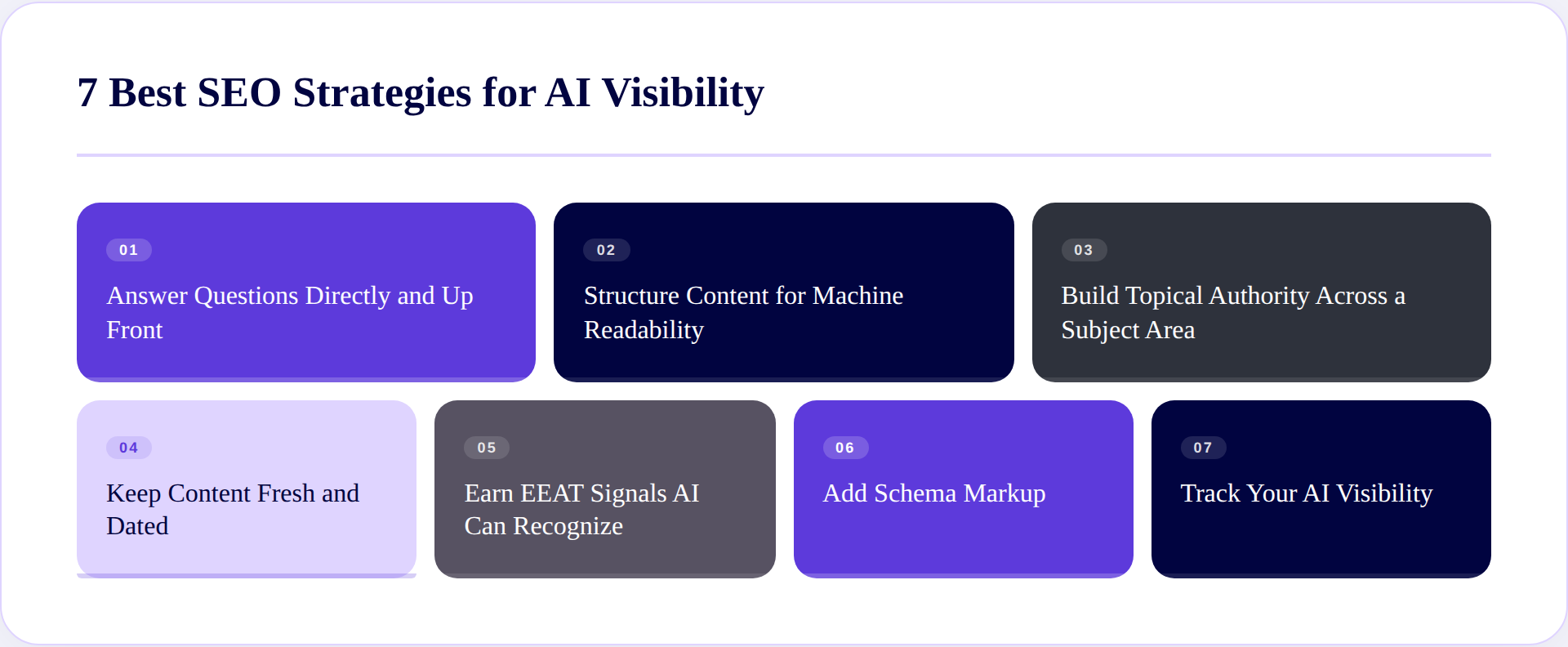
These aren't new tactics bolted onto old frameworks. They're content fundamentals — applied with AI citation patterns specifically in mind.
AI systems extract answers, not articles. If your answer isn't in the first paragraph of the relevant section, it probably won't get cited — regardless of how good the rest of the piece is.
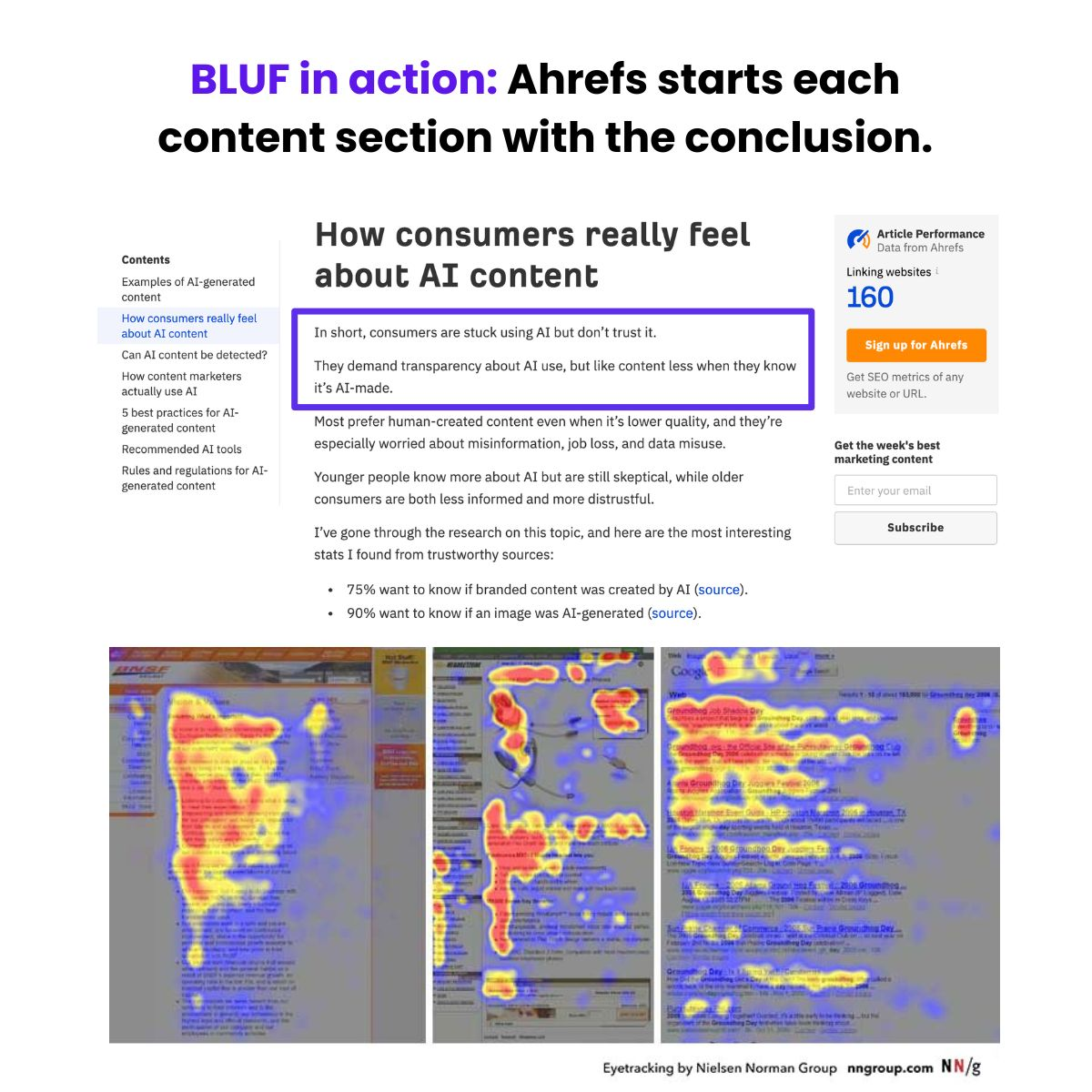
This is the BLUF principle applied to GEO: Bottom Line Up Front. Lead every section with a direct answer to the question it addresses. Don't bury your definition in paragraph four after three sentences of context-setting. The format that consistently gets cited looks like this: "What is bounce rate? Bounce rate is the percentage of visitors who leave a site after viewing only one page." One sentence. Answer first. Context second.
Use real user questions as H2 and H3 headers — "What is X?", "How does X work?", "What's the difference between X and Y?" — because AI systems pattern-match against conversational queries when generating responses. A heading that mirrors how someone would phrase a question in ChatGPT is far more likely to be surfaced than a clever editorial title that signals nothing to a machine.
Tool needed: None — this is a writing discipline. The only tool is the habit of asking "what is the direct answer to this question?" before writing every section.
AI systems scan for patterns. Headings, bullets, numbered lists, and tables are the patterns they trust most — because structured content reduces ambiguity about what a passage is claiming and how its parts relate to each other.
Structured content measurably improves AI citation rates: comparison pages with three tables earn 25% more citations, validation pages with eight list sections earn up to 26% more citations, and shortlist pages averaging 10 words or fewer per sentence earn 18% more citations.
Use H2–H3 hierarchy consistently. Break paragraphs into 2–3 sentences maximum. Use numbered lists for steps, bullets for options and comparisons. Dense walls of text are treated by AI models as lower-confidence sources — the implicit signal is that the information is harder to extract reliably.
One high-leverage move: add a TL;DR or Key Takeaways section to every long-form piece.
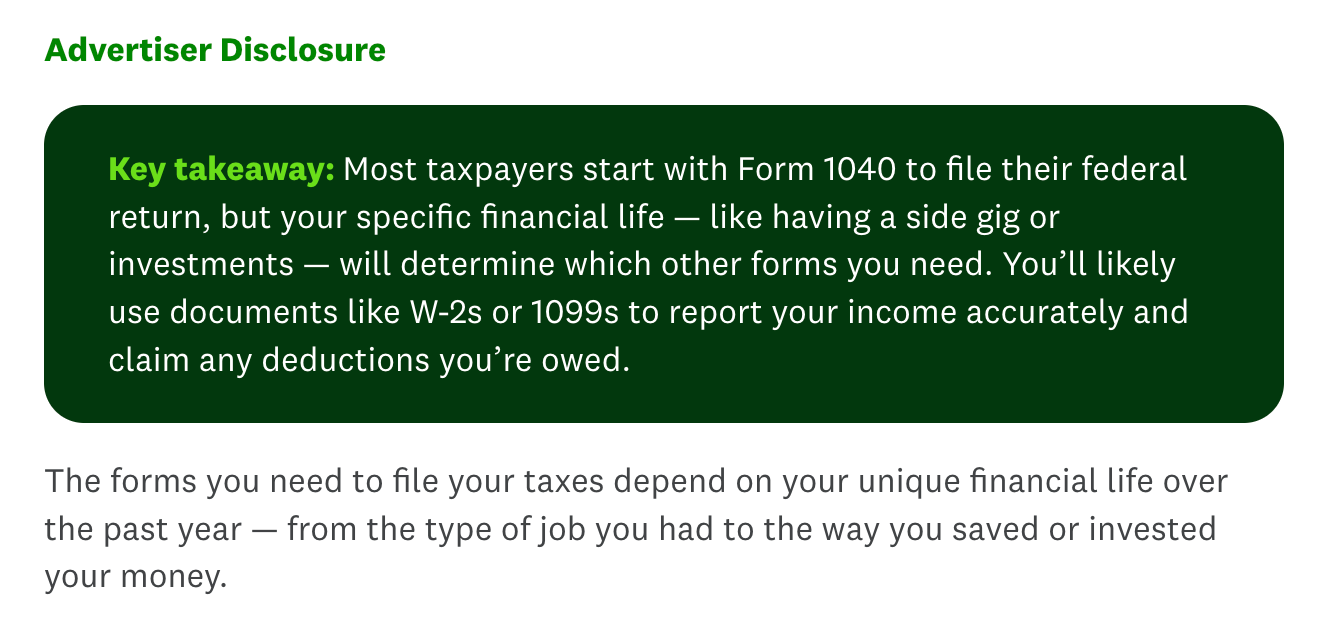
SE Ranking's own blog found that AI Overview citations pulled directly from their Key Takeaways sections — because a clean summary is, by design, exactly the kind of extractable passage AI is looking for.
Tool needed: None for the formatting discipline. Surfer SEO or Clearscope can score your structure against top-ranking competitors and flag where density, heading distribution, or list usage falls short.
AI systems don't just evaluate individual pages — they evaluate sources. A site that covers a topic comprehensively and consistently is treated as more authoritative than a site with one excellent post surrounded by unrelated content.
Domain traffic strongly correlates to AI citations, with high-traffic sites earning 3x more AI citations than low-traffic ones. But domain traffic is a lagging indicator — the underlying cause is topical depth. Sites that earn traffic on a topic earn it because they've covered the topic thoroughly.
Build content clusters: a main pillar page on your primary keyword supported by satellite articles covering related subtopics, questions, and use cases. If you're targeting "AI visibility," also cover "how AI Overviews work," "GEO vs SEO," "how to track AI citations," and "what schema markup does for AI search." Each page reinforces the others — and more importantly, each page answers the fan-out queries Google's AI generates when processing a related search.
Internal linking connects the cluster and signals topical depth to both Google's traditional crawler and its AI systems.
Tools that help: SE Ranking or Ahrefs, or Semrush for keyword clustering and gap analysis. Free alternative: Google's People Also Ask and Search Console's query report to find what questions your existing content is already being found for.
Freshness matters to AI systems — but not in the way most teams assume. It's not that newer content always wins. It's that a combination of recency and established trust is what AI systems favor.
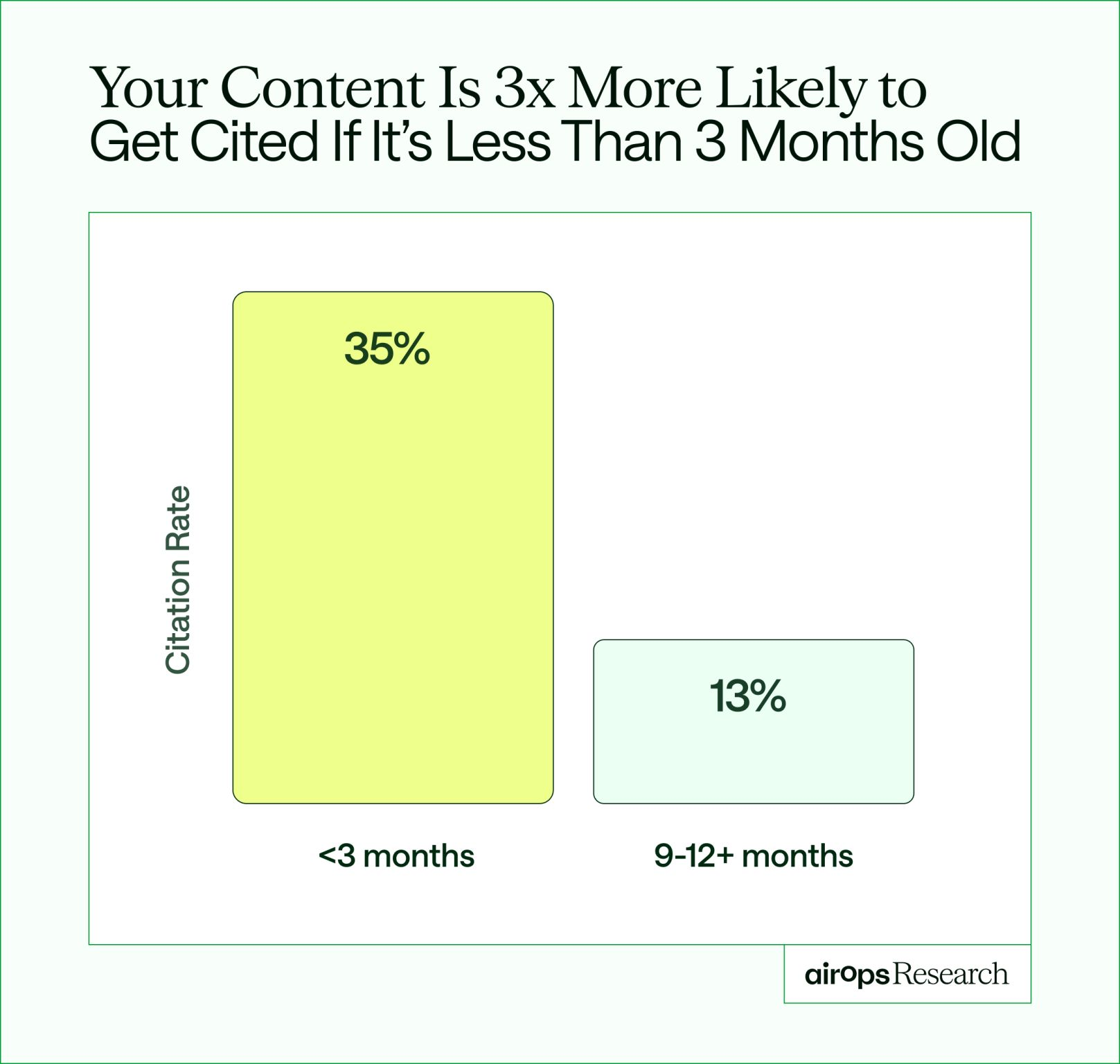
In fact, 28% of AIO citations come from 2025 content and 26% from 2024 content — but only 12% from content published within the last 30 days, meaning AI balances freshness with established trust signals. A page published three years ago and consistently updated will typically outperform a page published last week with no track record.
The practical actions are straightforward: update statistics annually, add a visible "last updated" date to your pages, refresh examples with current data, and add new data points when research emerges. You don't need to rewrite from scratch. Even small updates — a new stat, a refreshed example, a clarified heading — signal freshness to crawlers and, by extension, to the AI systems pulling from those crawl indexes.
Freshness appears to influence which sources are surfaced in AI-assisted search systems, including GPT-4o, GPT-4, GPT-3.5, and LLaMA-3, which means the investment in keeping pages current pays dividends across multiple AI search platforms simultaneously.
Tools that help: None required for updates themselves. Surfer's Content Audit or SE Ranking can surface which existing pages are losing rankings or citation opportunity — prioritize those for refreshes first.
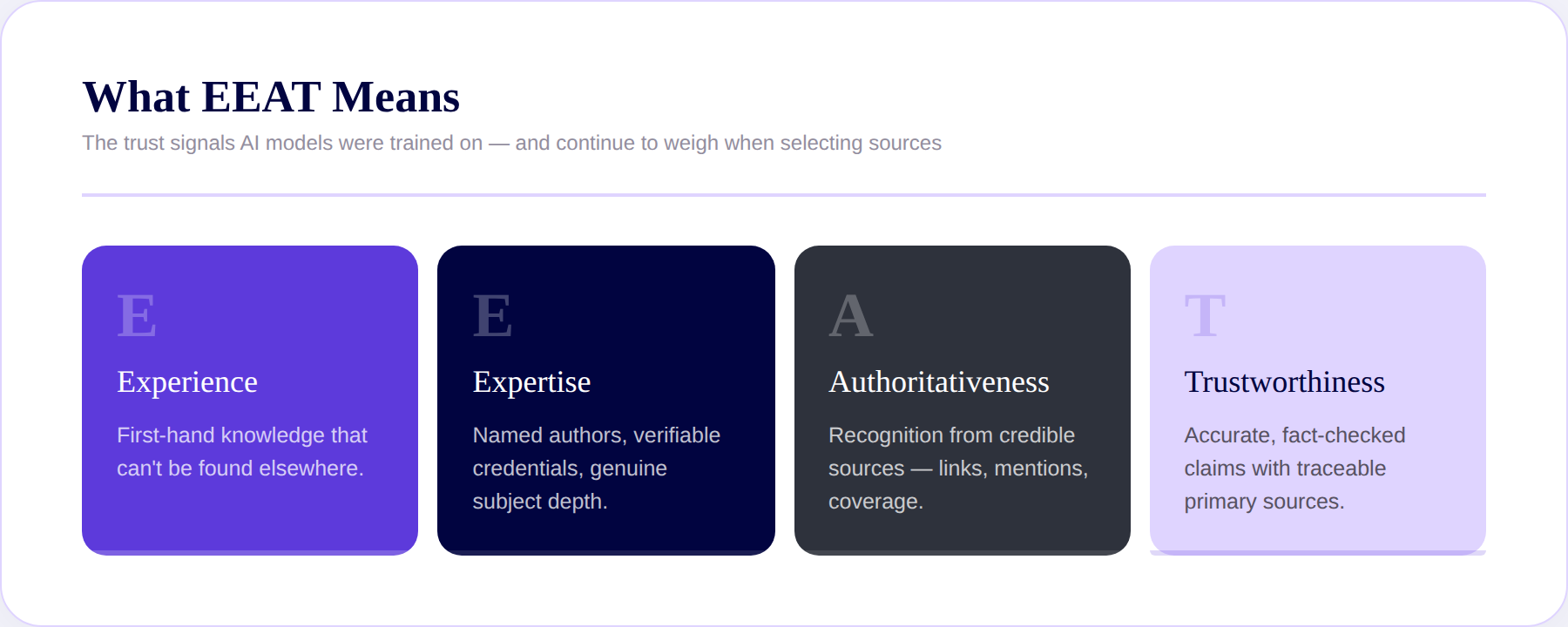
AI systems are trained to favor authoritative, trustworthy sources. EEAT — Experience, Expertise, Authoritativeness, and Trustworthiness — isn't just a Google quality framework. It's a set of content signals that AI models were trained on and continue to weigh when selecting sources.
The signals that matter most in practice: named authors with verifiable credentials and linked profiles; first-person experience or original data that can't be found elsewhere; links from reputable third-party sites in your industry; and accurate, fact-checked claims with traceable sources. Replace "Written by the [Company] Team" with real author names, bios, and LinkedIn profiles. Back every meaningful claim with a primary source — AI models consistently prefer content that cites research over content that states opinions as facts.
Remember that AI doesn't just evaluate your page in isolation. It considers what other sources say about you. Digital PR, brand mentions in industry publications, third-party reviews, and coverage on authoritative sites all contribute to how AI systems perceive your brand's credibility.
Tools that help: Ahrefs or SE Ranking for tracking brand mentions and inbound links. The implementation itself requires no tool — just editorial discipline and a consistent author byline policy.
Schema markup is structured data added to your page's HTML that tells AI and search systems exactly what type of content they're looking at — FAQ, HowTo, Article, Product — without requiring them to infer it from context. It doesn't change what readers see. It changes what machines read.
Most articles mention schema as a tactic and move on. Here's what actually matters for GEO: the content types AI systems cite most frequently map directly to the schema types that are easiest to implement.
The priority schema types for AI visibility are FAQ schema (because question-and-answer format is exactly what AI extracts when generating conversational responses), HowTo schema (for step-by-step instructional content), Article schema (which establishes authorship, publication date, and update date — all freshness signals), and Product schema for e-commerce or SaaS review content.
For non-technical teams: WordPress users can implement all of these through Yoast SEO or RankMath without touching code. Squarespace handles Article schema automatically for most standard content types. Google's Structured Data Markup Helper is free and walks you through tagging any page without writing a line of HTML.
Tools needed: Google's Structured Data Markup Helper (free); Yoast or RankMath for WordPress users (free tiers available). Validate your implementation with Google's Rich Results Test after adding markup.
You can't improve what you can't measure. Every strategy in this article produces output you need to track — citation frequency, prompt coverage, which pages AI pulls from, how competitors are appearing. Without measurement, you're running tactics without knowing if they're working.
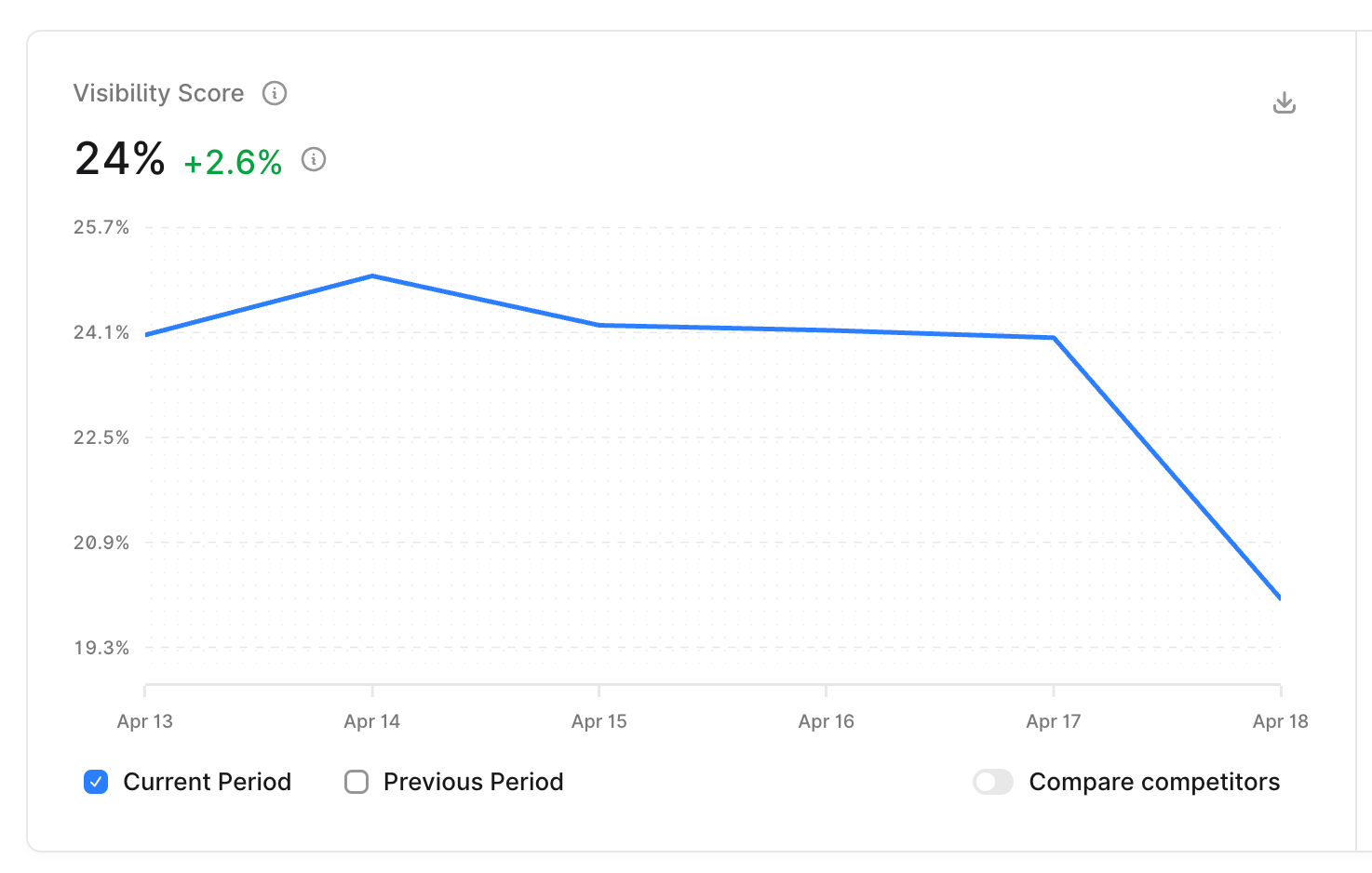
This is the most common gap in GEO strategies: teams implement structural and content changes, then have no way to connect those changes to AI search outcomes.
Here's how to build the measurement stack, by budget:
The most important thing is to start measuring, even at the free tier. You can't optimize a signal you can't see.
Google AI Overviews, ChatGPT, and Perplexity don't work the same way — and content optimized for one won't automatically win in all three.
The practical starting point: optimize for Google AI Overviews first — it has the most overlap with traditional SEO, the largest query volume, and the clearest optimization signals. Then layer in Bing indexing (submit your sitemap to Bing Webmaster Tools — free, takes ten minutes), which powers both Bing's own AI search and contributes to ChatGPT's web-browsing citations. Perplexity comes third: its recency weighting means your content update cadence is the highest-leverage input.
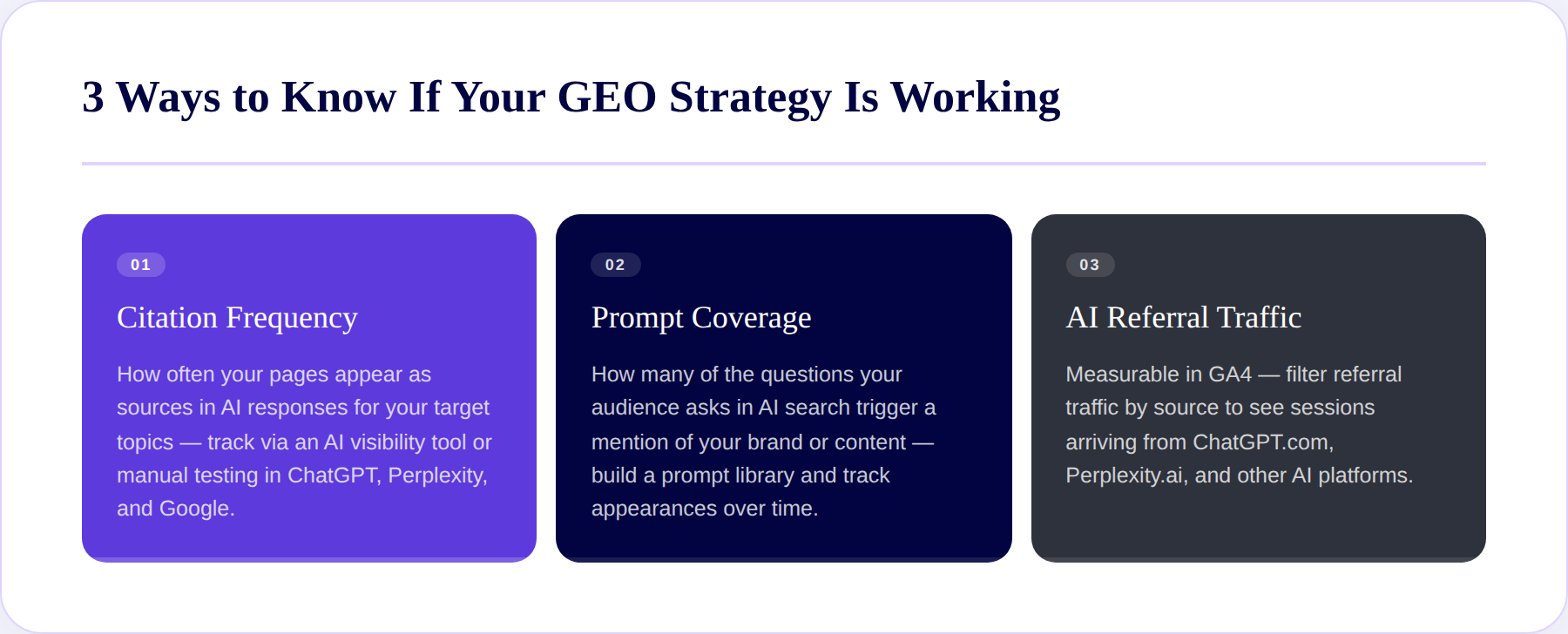
Track three things — citation frequency, prompt coverage, and AI referral traffic.
This shows you how often your pages appear as sources in AI responses for your target topics. The cleanest way to measure this is through a dedicated AI visibility tool (Otterly, Rankscale, SE Ranking Pro). At the free tier, manual testing — searching your target questions directly in ChatGPT, Perplexity, and Google with AI Overviews — gives you a directional read.
This one is about how many of the questions your audience asks in AI search trigger a mention of your brand or content. This is where tools like Rankscale add value: you can build a library of prompts that mirror real user queries and track your appearance across all of them over time.
This is measurable in Google Analytics 4. Filter your referral traffic by source to see sessions arriving from ChatGPT.com, Perplexity.ai, and other AI platforms.
Set up Bing Webmaster Tools and Google Search Console first (free), then add a paid AI visibility tool once you have enough published content to track meaningfully. For most teams, that threshold is around 15–20 indexed pages on your target topic cluster.
Most teams see measurable changes in citation frequency within 60–90 days of implementing structural and content changes. GEO is not a one-week experiment.
Most teams make the same three errors — and none of them are tactical, they're strategic.
AI matches intent, not exact phrases. A page targeting "email marketing software" will compete differently in AI search than a page answering "what email marketing software is best for a team of five?" Write for the question behind the keyword — not the keyword itself.
It isn't. Traditional SEO remains the foundation of AI visibility majority of AI Overview citations come from domains ranking in the top 10 for the original or fan-out query. Strong traditional SEO is still the best single investment you can make for AI visibility. GEO is the layer on top — not the replacement beneath.
Running GEO tactics without tracking citation outcomes is like running paid ads without conversion data. You'll produce content, make structural changes, and have no reliable way to know what's moving the needle. Set up measurement first, even at the free tier. Then optimize.
GEO isn't a new discipline requiring a new department. It's an extension of good content fundamentals — clear answers, authoritative sourcing, logical structure — applied to a distribution channel that's growing faster than any other in search.
AI search rewards the same things good readers reward: clarity, credibility, and depth. The brands showing up in AI answers right now didn't build a dedicated GEO strategy first. They built great content, structured it well, and made it easy for any system — human or machine — to extract the answer it was looking for.
This week: pick your highest-traffic page and apply strategies 1, 2, and 6 — answer directly in the first paragraph, restructure with clear H2/H3 headers and bullets, and add FAQ schema. Then set up Bing Webmaster Tools to start measuring. That's 80% of the GEO foundation, and it costs nothing but time.
The game has changed. The fundamentals haven't.
.webp)
With 10 years of writing experience and a deep interest in SEO, AI, and content management, Anna’s here to break down big ideas and translate them into plain English for readers of all levels. She's got a Master's Degree in International Information and is a lifelong learner of writing and storytelling. Outside of work, she’s on the yoga mat, in a good book, or planning her next adventure with family and friends.
.svg)
.svg)
.svg)
.svg)
.svg)