Small businesses want to show up on Google — but the SEO tool market is designed to confuse you. Most platforms are built for agencies, overpriced, and packed with features you'll never touch. Meanwhile, a growing wave of posts claims you don't need any of them: just use ChatGPT and save thousands a year.
This guide cuts through both problems — covering the best SEO tools for small businesses, evaluated on ease of use, pricing, core functionality, and modern search coverage across Google and AI.
Let's settle this before we get to the tools.
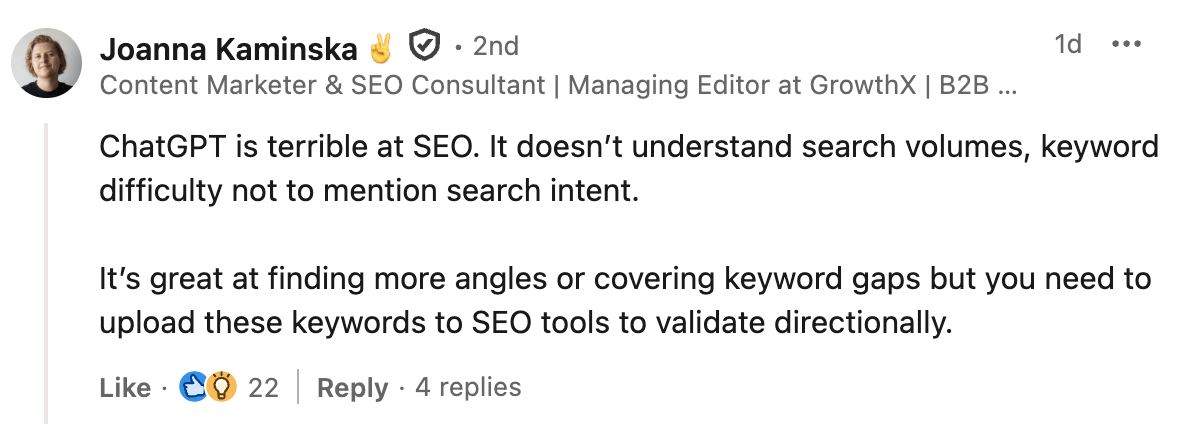
You've seen the posts. "Goodbye paid SEO tools — I saved $15,780 last year by replacing all of them with sharp ChatGPT prompts." They go viral, rack up thousands of likes, and they're completely misleading.
Here's the reality: ChatGPT doesn't do SEO. It can only talk about it.
LLMs are genuinely useful for idea generation — content angles, topic clusters, headline variations. But they have zero access to real search volume, keyword difficulty scores, or live search intent data. Ask ChatGPT to generate a keyword table with monthly volume and CPC data and it will produce one — confidently, cleanly formatted, and entirely fabricated. Those numbers aren't rough estimates. They're hallucinations dressed up as data.
The problem isn't the prompts. It's that LLMs are blind to the live datasets that tools like Ahrefs and Semrush have spent years building. No prompt engineering fixes a data access problem.
We evaluated each tool on five criteria relevant to small businesses — not enterprise teams:
The tools below are organized by use case, not ranked against each other.
If you could only use one SEO tool, Ahrefs is the most defensible choice for most small businesses. Its core superpower is visibility into what's working for your competitors — and why.
Site Explorer reveals any domain's top-ranking pages, the keywords driving that traffic, and the backlinks pointing to them. The Content Gap tool surfaces keywords competitors rank for that you don't — one of the fastest ways to find content opportunities you'd otherwise miss. Keywords Explorer delivers accurate search volume and keyword difficulty grounded in one of the largest crawl indexes in the industry.
For AI visibility, Ahrefs offers Brand Radar — a dedicated tracking tool that monitors how your brand appears across AI-generated answers.
.svg)
Best-in-class competitor and backlink data
Content Gap tool alone justifies the subscription
Brand Radar uses real search data, not synthetic prompts
Strong educational resources reduce the learning curve
.svg)
No traditional free trial on the core platform
Brand Radar is a separate add-on cost
Pricing:
Best for: Small businesses investing in content marketing or link building who want to understand and outcompete their search competitors.
SE Ranking is the strongest all-in-one SEO platform for small businesses that want broad capability without Semrush's price tag or complexity. Keyword research, rank tracking, backlink analysis, site auditing, and content optimization all live in one clean interface — and the entry tier is genuinely useful, not a stripped-down teaser.
The Content Editor compares your draft in real time against top-ranking pages for your target keyword, flagging missing terms and structural gaps before you publish. The AI visibility tracker monitors how your brand appears in AI Overviews, ChatGPT, and Perplexity — making SE Ranking one of the few mid-market tools that treats GEO as a first-class metric.
Best value all-in-one at the entry tier
Strong local SEO features
Clean interface with a short learning curve
14-day free trial
500 keyword rank tracking limit on Essential feels tight for businesses managing multiple sites
AI visibility tracker requires the Pro plan
Pricing: Core $129/mo, Growth $279/mo; 14-day free trial available
Best for: Small businesses and freelancers that want a capable all-in-one platform without Semrush's price — especially those doing local SEO or managing 2–3 sites.
Semrush Keyword Magic Tool contains over 25 billion keywords. Position Tracking monitors rankings daily across any location or device. The On-Page SEO Checker scores individual pages and prioritizes improvements based on competitive data. In 2026, Semrush added AI visibility tracking for ChatGPT, Gemini, and Google AI Overviews across all plans — a meaningful update that puts it ahead of most competitors on this front. The free Semrush Academy reduces the learning curve for new users navigating a platform with a significant surface area.
Most complete feature set at this price point
AI search visibility tracking on all plans
Free Semrush Academy reduces the learning curve
Strong client reporting for freelancers
Highest entry price on this list at $139.95/mo
Interface is overwhelming for beginners
Pro plan limits push many users to the $249.95 Guru tier quickly
Pricing: Pro $139.95/mo, Guru $249.95/mo; 14-day free trial available
Best for: Growing small businesses and freelancers managing multiple clients who want one platform covering keyword research, competitor analysis, technical SEO, and AI visibility tracking.
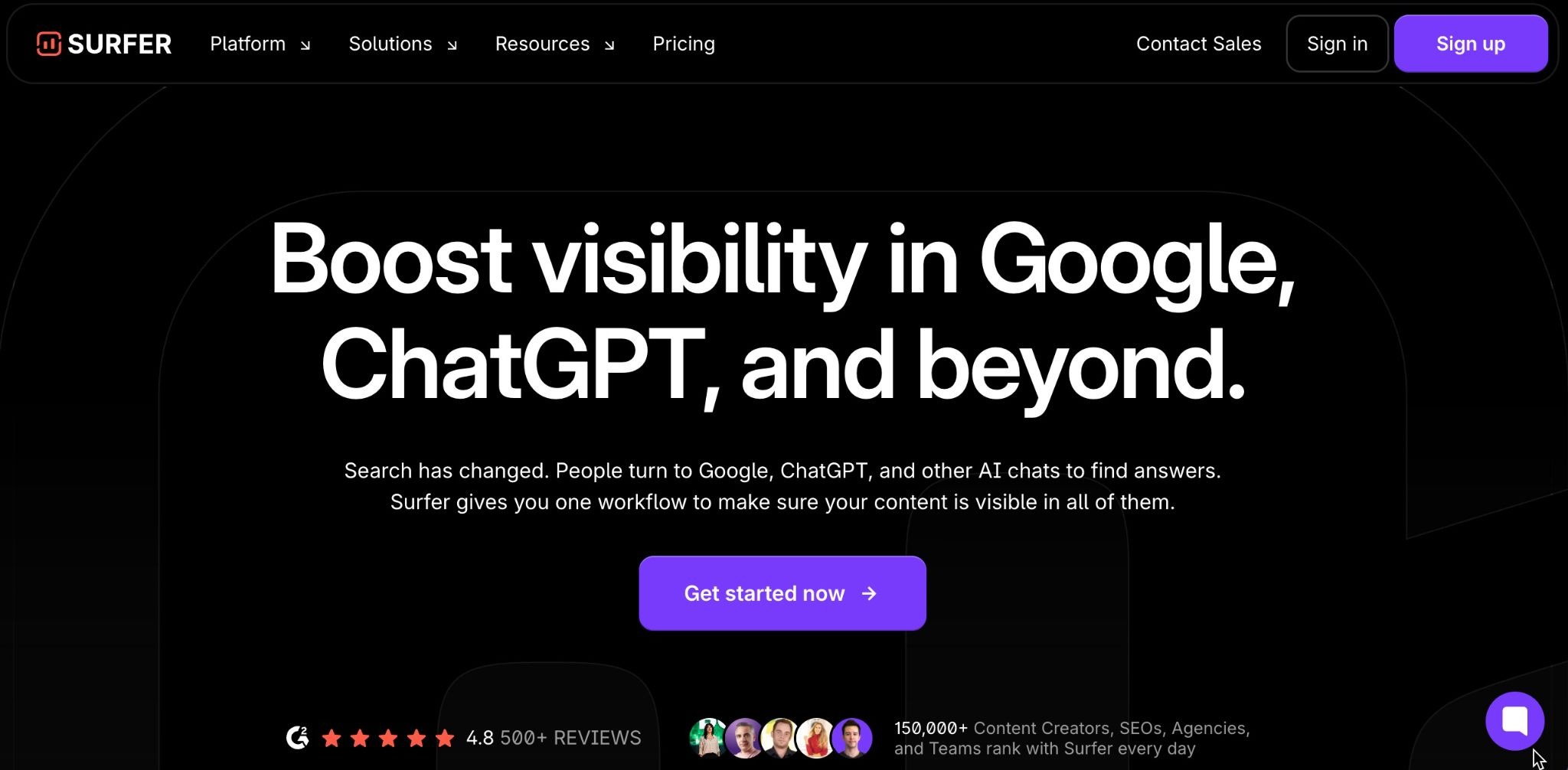
Surfer does one thing exceptionally well: it tells you exactly what your content needs to rank for a specific keyword, before you hit publish. The Content Editor scores your draft in real time against the top-ranking pages for your target keyword — flagging missing terms, optimal word count ranges, and heading structure drawn from actual SERP data. The SERP Analyzer breaks down what the top 48 results have in common across 500+ data points. Google Docs integration means your writers can work inside the scoring environment without learning a new tool.
One of the best content editors available
SERP Analyzer answers structural questions most teams guess at
Google Docs integration removes workflow friction
Not a keyword research tool — you need your target keyword before opening it
Expensive if you publish infrequently
No rank tracking or backlink analysis
Pricing: Essential $99/mo, Scale $219/mo; 7-day money-back guarantee
Best for: Content-heavy small businesses that publish regularly and want data-driven guidance on what their content needs to rank — paired with Ahrefs or SE Ranking for keyword discovery.
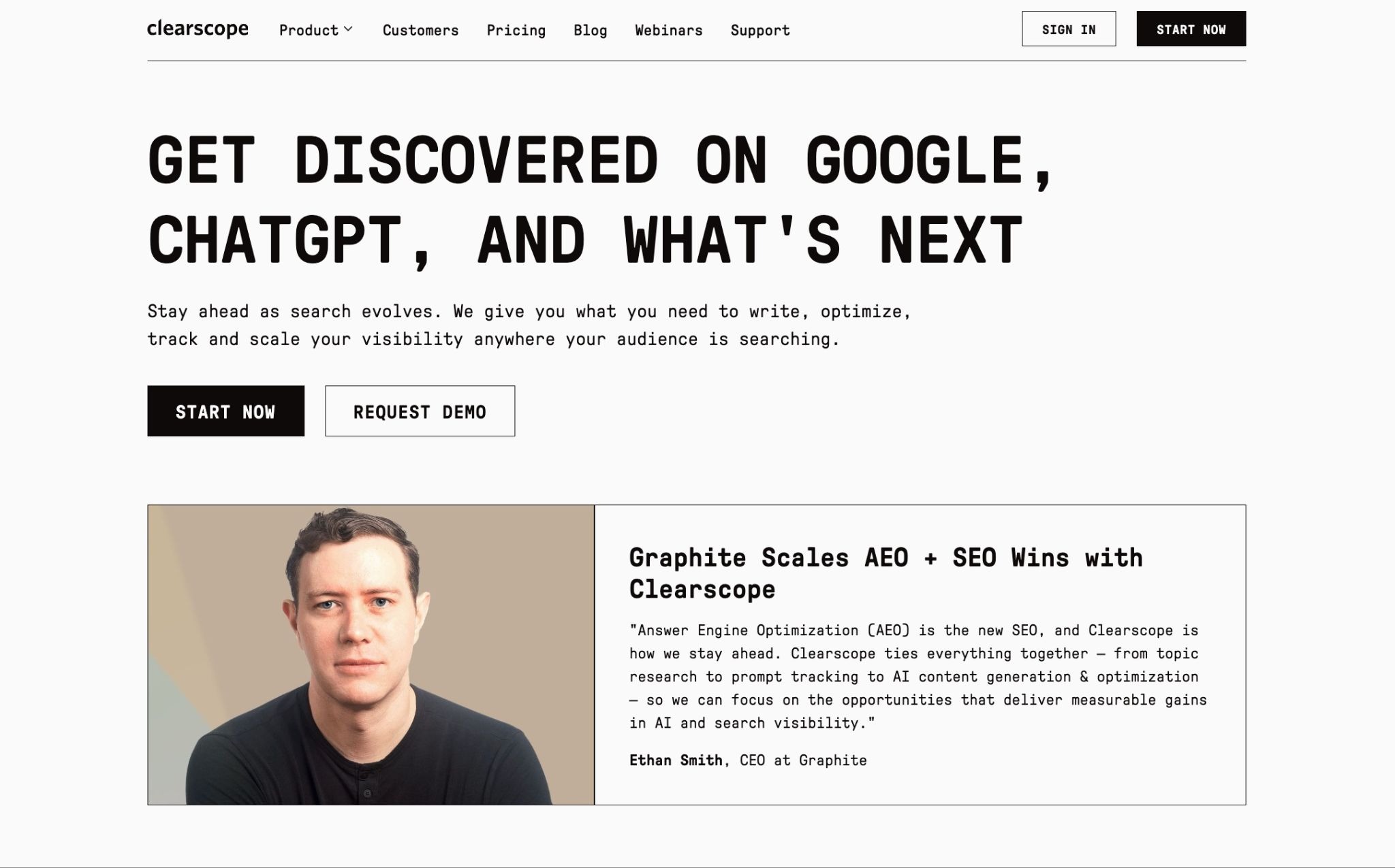
Clearscope occupies a similar space to Surfer SEO but with a sharper focus on editorial quality, team collaboration, and content lifecycle management. The Content Inventory feature monitors your entire published library for performance decay — flagging pages losing rankings over time so your team can prioritize refreshes before traffic drops. This shifts content strategy from reactive to proactive in a way Surfer doesn't offer. GSC integration pulls real performance data directly into the platform, and Google Docs and WordPress integrations bring scoring into your existing writing workflow.
Content Inventory flags decaying pages before traffic drops
Cleaner, more editorial-focused interface than Surfer
Strong customer support reputation
Expensive at $189/mo for a single-use-case tool
Not a full SEO platform
Best ROI requires publishing 4–6+ pieces per month
Pricing: Essentials $129/mo, Business $399/mo
Best for: Content-focused small businesses with an existing content library and a team that publishes regularly — where decay monitoring and editorial workflow matter as much as new content optimization.
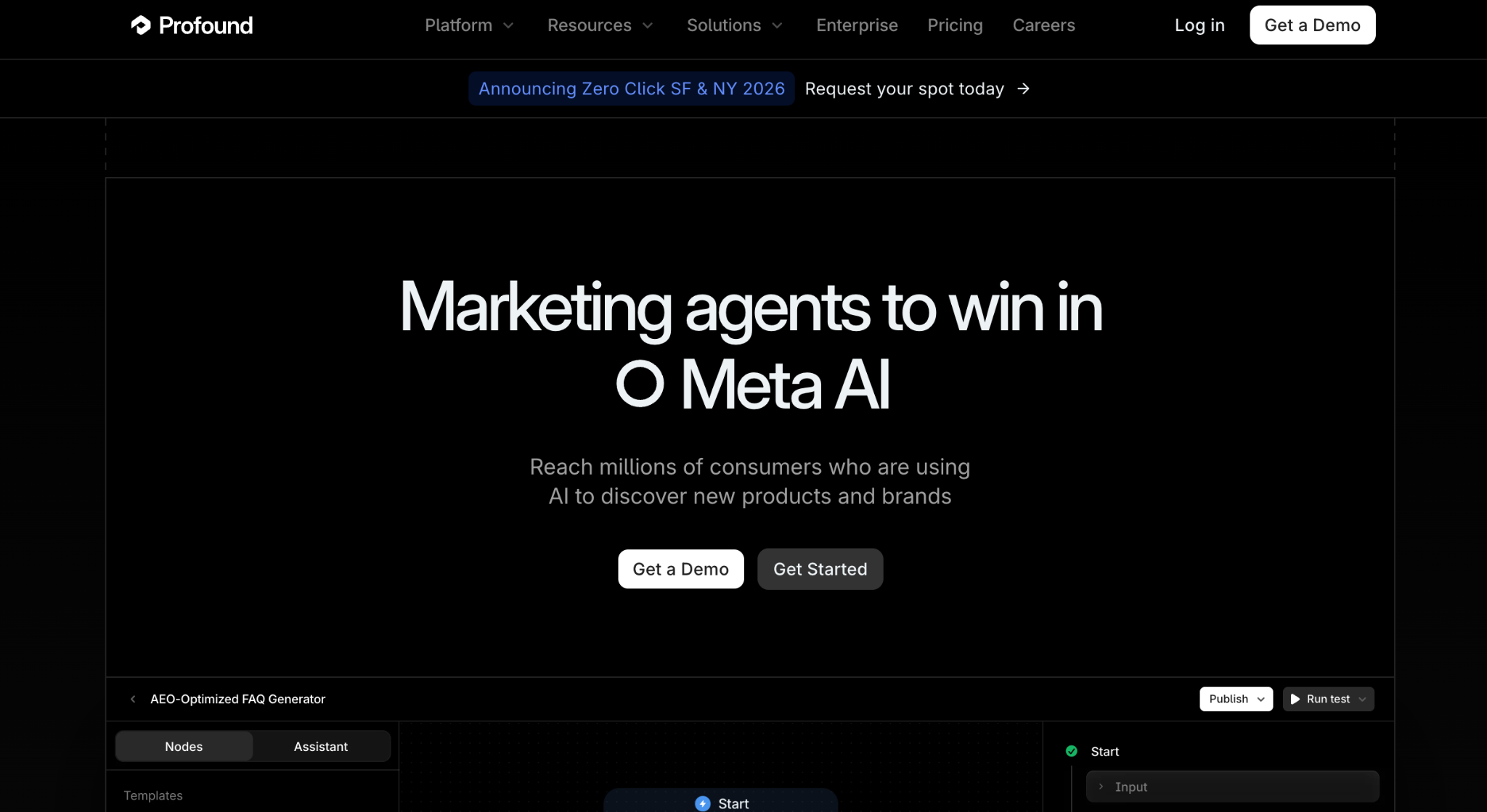
Where traditional tools track where your pages rank on Google, Profound tracks how your brand appears in AI-generated answers across ChatGPT, Perplexity, Google AI Overviews, and Gemini. GEO is an extension of SEO, not a replacement — but as AI search pulls more consideration-stage traffic that rank tracking won't show you, visibility into that layer is increasingly necessary.
One of the most sophisticated AI search tracking platforms available
Competitor AI visibility data is genuinely novel
Fills a growing gap no traditional SEO tool covers
Custom pricing requires a sales conversation to budget
Not a replacement for traditional SEO tools
Most valuable once you have meaningful published content to track
Pricing: Custom — contact Profound for a quote; third-party sources place entry around $499/mo
Best for: Small businesses actively investing in SEO and content who want visibility into how they appear in AI search results — particularly in categories where AI Overviews and ChatGPT are already influencing buyer decisions.

Scrunch focuses on a specific problem: knowing when and how your brand is mentioned in AI-generated responses, and using that intelligence to influence what AI systems say about you. It monitors AI outputs across major LLMs, surfaces brand mention sentiment and context, and helps teams understand what content signals are driving AI behavior around their brand.
Accessible entry pricing relative to Profound
Sentiment analysis adds depth pure mention-tracking tools don't offer
Straightforward interface with a short learning curve
Narrower scope than a full GEO platform
Best used as a complement to traditional SEO tools, not a replacement
Category is still early — benchmarks are still being established
Pricing: From approximately $250–300/mo — contact Scrunch for current plan details.
Best for: Small businesses in competitive categories that want to understand and improve how AI talks about their brand, without enterprise-level investment.
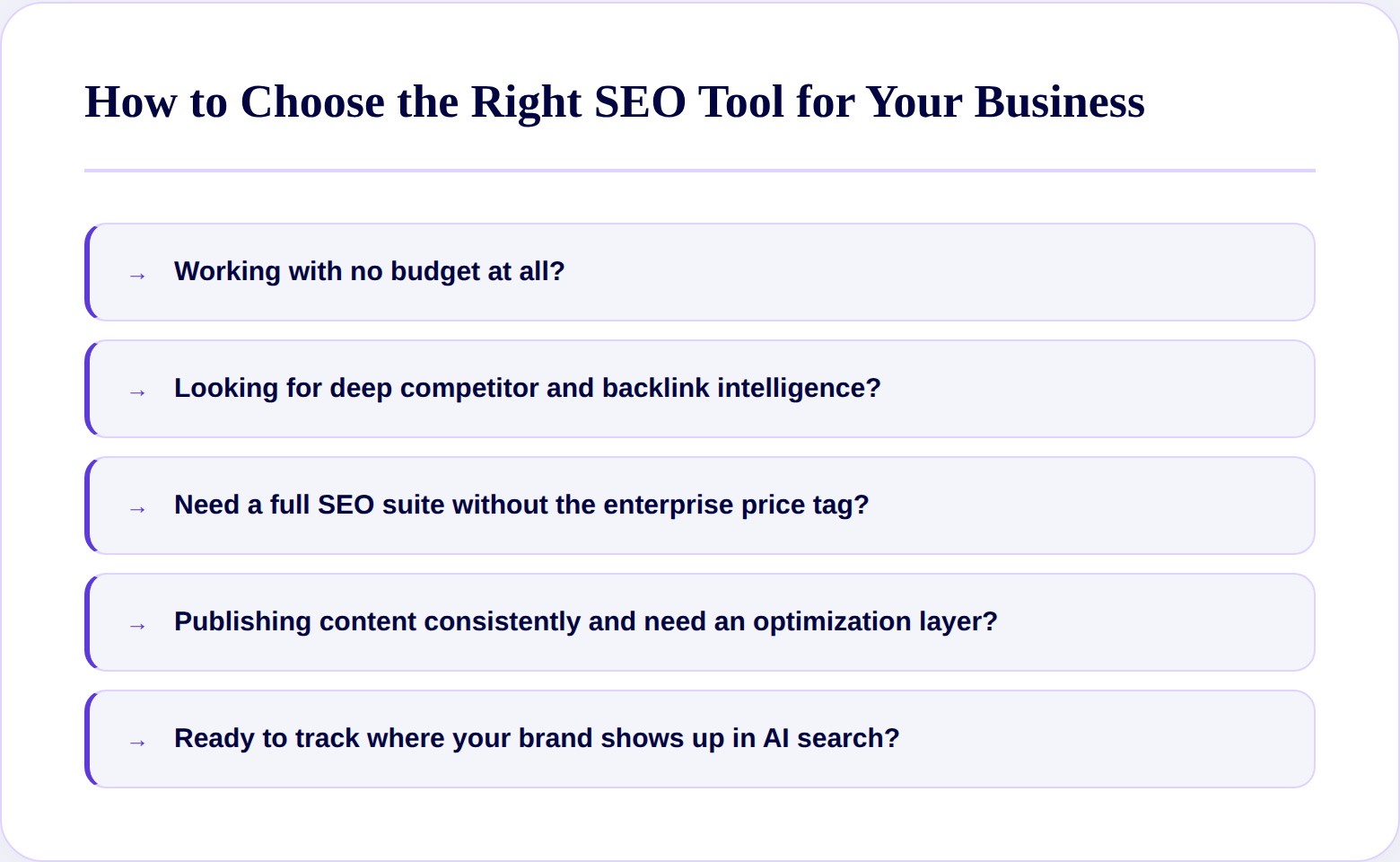
Start with the non-negotiables: GSC, Google Keyword Planner, and Bing Webmaster Tools. Free, essential, and most small businesses underuse all three. Once those are in place, use this framework:
For most small businesses, one traditional SEO tool plus GSC is enough to start. Add GEO tools when AI search visibility enters your traffic conversations. And if you're using AI in your SEO workflow, connect it to real data — the Ahrefs MCP Server is the most practical way to do that right now without leaving your existing tool stack.
The right tools, the real data
The "replace your tools with ChatGPT" posts will keep coming. Small businesses that follow that advice will keep wondering why their rankings aren't moving — because real SEO data comes from platforms that have spent years building the infrastructure to collect it. No prompt accesses what doesn't exist in a model's training data.
Start with GSC and Bing Webmaster Tools today if you haven't already. Add one paid tool when you're ready to go beyond your own site's data. If you publish content regularly, pair a research tool with a content optimization tool. And when AI search visibility starts showing up in your traffic conversations — which it will — add a GEO tool to the stack.
.webp)
With 10 years of writing experience and a deep interest in SEO, AI, and content management, Anna’s here to break down big ideas and translate them into plain English for readers of all levels. She's got a Master's Degree in International Information and is a lifelong learner of writing and storytelling. Outside of work, she’s on the yoga mat, in a good book, or planning her next adventure with family and friends.
.svg)
.svg)
.svg)

.svg)
%20(1).svg)
%20(3).svg)
.svg)
.svg)