
.svg)
%20(1).svg)
%20(3).svg)
Back to articles
Best AI Search Monitoring Tools: Find Out Who's Winning
June 25, 2026
By
Irina Maltseva
You can rank #1 on Google and be completely invisible in AI search. Traditional rank trackers won't show it — they don't tell you whether ChatGPT recommends your brand, whether Perplexity cites your content, or whether AI Overviews are sending your competitors' names into buyer conversations instead of yours.
This guide compares seven of the best AI search monitoring tools across coverage, data quality, pricing, and use case — so you can pick the right one without wasting budget on dashboards that don't drive decisions. Tools are evaluated on multi-platform coverage, prompt methodology, citation analysis, competitive intelligence, and entry-tier value.
Google ranks pages. AI search engines extract answers. When someone asks ChatGPT "what's the best project management tool for a remote team?" the system synthesizes a response — and either names your brand or it doesn't. There's no position two.
In fact, AI-referred sessions grew 527% year-over-year in the first half of 2025. LLM visitors convert 4.4x better than organic search visitors. The channel is small but growing fast — and the traffic that does arrive is higher-intent than almost anything else in your analytics.
That's a fundamentally different visibility problem from traditional SEO. Rank trackers measure where you appear in a list. AI search monitoring tools measure whether you appear in a synthesized response — and if so, how, in what context, and alongside which competitors.
These tools work through prompt-based monitoring: they send queries to AI engines, capture responses, and analyze whether your brand surfaces as a mention, citation, or recommendation — a core part of AI visibility tracking.
Key platforms to track:
Only 12% of sources cited across ChatGPT, Perplexity, and Google AI Overviews overlap. Optimizing for one platform does not guarantee visibility on others — which is exactly why multi-platform monitoring matters
GEO — Generative Engine Optimization — is the discipline these tools serve. It's an extension of SEO, not a replacement for it.
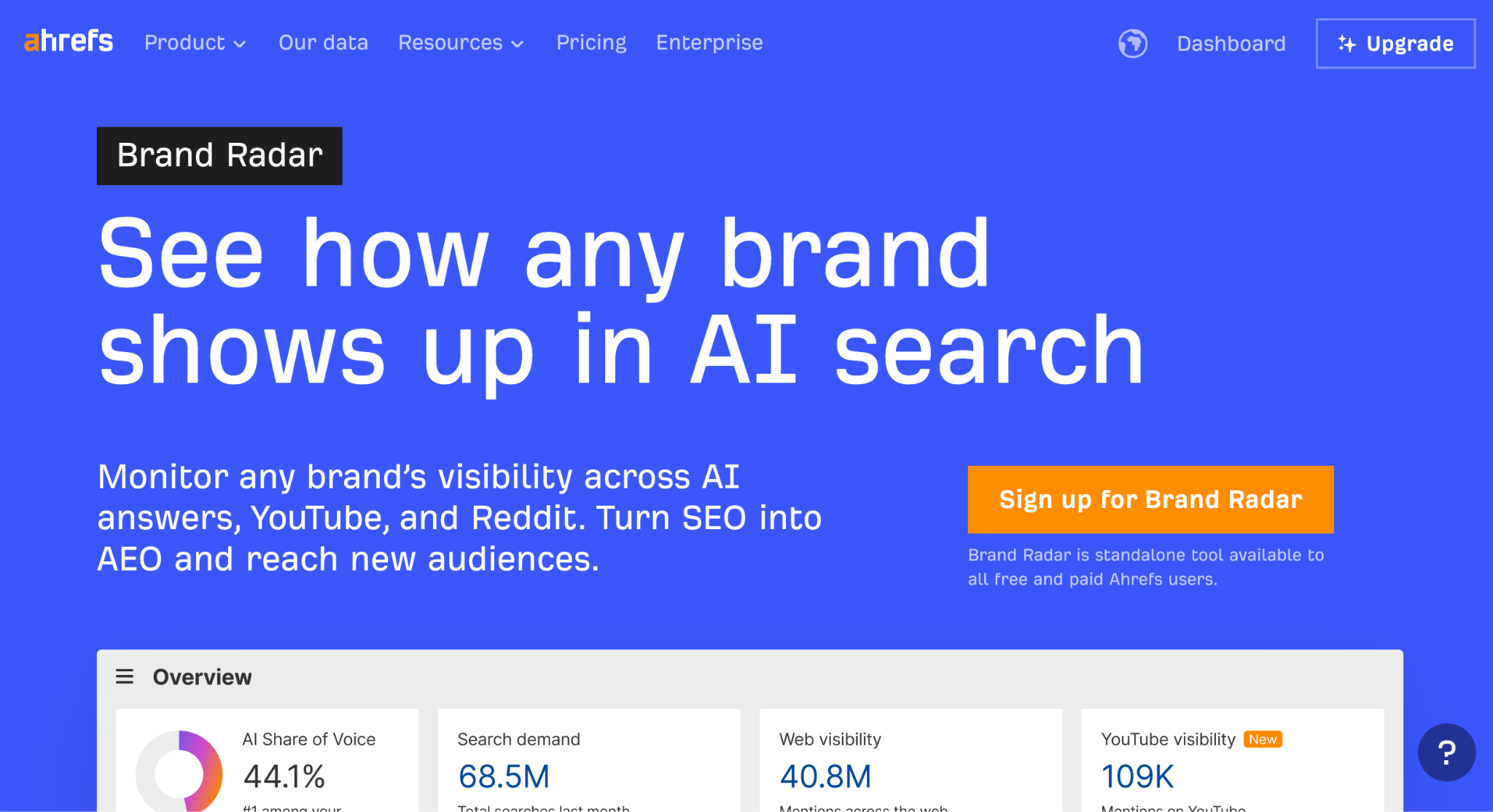
Ahrefs Brand Radar is the only AI search monitoring tool built on search-backed prompts from a real keyword database. Most tools generate synthetic prompts — essentially guessing what users might ask. Brand Radar derives prompts from Ahrefs' index of hundreds of millions of actual search queries, giving you visibility data grounded in real user behavior. The platform tracks six AI platforms alongside web, YouTube, Reddit, and TikTok visibility in a single dashboard — the broadest scope on this list.
In fact, brands in the top 25% for web mentions earn 10x more AI visibility than those in the next quartile. Around 80% of URLs cited across ChatGPT, Perplexity, Copilot, and AI Mode do not rank in Google's top 100 results for the original query — reinforcing that AI citation and traditional rankings are genuinely different signals.
Key features: Six AI platforms; 300M+ search-backed prompts; Custom Prompts from $50/mo; AI Share of Voice vs. competitors; competitor gap analysis; web/YouTube/Reddit/TikTok visibility; free permanent plan via Ahrefs Webmaster Tools (Site Explorer, Site Audit, Web Analytics, Social Media Monitor, AI Content Helper)
.svg)
Only tool built on 300M+ search-backed prompts from real keyword data — not synthetic
Zero setup — research any brand instantly without building a project
Broadest platform scope: six AI engines plus web, YouTube, Reddit, and TikTok
Free permanent entry point via Ahrefs Webmaster Tools
Integrates directly with existing Ahrefs SEO and backlink data
.svg)
AI indexes are separate add-ons on top of a required Ahrefs base subscription
Snapshot-based methodology can underreport mentions on ChatGPT and Perplexity
Prompt database skews heavily toward Google AI Overviews — thinner coverage elsewhere
No optimization recommendations — measurement only
Pricing: Ahrefs Webmaster Tools free permanently; Custom Prompts from $50/mo; per AI index from $199/mo; all indexes $699/mo
Best for: SEO teams and brand marketers who want AI visibility monitoring built on real search data, especially those already using Ahrefs.

Scrunch goes beyond monitoring by adding GEO audit recommendations — not just showing where you're invisible, but suggesting why and what to do about it. Persona-based tracking lets you see how AI responds to queries from different buyer profiles, and the Agent Experience Platform (AXP) creates machine-readable content layers to improve AI crawler indexing.
Key features: Multi-engine tracking (6 engines on Growth); citation breakdowns; GEO optimization recommendations; persona-based prompt filtering; Agent Experience Platform; competitor analysis
Most actionable output on this list — surfaces what to fix, not just what's broken
Persona-based tracking shows how AI responds to different buyer profiles
Agent Experience Platform (AXP) creates machine-readable content layers for AI crawlers
Citation source breakdown reveals exactly which content influences AI mentions
Core plan limits you to 125 prompts and 1 brand workspace
Claude, Gemini, Meta AI, AI Mode, and Grok locked behind Enterprise
Only 1 page optimization per month on Core
No content creation tools on self-serve plans
Pricing: Core $250/mo (125 prompts, 4 engines, 1 brand, 5 users); Enterprise: custom (9 engines, unlimited prompts, API access)
Best for: SEO professionals who want to improve how AI represents their brand — not just measure it.
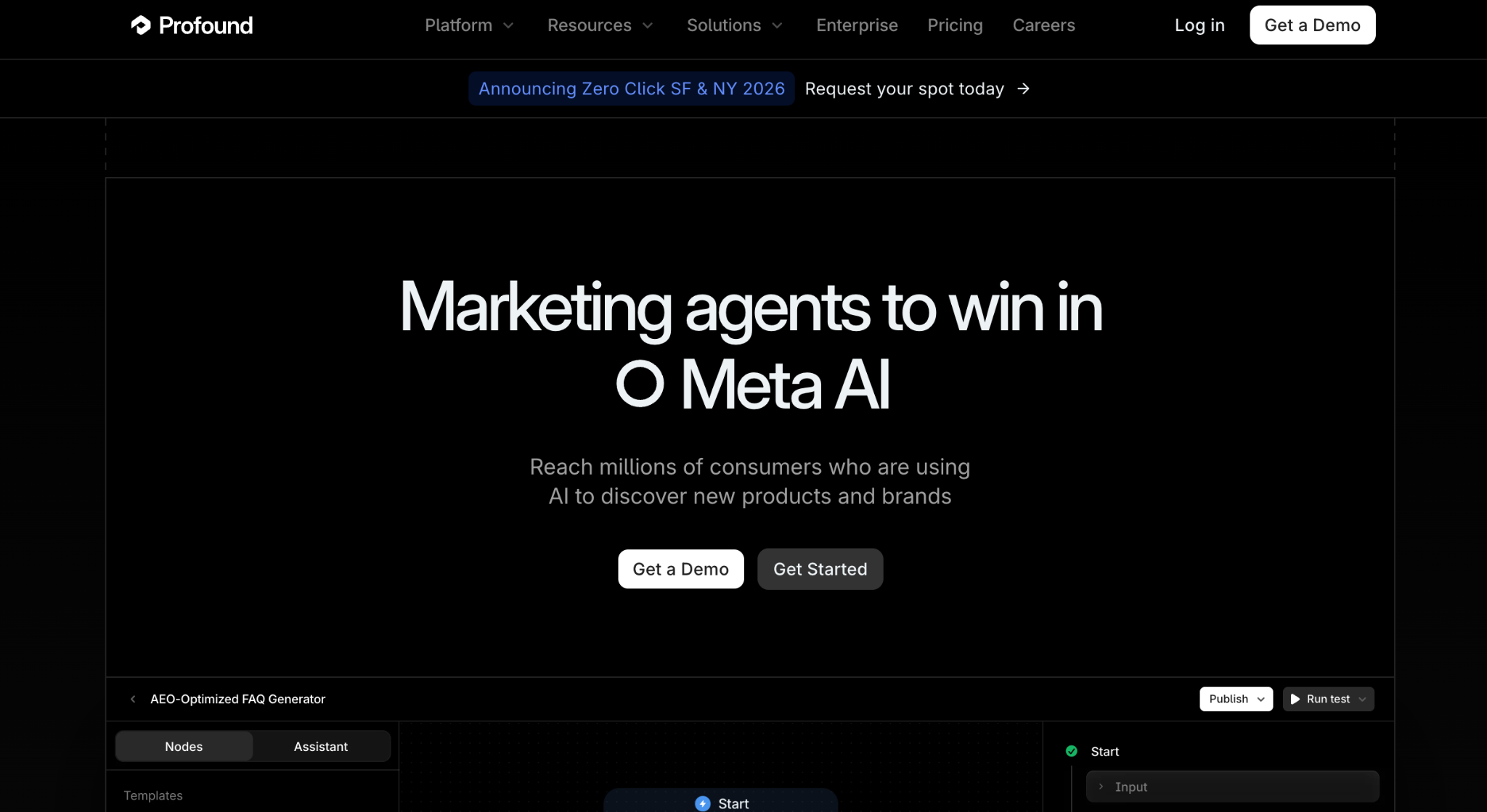
Profound is purpose-built for enterprise teams with compliance requirements. Following a $96M Series C, the platform covers 10+ AI engines and its Conversation Explorer approximates the volume of conversations happening around specific topics in AI engines — not just whether you appear, but how large the opportunity is.
Key features: Conversation Explorer for AI search volume estimation; Agent Analytics for AI crawler behavior; Shopping Intelligence for ChatGPT product recommendations; SOC 2 compliance and SSO/SAML; CDN integration tracking actual site visits from AI sources
Deepest conversation dataset in the category — 400M+ real AI conversations
SOC 2 Type II compliance and SSO/SAML for enterprise procurement
Conversation Explorer approximates AI search volume — unique in the market
ChatGPT Shopping visibility tracking not available elsewhere
G2 AEO category leader in their inaugural grid report
Entry plan ($99/mo) covers ChatGPT only; Growth ($399/mo) adds just 2 more engines
Full 10+ engine coverage requires Enterprise at custom pricing
Interface is data-heavy and unintuitive without a dedicated analyst
No content creation or optimization tools at any self-serve tier
Pricing: Starter $99/mo (ChatGPT only, 50 prompts); Growth $399/mo (3 engines, 100 prompts); Enterprise: custom
Best for: Large enterprises with compliance requirements and dedicated analytics functions. Not suited for mid-market teams needing affordable multi-platform coverage.

Otterly automates daily prompt checks, stores historical responses, and delivers brand dashboards with mentions, citations, and share of voice. The GEO Audit with SWOT analysis is a useful differentiator at the entry price — it provides a structured framework for prioritization rather than just raw data.
Key features: Brand mention and citation tracking; Share of AI Voice metric; GEO Audit with SWOT analysis; AI keyword research converting keywords into prompt variations; daily automated monitoring; Semrush App Center integration
Lowest credible entry price in the category at $29/mo
Daily automated prompt monitoring — no manual checking required
GEO Audit with SWOT analysis adds structured optimization framework
Semrush App Center integration for combined GEO and traditional SEO data
Gartner Cool Vendor 2025 recognition
Only 15 prompts at $25/mo — meaningful monitoring requires the $160/mo Standard plan
Gemini and AI Mode are paid add-ons, not included at entry
Tracks AI outputs only — cannot confirm whether AI crawlers visited your site
Pricing: Lite $25/mo (15 prompts, 4 engines); Standard $160/mo (100 prompts); Premium $422/mo (400 prompts); Google AI Mode and Gemini available as add-ons from $9/mo
Best for: Solo marketers and small teams who want automated AI visibility tracking at low entry cost — with the expectation of upgrading quickly.
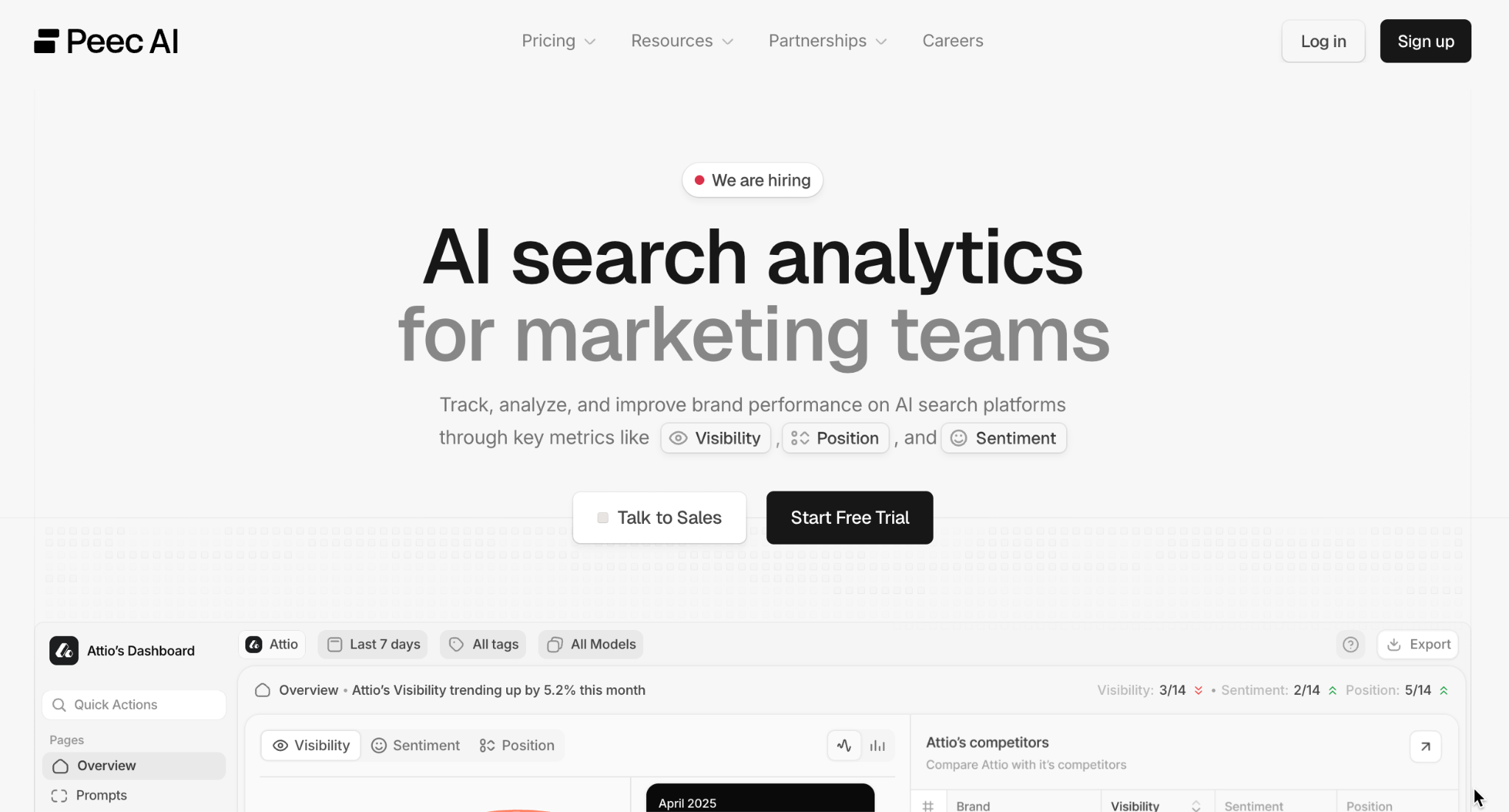
Peec covers six AI engines including DeepSeek and Llama, includes unlimited team seats across all plans, and supports multi-country tracking at no extra cost — meaningful advantages for agencies with international clients. Backed by $21M Series A funding, the platform serves clients including Chanel, ElevenLabs, and Axel Springer.
Key features: Six AI engines; unlimited team seats on all plans; multi-brand project support; citation source intelligence; competitor benchmarking; multi-country/language tracking included
Unlimited team seats on all plans — no per-seat fees
Multi-country and multi-language tracking included at no extra cost
Broad LLM selection: choose from 7 engines including Grok and AI Mode
Daily tracking frequency across all plans
Backed by $21M Series A — strong product investment trajectory
Only 3 models included per plan — additional models cost $35–$165/mo extra
Claude and GPT-5 Search locked behind Enterprise
50 prompts on Starter is tight for multi-product or multi-competitor tracking
No API access until Enterprise
Pricing: Starter $95/mo; Pro $245/mo; Advanced $495/mo; Enterprise custom. Additional models from $35/mo add-on.
Best for: Marketing agencies needing multi-brand AI visibility reporting with unlimited seats across multiple countries.
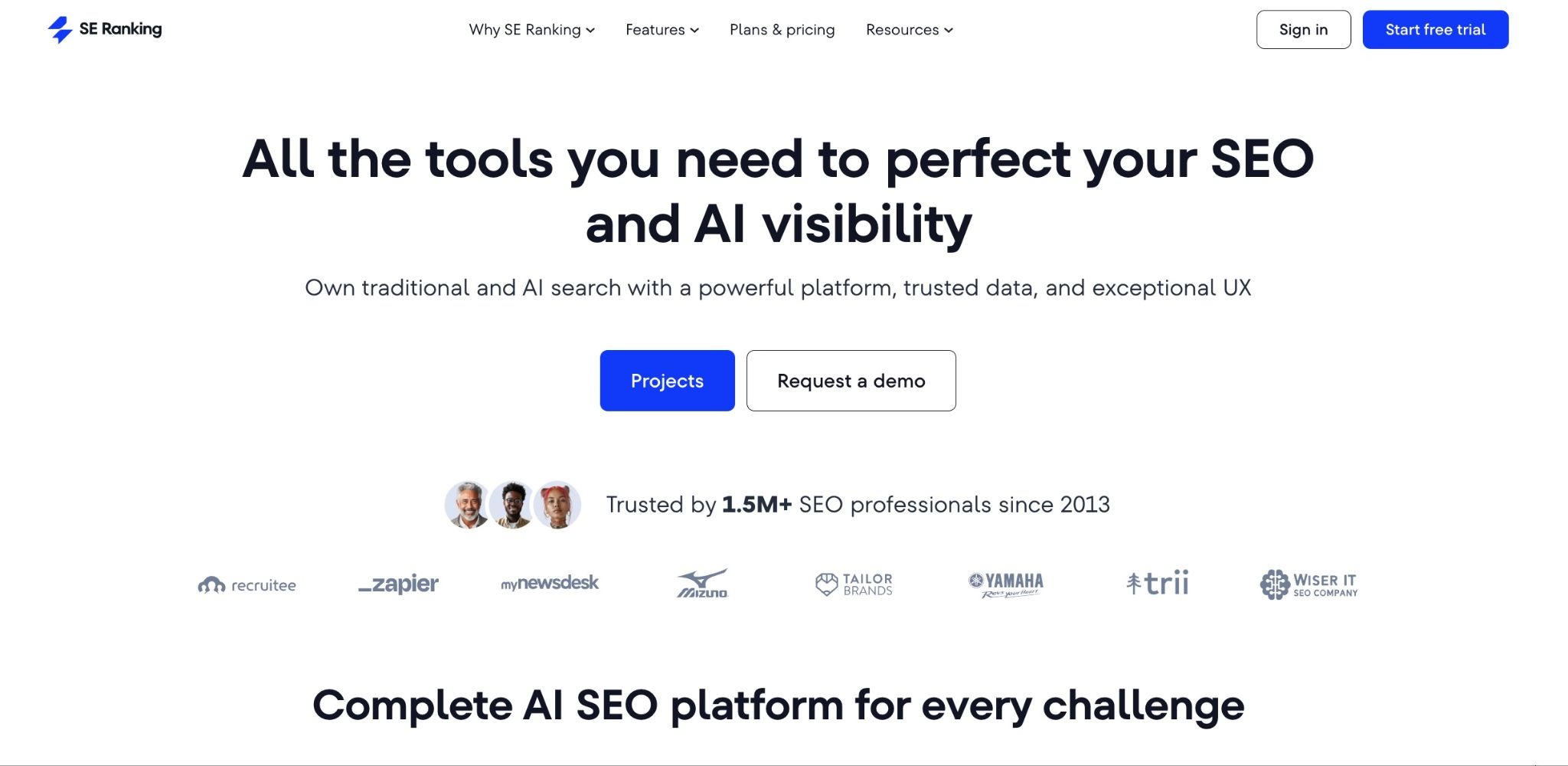
SE Ranking's AI visibility add-on layers AI Overview tracking, AI Mode tracking, and brand monitoring across ChatGPT, Perplexity, and Gemini directly into the existing SE Ranking dashboard. The "No cited" feature — surfacing competitor mentions in AI responses where your brand is absent — is consistently flagged by users as a practical content strategy input.
Key features: AI Overviews and AI Mode trackers; ChatGPT, Perplexity, Gemini monitoring; "No cited" competitor gap feature; daily tracking updates; multi-country and multi-language support
No new tool to learn — AI visibility built into existing SE Ranking dashboard
"No cited" feature surfaces competitor AI mentions where your brand is absent
Combines traditional rank tracking and AI visibility in one subscription
Daily tracking updates at a competitive price point
AI visibility tracker requires Pro plan — not included at entry tier
Sentiment tracking is shallow compared to dedicated GEO tools
Limited export options beyond CSV
Pricing: Included in SE Ranking Core at $103/mo; SE Growth standalone from $223/mo. 14-day free trial.
Best for: Teams already on SE Ranking who want AI visibility without a second subscription.
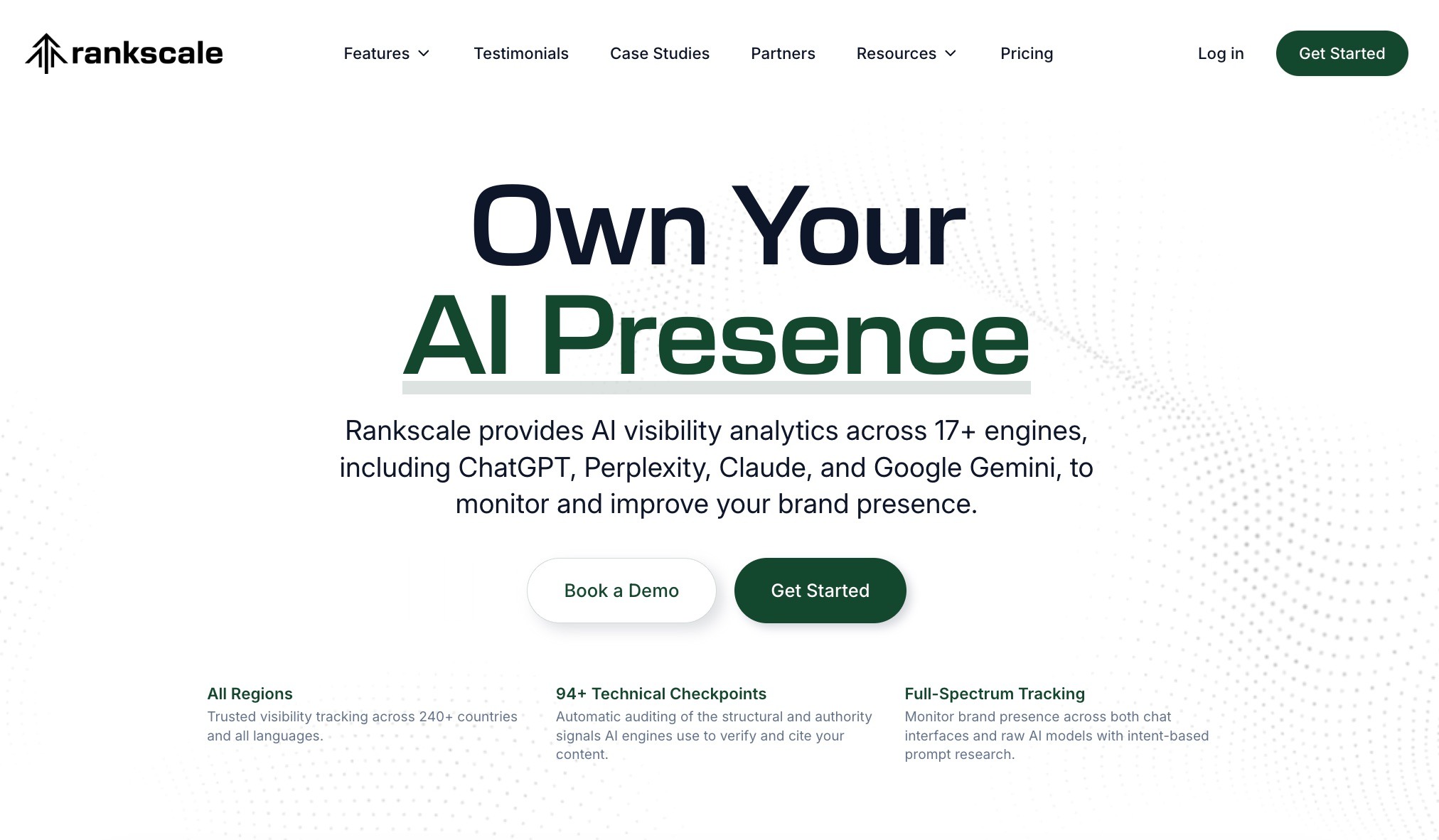
Rankscale's €20/mo Essential plan includes 17+ AI engines with no per-engine upsells — where most entry plans cover four engines and gate others behind add-ons. The AI Readiness Score audit identifies technical and content issues affecting AI search visibility, adding diagnostic value beyond basic monitoring.
Key features: 17+ AI engines on all plans; AI Readiness Score audit; brand dashboards with citation and sentiment monitoring; competitor benchmarking; Looker Studio connector (Pro); daily tracking
Best price-to-coverage ratio in the category — 17+ engines at $20/mo
No per-engine upsells — all platforms included from day one
AI Readiness Score audit adds diagnostic value beyond basic monitoring
OMR Reviews 9.9/10 customer support score
Independently validated prompt methodology
Cannot connect AI visibility data to sessions, leads, or revenue
Looker Studio requires Pro (€99/mo)
Newer entrant with a smaller track record than established tools
Pricing: Essentials €20/mo; Pro €99/mo; Growth €385/mo (agencies); Enterprise €780/mo
Best for: Startups and small businesses that want broad AI engine coverage at the lowest credible entry price.
AI platforms generated 1.13 billion referral visits in June 2025 — a 357% increase from June 2024. AI search traffic converts at 14.2% compared to Google's 2.8%. The channel is still small as a share of total web traffic, but the conversion quality is already impossible to ignore.
The brands winning in AI search right now didn't wait for the category to mature — they started measuring earliest and acted on what they found. One tool, used consistently, beats six dashboards collecting dust.
A platform that tracks how your brand appears in AI-generated responses from ChatGPT, Perplexity, Google AI Overviews, and Gemini — measuring mentions, citations, sentiment, and share of voice that traditional rank trackers don't capture.
Traditional SEO tracks position in a ranked list of links. AI search monitoring tracks whether you appear in a synthesized, conversational response — with no "position two." Optimization signals also differ: structured content, authoritative sourcing, and citation patterns matter more than keyword placement.
Search-backed prompts come from real keyword databases reflecting actual user searches. Synthetic prompts are fabricated by the monitoring tool. Search-backed prompts give you visibility into topics that demonstrably drive search behavior. Ahrefs Brand Radar is currently the only AI monitoring platform built on search-backed prompts at scale.
Entry pricing ranges from $20/mo (Rankscale) to $99/mo (Profound). Mid-market options cluster between $29/mo and $199/mo. Note that entry plan pricing is often misleading — many tools cover only one or two engines at the lowest tier.
Start with ChatGPT and Google AI Overviews. Add Perplexity for research-focused audiences and Gemini as Google's ecosystem expands. Microsoft Copilot matters for B2B audiences. DeepSeek and Grok are worth adding for tech-forward users.
Most track visibility. Scrunch AI and SE Ranking AI Visibility add optimization recommendations. For content creation and publishing workflows, you'll typically need a separate content tool alongside your monitoring platform.
A citation is when an AI engine links to or attributes a response to a specific source. Being cited means AI treats your content as credible. Monitoring which pages get cited — and which third-party sites influence those citations — is the foundation of any GEO strategy.

Irina is a Founder at ONSAAS, Growth Lead at Aura, and a SaaS marketing consultant. She helps companies to grow their revenue with SEO and inbound marketing. In her spare time, Irina entertains her cat Persie and collects airline miles.
.svg)
.svg)
.svg)
.svg)
.svg)