Search is splitting. Type a question into Google, and you might get ten blue links. Type a slightly different version of the same question, and you get a 300-word AI-generated answer with no links at all. The query decides the format, and the format decides whether your content gets a click — or gets cited without one.
Optimizing only for rankings means missing citations in AI answers that shape buyer perception before anyone visits your site. Optimizing only for AEO means walking away from organic traffic that still converts. This guide covers what each discipline is, how they differ, when to prioritize which, and how to measure both. Most sites need both — the right mix depends on your audience, query type, and conversion model.
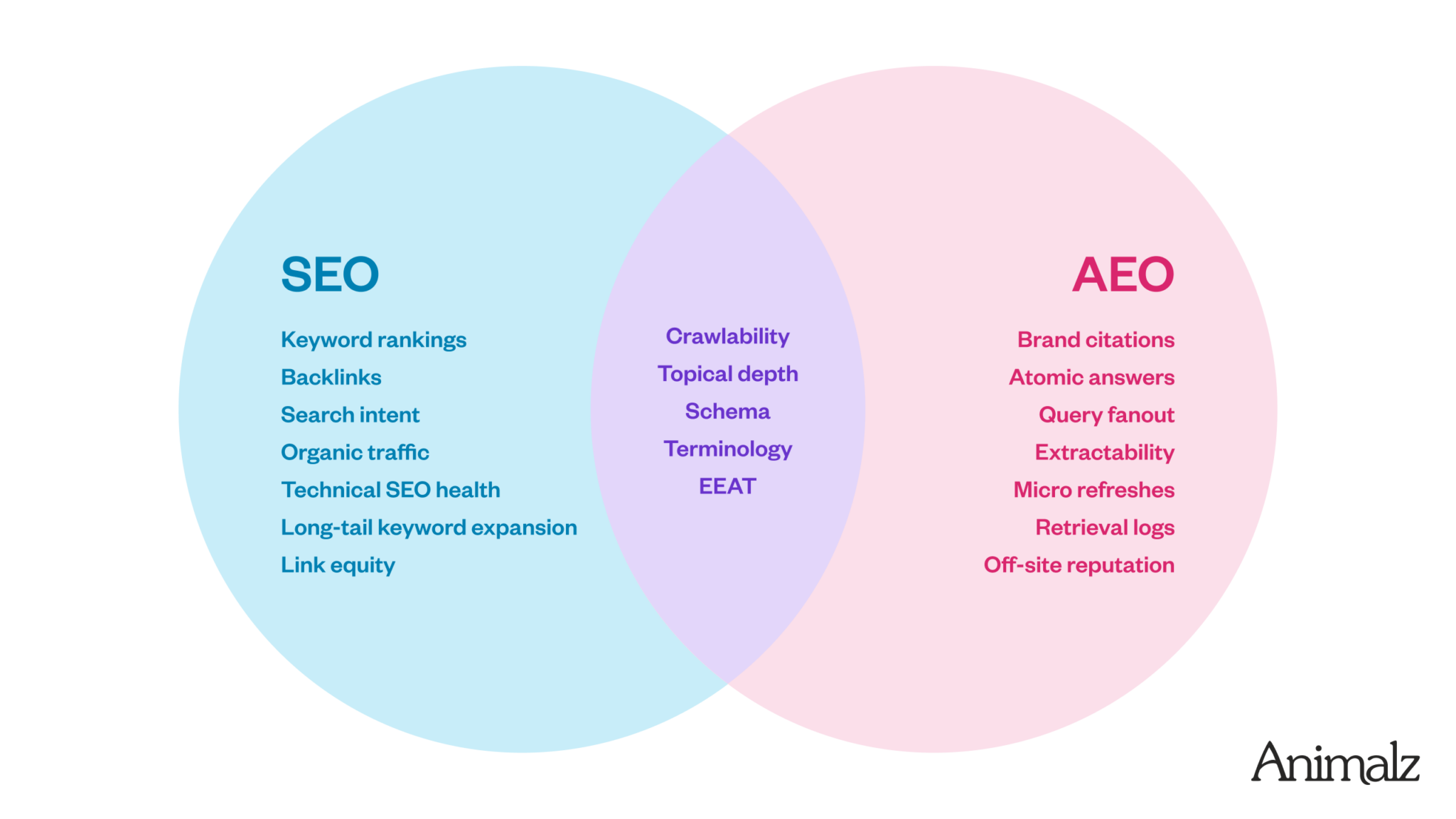
SEO optimizes pages so search engines rank them and users click through. Core levers: keyword targeting, backlinks, metadata, site architecture, and UX signals. Trust foundation: E-E-A-T — the framework that determines not just rankings but whether AI systems treat your content as citable at all.
AEO optimizes content so AI systems can extract, trust, and cite it — with or without a click. Zero-click searches now account for 58% of all Google searches — and on queries where AI Overviews appear, organic CTR drops by an average of 61%. The results page is increasingly the destination, not the gateway.
The relationship: SEO is the baseline. AEO layers on top. AI Overviews pull from top-ranking pages roughly 76% of the time — you don't skip SEO to do AEO.
Where they diverge — execution:
SEO is about your site. GEO is about your footprint across the web. AEO is what connects them — and executing all three in parallel is where most in-house teams hit their limits. Seen is an AI SEO agency built specifically for SaaS teams that need visibility across both Google and LLMs, running unified strategies that cover rankings, citation presence, and off-site brand signals in one program.
The difference between SEO and AEO writing isn't the topic — it's the structure. Here's the same content optimized each way:
For SaaS teams that want both disciplines executed together — ranking on Google while building LLM citation presence — Seen runs unified Google + AI search visibility strategies built around exactly this.
The answer is almost always hybrid — but the balance depends on what your buyers are searching for and how AI is already answering those queries.
The fastest way to know where to invest: search your target queries in an incognito window. Is there an AI Overview? Then AEO matters for that term. No Overview? Protect your SEO ranking first. Are your buyers researching via ChatGPT or Perplexity? You need to exist in those answers before they reach your site. Is your conversion model click-dependent? Don't sacrifice traffic for citations.
Scrunch's AI Search Trends shows which of your target topics are gaining traction in AI-generated answers — useful for identifying where AEO investment will have the most impact before building the content.
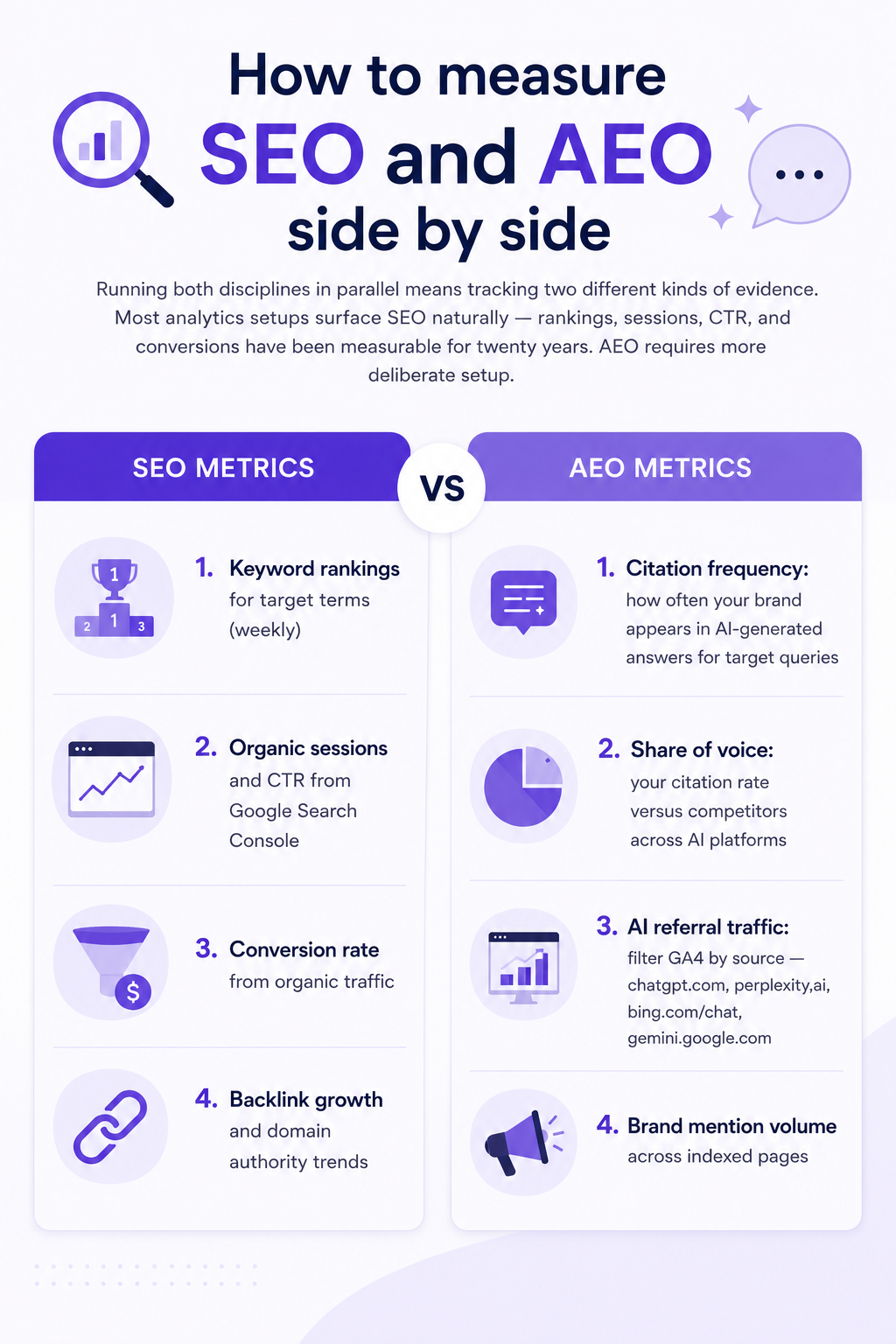
One pattern worth watching: rising AI citations combined with declining organic clicks isn't necessarily bad. Seer Interactive's analysis of 3,119 informational queries found that brands cited in AI Overviews saw 35% more organic clicks and 91% more paid clicks than competitors who ranked but weren't cited. Being named in the answer concentrates clicks toward cited brands rather than eliminating them.
Scrunch brings AEO metrics into one dashboard — prompt-level citation tracking, competitive share of voice, and GA4 integration so SEO and AEO performance sit side by side rather than in separate tools.
If you're adding AEO to an existing SEO program, the sequencing matters.
In the first 30 days, audit which target queries now trigger AI Overviews, set up a GA4 AI referral channel group, and run manual citation checks in ChatGPT and Perplexity to establish a baseline.
In days 31–60, rewrite your top 10 pages answer-first and add FAQPage and Organization schema — validate everything with Google's Rich Results Test before moving on.
In days 61–90, build off-site presence: publish on Reddit in relevant communities, establish LinkedIn presence for named authors, identify unlinked brand mentions for reclamation, and begin measuring citation frequency against the baseline you set in month one.
Review quarterly and rebalance based on where AI Overviews are appearing for your terms — coverage shifts faster than most teams expect.
SEO and AEO aren't competing priorities — they're sequential. SEO builds the foundation: clean site architecture, strong E-E-A-T signals, keyword-targeted content that ranks. AEO builds on top: answer-first structure, schema markup, and off-site presence on the platforms AI cites most.
The operational sequence:
Scrunch's Insights surface AEO gaps specifically — flagging which pages are underperforming in AI answers and what to fix, without requiring manual prompt testing across every platform.
No — but it's becoming equally important for informational and research-stage queries. AI Overviews pull from top-ranking pages the majority of the time, so strong SEO is still a prerequisite for strong AEO. What's changing is that ranking alone is no longer sufficient if AI answers are satisfying user intent before anyone clicks.
AEO focuses on optimizing your own pages — structure, schema, answer-first writing — so AI systems can extract and cite them. GEO focuses on your off-site presence: Reddit, LinkedIn, Quora, Wikipedia, and industry publications that AI systems train on and retrieve from. AEO is on-site; GEO is off-site. Most brands need both.
Schema markup isn't strictly required, but it significantly improves extraction reliability. FAQPage schema removes ambiguity — it tells AI systems with certainty that a block of text is a question-and-answer pair, making it significantly more likely to surface in answer-format responses. For FAQ content, the combination of visible on-page text and FAQPage markup is the highest-impact AEO technical investment available.
Schema markup changes can influence AI interpretation within days of indexing. Answer-first rewrites can improve extraction rates within weeks. Off-site GEO presence takes longer — 60–90 days of consistent effort before measurable AI referral traffic improvements typically appear. Citation frequency in established AI systems like ChatGPT depends partly on training data cycles, which aren't publicly disclosed, making exact timelines hard to predict.

Irina is a Founder at ONSAAS, Growth Lead at Aura, and a SaaS marketing consultant. She helps companies to grow their revenue with SEO and inbound marketing. In her spare time, Irina entertains her cat Persie and collects airline miles.
.svg)
.svg)
.svg)

.svg)
%20(1).svg)
%20(3).svg)
.svg)
.svg)