
.svg)
%20(1).svg)
%20(3).svg)
Back to articles
Why Use AI Search Monitoring Tools? (And Which One Actually Delivers)
July 22, 2026
By
Irina Maltseva
Your customers asked ChatGPT about your industry last week. Did your brand show up — or your competitor's?
That question used to be hypothetical. It isn't anymore. AI systems like ChatGPT, Gemini, Claude, and Perplexity are increasingly the first stop for buyer research, product discovery, and vendor comparisons. The problem? Traditional SEO dashboards were built for a world of keywords and blue links. That world is eroding fast.
By the end of this article, you'll understand exactly what AI search monitoring tools do, why they matter, and which one is worth investing in first.
Here's what makes AI search fundamentally different from Google: there's no Search Console for ChatGPT. When an AI model cites a competitor, recommends a product, or describes your category in a way that's factually wrong about your brand, you get no notification. No impression data. No alert. Nothing.
Think of it like this: imagine a journalist is writing a piece about your industry and they only interview your competitors. You'd never know it happened. That's AI search without monitoring.
The risks are real and compounding. AI models can confidently state outdated product descriptions, wrong pricing, or misattribute features to a competitor. Your brand's share of voice in AI-generated responses is being set right now — and if you're not tracking it, someone else is capturing it.
There's also a subtler problem: the dark funnel. Someone asks Perplexity which tool is best for their use case. Perplexity recommends a competitor. The user doesn't click anything — they just remember the name. Three days later, they search for that brand directly and convert it as "branded search" in GA4. Your attribution model never connects the dots. AI search influenced that buyer journey at the top, and you have no idea it happened.
This is why the share of voice in AI search isn't just a vanity metric. It's an invisible pipeline.
The tools aren't interchangeable. Understanding what each category was built for — and where each one stops — is the fastest way to figure out what you actually need.
Traditional SEO tools are excellent at what they were built for: tracking keyword rankings, monitoring backlinks, and auditing technical health. That's still valuable work, and the best SEO platforms do it well.
But their architecture is SERP-centric. They were designed around a world of queries and blue links — where the unit of analysis is a keyword like "project management software" and success means ranking on page one. They can tell you where a page ranks. They can't tell you how a model interprets your brand, which prompts you to win at the top of the funnel versus losing at the comparison stage, or whether an LLM is actively spreading misinformation about your product.
SEO incumbents have started bolting AI features onto their platforms, but the underlying architecture shapes what's possible. The result tends to feel like an add-on, because it is.
AI search monitoring tools fill a different gap entirely. When someone asks ChatGPT, "What's the best tool for X," there's no Search Console equivalent that tells you whether your brand appeared, how it was described, or which source was cited. AI monitoring tools are built specifically to answer those questions.
The core capabilities worth understanding: brand presence tracking across LLMs, citation monitoring (which pages are being cited and when), sentiment analysis, competitor share of voice, and custom prompt monitoring.
The biggest conceptual shift is this: the prompt is the new keyword. In traditional SEO, your buyer searches. In AI search, your buyer asks: "I run a 20-person team, and we keep missing deadlines. What software should I use?" Most SEO tools have no native way to track that kind of conversational query. They're not built for it.
The practical difference shows up fast. Imagine a CMO running Q4 demand gen discovers through an AI monitoring tool that their brand appears consistently in top-of-funnel prompts ("what is X?") but drops out entirely at comparison prompts ("X vs. competitor Y"). Without monitoring, they'd never know. With it, they have a clear content brief and a specific gap to close.
These are complementary tools, not competing ones. Most mature marketing teams will eventually run both. But if your buyers are researching in AI and you have no visibility into what they're finding, that's the gap to close first.
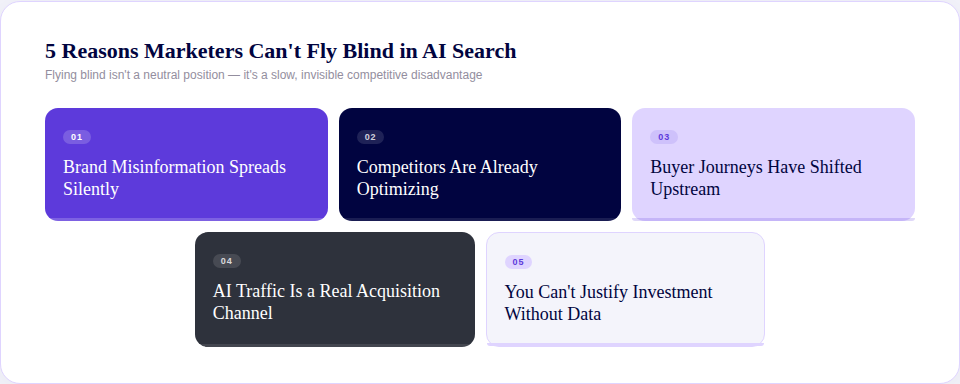
AI models state things confidently, whether or not they're accurate. I've seen tools confidently describe a company's pricing from two years ago, misattribute a feature to the wrong product, and recommend a brand as a "great free option" for a tool that's been paid-only for 18 months. Without monitoring, you have no way to catch this — let alone correct it with updated content that AI crawlers will actually pick up.
The GEO space is moving fast. Dedicated tools like Scrunch and Profound are growing at hundreds of new customers per quarter. If you're not tracking AI citations, someone in your competitive set is studying them right now and building content specifically to displace your brand in the prompts your buyers are using.
Research increasingly starts before a prospect ever visits your site. AI-generated answers are a meaningful part of that invisible pre-purchase journey. If you're measuring success by site traffic alone, you're missing the stage where intent is formed.
AI-referred traffic is growing fast — and it's largely untracked in GA4 without dedicated tooling. Visitors arriving via AI recommendations tend to convert at higher rates than traditional organic search because they've already had their questions answered. Scrunch's GA4 integration was one of the most praised features in independent reviews precisely because it connects AI visibility data to actual business outcomes.
You can't justify GEO or AEO investment to leadership without data. "We should be showing up in ChatGPT" is not a strategy. "We have 12% share of voice in our top 30 comparison prompts versus a competitor's 41%, and here's what we're doing about it" is. Monitoring gives you the before/after to prove ROI and get the budget to act on it.
The bottom line: flying blind in AI search isn't a neutral position. It's a slow, invisible competitive disadvantage.
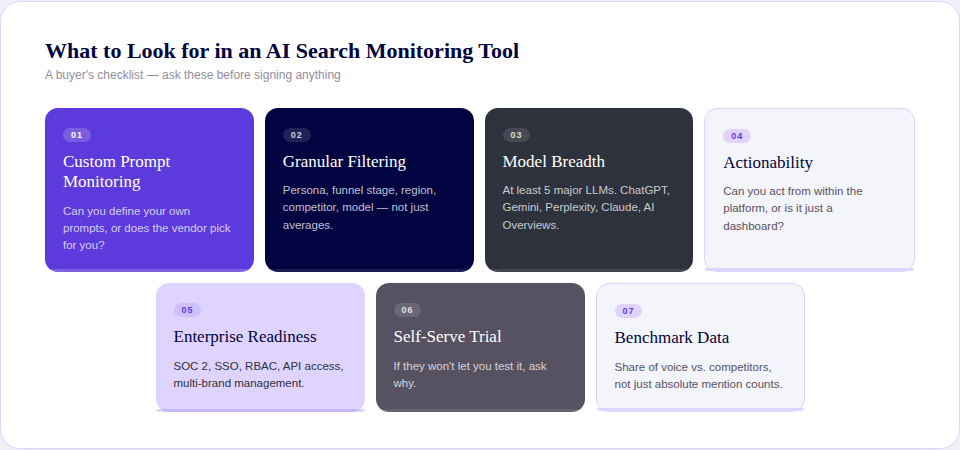
Not all tools in this space are equal. Here's a genuine buyer's checklist — the questions a skeptical buyer should ask before signing anything.
Can you define your own prompts, or does the vendor pick for you? Most vendors auto-suggest prompts based on your website content, which is a fine starting point. But if you can't define a prompt like "best [category] tool for [specific persona]" yourself, you're tracking the vendor's best guess, not your buyers' actual questions. That's a red flag.
Persona, funnel stage, region, competitor, model. Without this kind of filtering, you're looking at averages that hide actionable signal. Knowing your overall mention rate is less useful than knowing you rank well with enterprise buyers but disappear entirely in SMB-focused prompts.
The tool should track at least five major LLMs. Single-model tools give you an incomplete picture. ChatGPT, Gemini, Perplexity, Claude, and Google AI Overviews are table stakes. If a tool doesn't cover most of those, keep looking.
Can you do something from within the platform, or does it just show you a dashboard? Insights-only tools are useful but incomplete. The best tools offer optimization recommendations, content auditing, or direct integration with your tech stack so you can act on what you learn.
If you're at scale, ask directly about SOC 2 compliance, SSO, RBAC, API access, and multi-brand management. These aren't afterthoughts — they're table stakes for any tool touching brand data in a regulated or large-scale environment.
If a vendor won't let you test the product before committing, ask why. The best tools in this space offer trials. A refusal to offer one is worth noting.
How much is your brand actually cited compared to competitors? A tool that gives you an absolute number without competitive context is less valuable than one that shows you your share of voice across the prompts that matter.
One more thing: watch for tools that promise everything in one platform but excel at none of it. In a category this new, specialization tends to win. Know whether you need monitoring depth, content workflow, or both — and buy accordingly.
Not all tools in this space are equal. Here's an honest breakdown of what's worth your attention — including the tradeoffs most roundups won't mention.
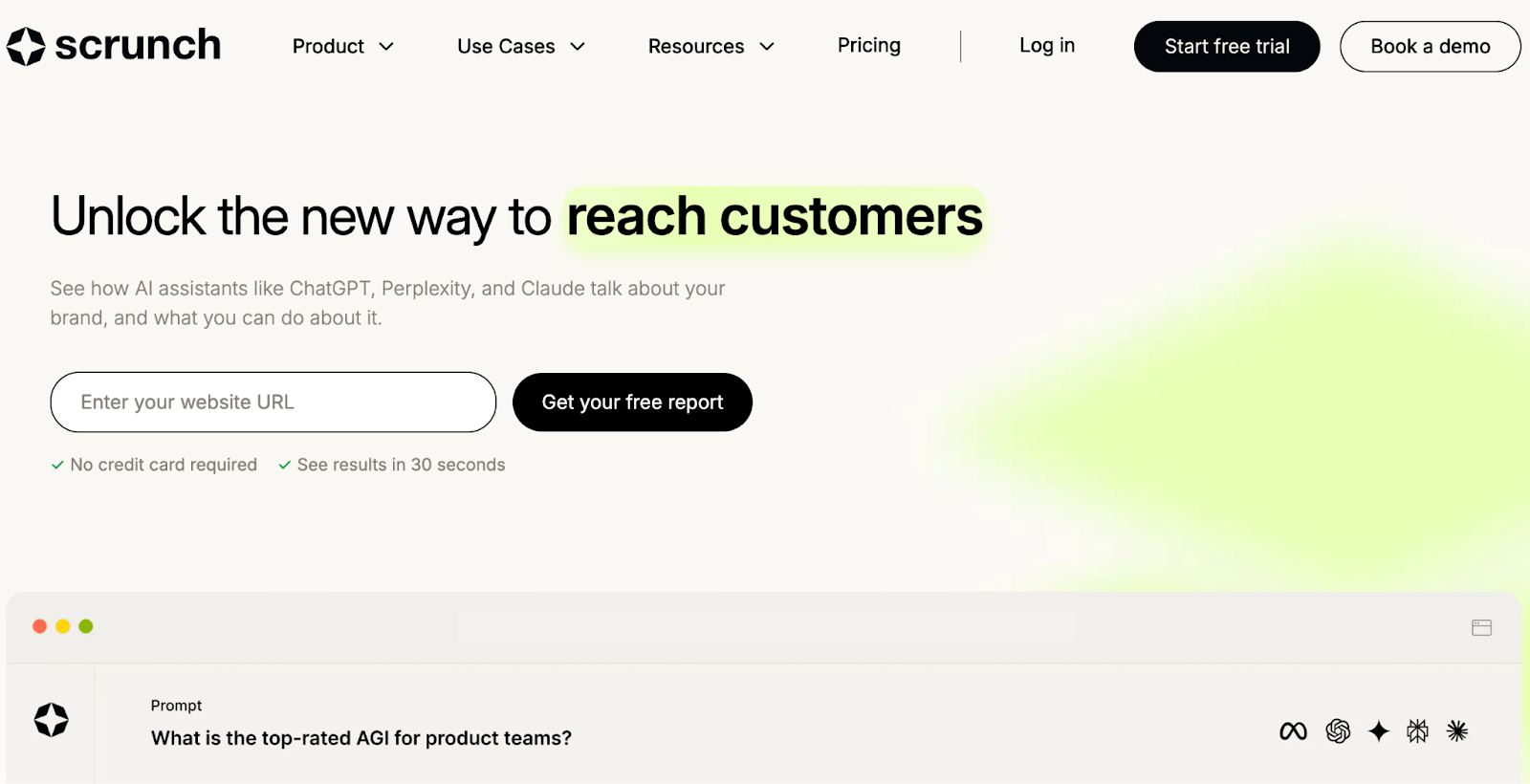
What makes Scrunch genuinely different from most tools in this space is that it was built AI-first from the ground up — not an SEO tool with an AI layer bolted on. That architectural decision shows up in the product in meaningful ways.
The monitoring is comprehensive: Scrunch tracks seven or more major AI platforms including ChatGPT, Claude, Perplexity, Gemini, Google AI Overviews, Meta AI, and Google AI Mode — the broadest coverage of any tool I looked at. You can filter by persona, topic, funnel stage, geography, and competitor, which means you're not looking at aggregate visibility scores. You're seeing where you specifically win and lose by context.
The GA4 integration is a standout. Independent reviewers consistently highlighted it as one of the more practical features in the platform, because it connects AI citation data to real traffic and conversion behavior — the missing link most teams are trying to cobble together manually.
Two differentiators worth noting: the customizable dimensions system lets you organize and track prompts across the categories that matter to your business, not just generic vendor-predefined ones. And AXP (Agent Experience Platform) is designed to create a machine-readable layer of your site specifically for AI agents and crawlers, moving from monitoring toward active optimization. It's in limited rollout as of early 2026, but the concept points in the right direction.
Honest downside: no free trial, $300/month starting price, and AXP isn't yet accessible to most customers. This is a tool for teams that are serious about AI visibility and willing to invest. But for mid-market to enterprise marketing teams and agencies that want depth, configurability, and control, Scrunch is the most complete monitoring platform I tested.
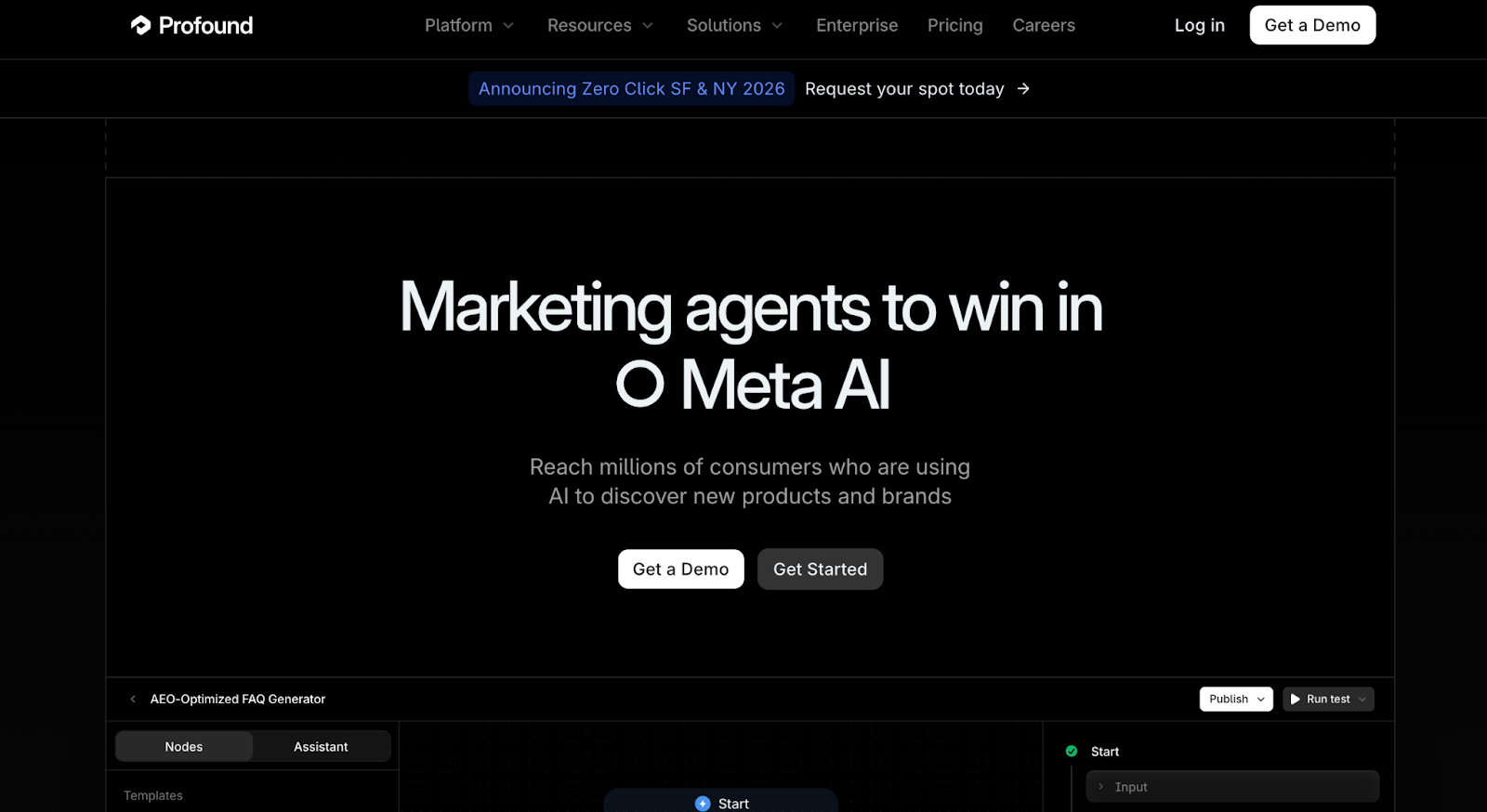
Profound is one of the earliest players in this space, having raised $58.5 million across seed, Series A (Kleiner Perkins, NVIDIA), and a $35 million Series B (Sequoia). The platform combines monitoring with AI content generation in one place. The Conversation Explorer by Profound surfaces real-time AI search volume data across platforms. Shopping data tracking makes it relevant for e-commerce brands. SOC 2 Type II and HIPAA compliant.
Best for: Large enterprise teams where AI visibility is a boardroom priority and the goal is closing the loop between monitoring data and content action without stitching tools together.
Considerations: The Starter plan ($99/month) only tracks ChatGPT. Growth ($399/month) adds Perplexity and Google AI Overviews. Full access to 10+ engines requires the custom Enterprise tier. No free trial.
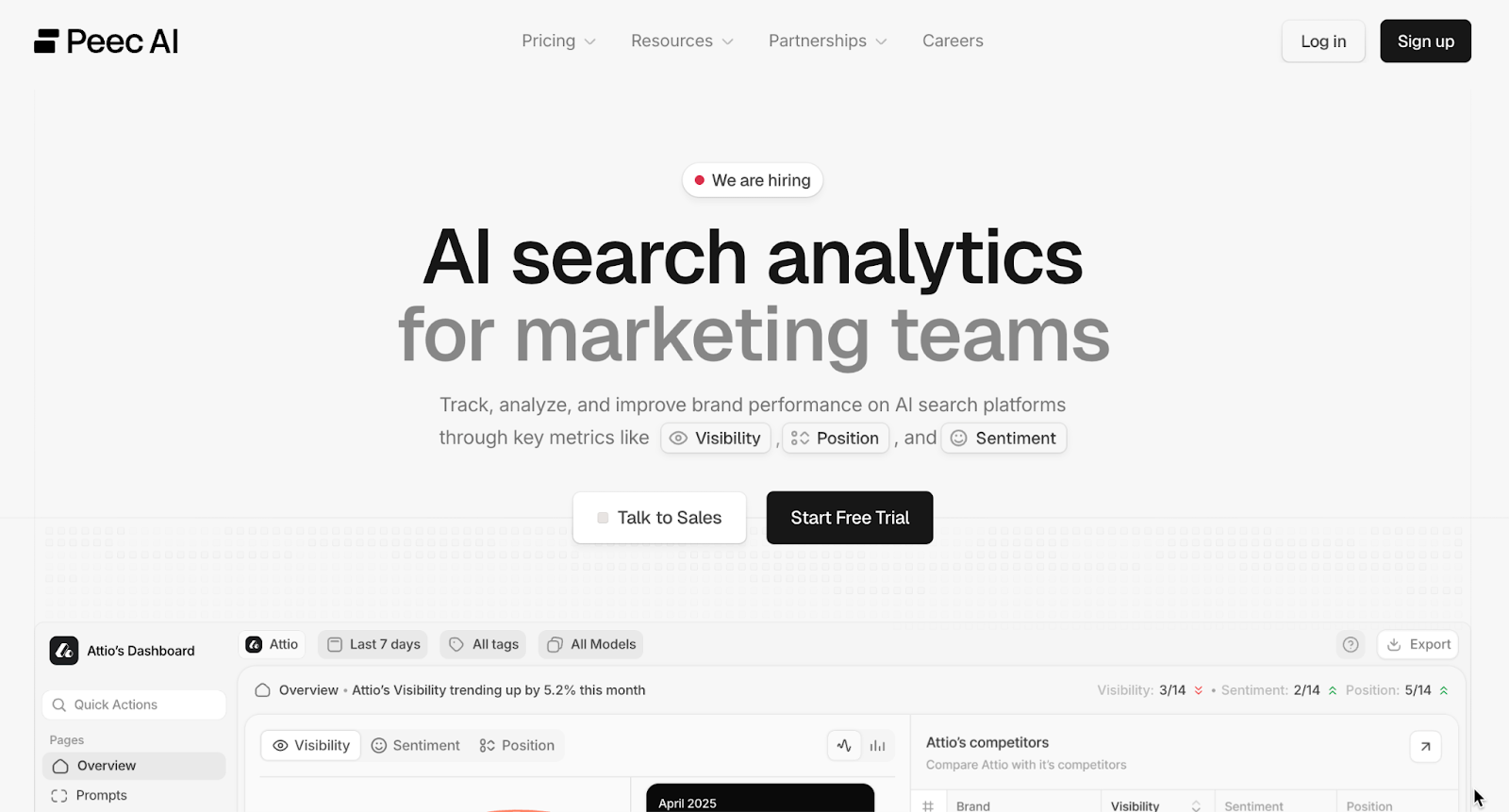
Peec launched in early 2025, reached €650K ARR in four months, and raised €7 million within five months from investors including 20VC and Antler. Pricing starts at €89/month with a 14-day trial. Tracks ChatGPT, Perplexity, and Google AI Overviews by default; Claude, Gemini, DeepSeek, Grok, and others available as add-ons at €20–30/month each. Unlimited seats across all plans. The Suggested Prompts feature scans your site and auto-generates tracking prompts to reduce setup time.
Best for: Smaller teams and solo marketers who want to establish AI visibility tracking quickly without an enterprise contract.
Considerations: Primarily a monitoring platform — no content generation, technical fix suggestions, or implementation. The Actions feature was in beta as of early 2026. Limited public documentation on SOC 2 and API access.
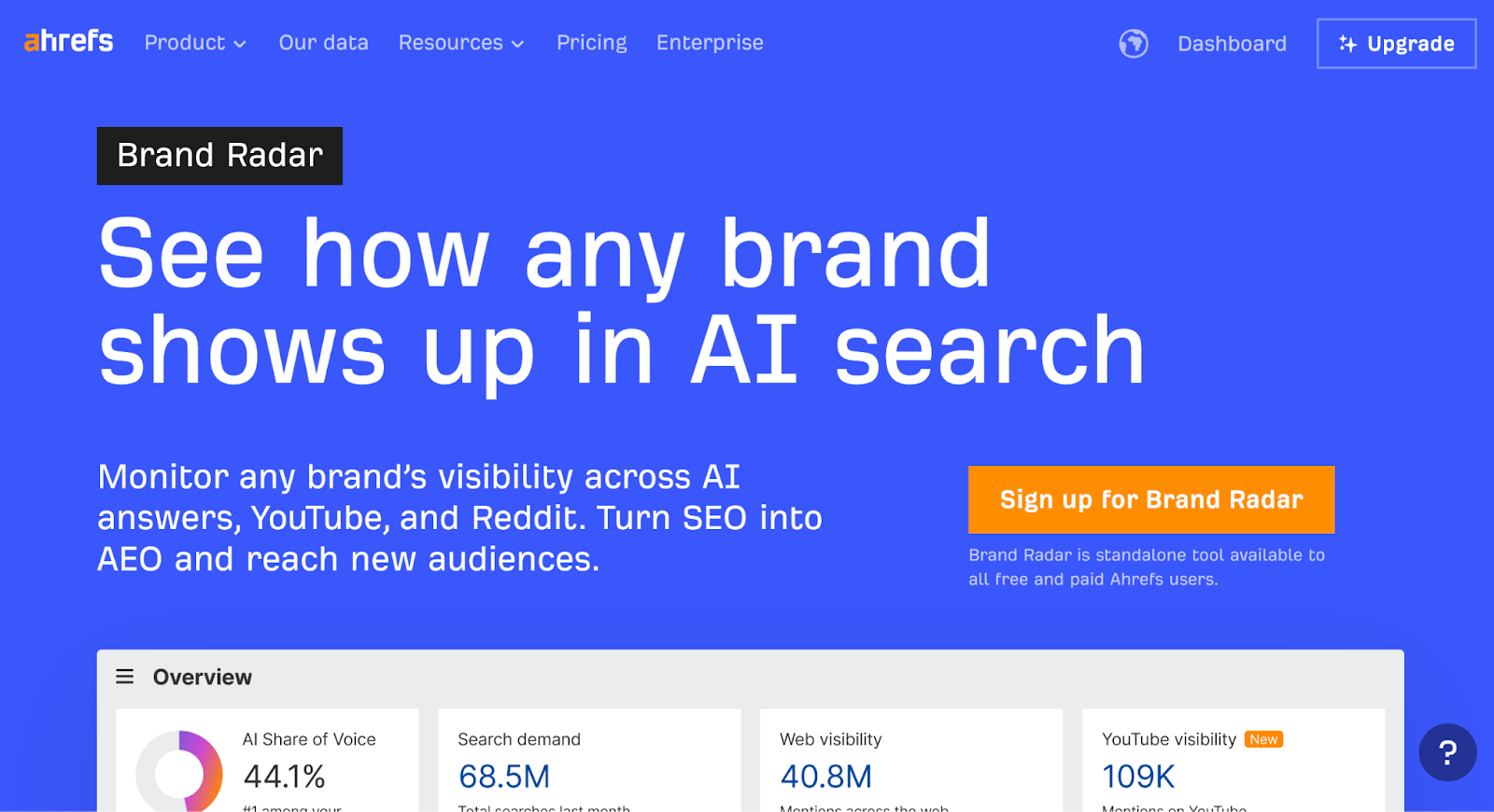
Brand Radar draws from 199 million+ search-backed prompts across six AI platforms: ChatGPT, Perplexity, Gemini, Copilot, Google AI Overviews, and AI Mode. Zero setup required — research any brand or competitor immediately. Beta tracking for YouTube, Reddit, and TikTok brand mentions is included. If you're already on an Ahrefs plan, beta indexes are included at no extra cost.
Best for: Teams already invested in Ahrefs who want directional AI visibility data alongside existing SEO metrics without adding a separate tool.
Considerations: Functions as a research database rather than a live tracking tool — uses timed snapshots against a static prompt library, not real-time monitoring. Does not track Claude or Grok. Custom prompt tracking costs an extra $50/month. Full bundle runs $828+/month ($699 for all six AI indexes plus base Ahrefs plan from $129/month).
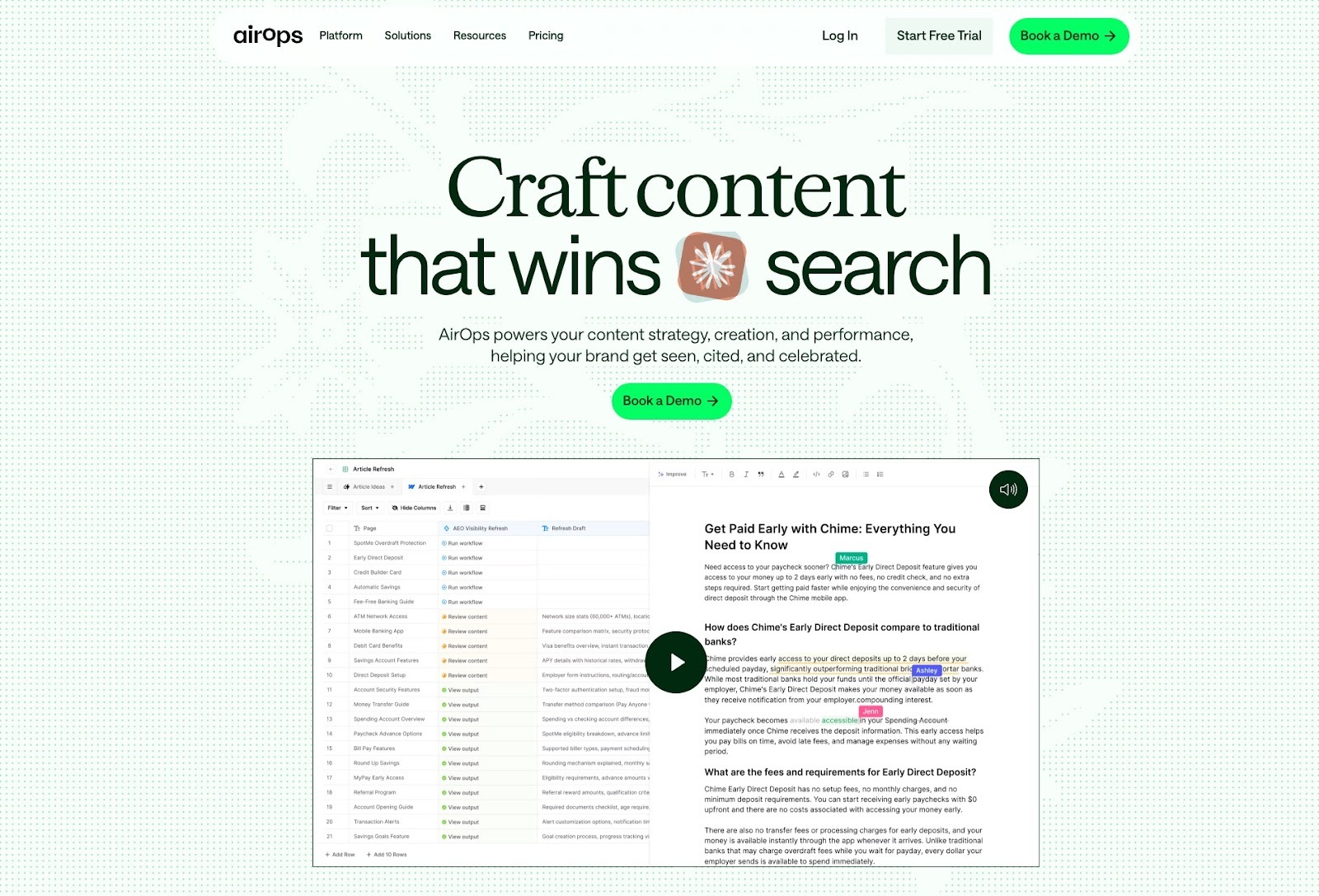
AirOps raised a $40 million Series B. Its core product is a no-code workflow builder for content operations, with direct CMS integrations for WordPress, Webflow, and Shopify. Brand Kits maintain voice consistency across AI-generated content. Human-in-the-loop checkpoints prevent unpproved publishing. Webflow reported 5x faster content refresh cycles. AI Search Visibility Insights is available on paid plans, but monitoring is secondary to the platform's core function.
Best for: Teams that already have a content strategy and need to execute it at speed and scale.
Considerations: Not primarily built for monitoring — if visibility data is your main need, this isn't the right starting point. Pricing for tiers that include AI search features requires contacting sales.
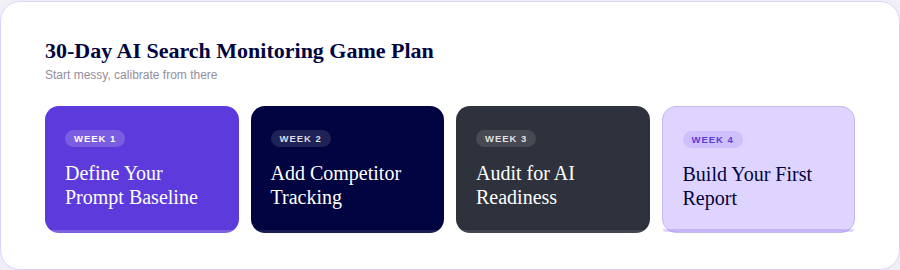
The biggest mistake teams make with AI monitoring is waiting until they have a perfect setup before starting. Start messy, and calibrate from there.
Write down 10-15 prompts your ideal buyer might type into ChatGPT. Think by persona, funnel stage, and use case. "Best [category] tool for [specific situation]" prompts are more useful than generic brand queries. Establish your baseline brand presence across at least three major models.
Once you know where you stand, add your top three competitors. Where do they outrank you? In which prompts are they winning and you're invisible? That gap analysis is your content brief.
AI crawlers consume content differently from Google. Look for pages with thin content, poor structure, or missing schema markup. Which pages are being cited in AI responses, and which aren't being picked up at all? Tools with site audit features — like Scrunch's Insights functionality — earn their keep here.
Compile your share of voice data, citation sources, and sentiment trend for your brand across models. Present to leadership with a before/after framing: here's where we are, here's where we need to be, and here's what we're doing about it. That's your budget justification.
If you're a small team getting oriented, Peec's self-serve trial is the lowest-friction starting point. If you're a mid-market or enterprise team that needs configurability and enterprise readiness from day one, Scrunch is worth the investment.
AI search is real, growing fast, and largely untracked for most marketing teams. The brands winning in AI-generated responses right now started paying attention early — not because they had bigger budgets, but because they had better data.
Your customers asked ChatGPT about your industry last week. Your competitors are either monitoring that already or will be soon. The cost of waiting isn't a subscription fee. It's invisible market share loss you'll only measure in hindsight.
This isn't about chasing a trend. It's about having the data to make smarter decisions in a landscape that has already changed. Pick a tool, establish your baseline, and start from there.
AI monitoring tells you where and how your brand appears in AI-generated responses across tools like ChatGPT, Perplexity, and Gemini. The core benefits are catching brand misinformation before it spreads, tracking competitive share of voice in AI answers, connecting AI visibility to actual traffic and conversion data, and building the measurement foundation needed to justify GEO investment to leadership.
Traditional SEO tools track keyword rankings and page performance in Google. They don't show you whether your brand is being cited, recommended, or misrepresented in AI-generated responses. AI monitoring tools fill that gap. As AI search continues to absorb a larger share of the research journey — especially in B2B and high-consideration purchases — the ability to track and optimize for AI citations is becoming a core marketing capability, not a nice-to-have.
The best tool depends on your use case. For mid-market to enterprise teams wanting the most comprehensive monitoring and configurability, Scrunch leads the field. For enterprise teams that also want AI content generation in one platform, Profound is worth evaluating. For SMBs and individuals starting out, Peec AI offers the most accessible entry point with a self-serve trial. If you're already in the Ahrefs ecosystem, Brand Radar gives you directional AI visibility data without adding a separate tool. And if your primary need is scaling content production with AI workflows, AirOps is built for that job.

Irina is a Founder at ONSAAS, Growth Lead at Aura, and a SaaS marketing consultant. She helps companies to grow their revenue with SEO and inbound marketing. In her spare time, Irina entertains her cat Persie and collects airline miles.
.svg)
.svg)
.svg)
.svg)
.svg)