Most SEO guides for SaaS startups assume you have a content team, a domain with three years of authority behind it, and the patience to publish 20 blog posts before anyone notices you exist. But if you're reading a guide like this at month two of a SaaS product with a new team and real revenue pressure, that advice isn't just unhelpful — it can actively set you back.
This guide takes a different approach. It's structured sequentially — channel fit first, tactics second. Before we talk about keywords and content, we'll establish whether SEO is even the right bet for where you are right now.
The reflex when starting SEO is to open Ahrefs or Semrush and search for terms in your category. This produces a list of keywords with volume attached, and the volume numbers make some options feel obviously better than others. The problem is that volume is a metric about the size of the audience searching, not the size of the audience that will ever buy from you.
Start instead from your ideal customer profile. Who has the problem your product solves? What does that problem feel like when they're living it? What would they type into Google when the pain becomes acute enough to act?
A keyword searched 400 times per month by your exact ICP is more valuable than a keyword searched 10,000 times per month by people who will never convert.
When building authority, the goal is to start with the keywords most relevant to your business and closest to how buyers actually search when they have the problem. This doesn't always mean BOFU sales-focused content first — it means relevance first, volume second.
Some SaaS startups are creating new categories. If no one is searching for your product type yet, you have a demand creation problem, not a demand capture problem. SEO won't solve this on its own.
Build content around the underlying problem — the pain that exists before your category name does — and establish your authority there. When the category matures and the search volume emerges, you'll already own the territory.
The highest-converting keywords in most SaaS businesses are ones that volume tools never flag. The best source is your own sales and customer success conversations.
Ask: what triggered the search? What did they Google first? What competitors came up in their research? The answers to those questions will surface intent signals that no tool can replicate, because they come directly from the people who already bought.
Traditional keyword research remains the foundation of SaaS SEO. That's not changing. What's changing is that it no longer tells the full story of how buyers find solutions.
The two disciplines are complementary, not competing. Keyword research and content authority are what AI engines draw from. But without tracking how AI represents your brand, you have no visibility into an increasingly important channel. This is where Answer Engine Optimization (AEO) becomes a practical discipline, not just a buzzword.
The more useful approach is to group related prompts into clusters by intent, funnel stage, or product area. "What's the best CRM for early-stage startups," "CRM tools with a free tier," and "sales software for small teams" might be three prompts in one cluster. What matters is the directional aggregate: is your brand showing up across this cluster or not, and is that share trending up or down?
This is the kind of structured prompt monitoring that Seen builds for SaaS clients — unified AI visibility rather than point-in-time snapshots.
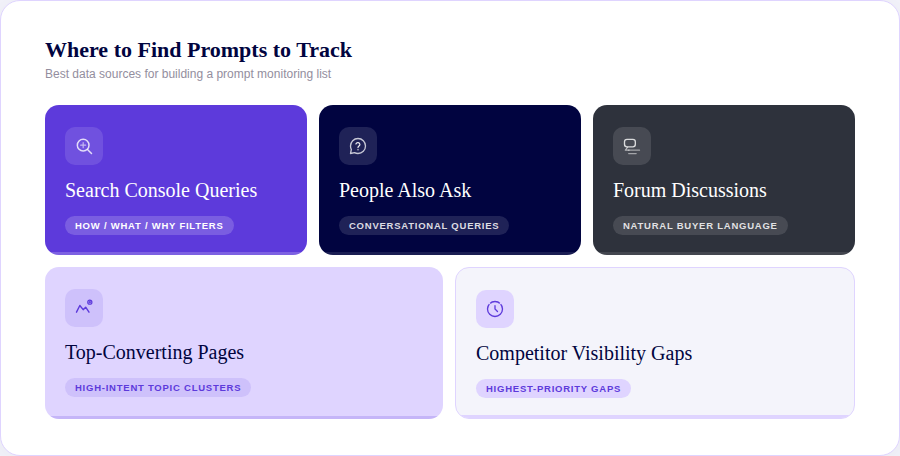
The best data sources for building a prompt monitoring list:
Once you have a list of traditional search queries, pass them through an LLM with a simple instruction: convert each into how a user might phrase this as a conversational question to an AI assistant. This surfaces the prompt variants worth monitoring.
AI engines don't always get it right. They pull from indexed content, third-party sources, and training data that may be months old. It's entirely possible that ChatGPT is describing your pricing incorrectly, attributing features you don't have, or positioning you against the wrong competitors.
Audit this systematically. Ask ChatGPT, Perplexity, and Gemini about your product directly. Ask them to compare you to competitors. Ask them who your product is for.
When responses are wrong or outdated, you can do one of two things:
Prompt tracking is only useful if it drives decisions. The actions that matter:
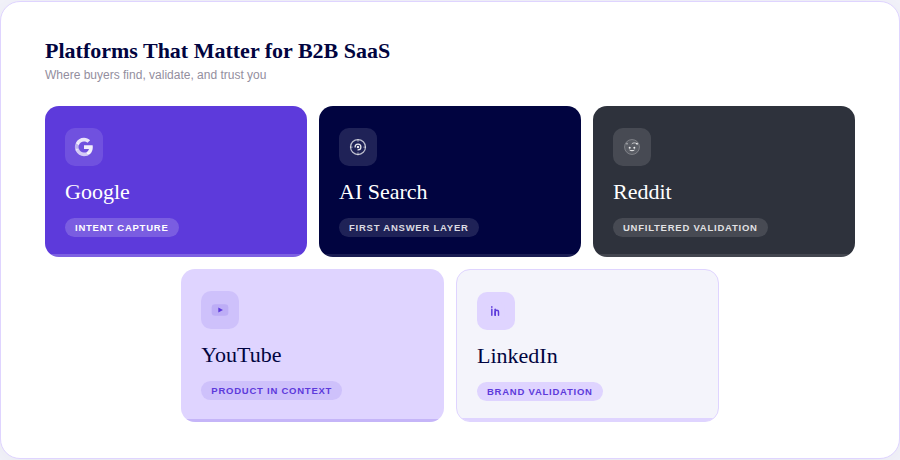
The modern buyer journey is no longer a straight line from search query to product page.
A potential customer might encounter your brand when ChatGPT recommends it in response to a question about their problem. They validate it on Reddit, where someone in their industry has mentioned it in a genuine discussion thread. They watch a YouTube comparison video. They search your brand name on LinkedIn to understand who's behind it. Only then do they Google you directly before converting.
The surfaces that matter:
Startups don't need to be everywhere. They need to be present where their specific buyer validates decisions.
Search Everywhere Optimization isn't a departure from SEO — it's an extension of it.
The content authority you build through traditional keyword research, link building, and technical SEO is the same foundation that AI engines and social platforms draw from when deciding who to feature.
Build the foundation right, and the downstream visibility compounds. Seen works specifically on this unified visibility layer for SaaS startups — connecting traditional SEO performance to AI search presence so nothing falls through the gap.
The content you publish first should not be the content that's hardest to rank. It should be the content that's closest to a conversion and most achievable given where you're starting.
Start with topic-first, problem-and-solution content that builds authority around the problems your product solves. This isn't product-first content — it's problem-first content that naturally features your product as the solution. The goal is to establish relevance for your core topic area before anything else.
Tip: Before adding more content, make sure what you have is technically sound and properly connected. No orphaned pages. Every post should link to at least one product or solution page, and product pages should link back into relevant content.
These pages are less contested, carry high buyer intent, and are achievable to rank for even at low domain authority. A well-built "[Your tool] vs [Competitor]" page does several things at once: it captures decision-stage search traffic, it pre-answers objections buyers are already researching, and it positions your product against the most relevant frame of reference.
Tip: Don’t write these pages as if the competitor is irrelevant or obviously worse. Buyers can smell bias immediately. Good comparison pages acknowledge strengths honestly and win on specificity.
Vertical or role-specific targeting. These pages have lower volume than category-level keywords, but they convert at higher rates and are far more achievable to rank for early. "Contract management software for freelance designers" is a real example of a keyword that a new SaaS could own, while "contract management software" is firmly controlled by established players.
Tip: Focus on specificity and real buyer scenarios — include concrete job roles, industries, or workflows in your copy, headings, and meta tags to signal relevance and boost conversion potential.
Informational top-of-funnel content — "what is X," "how does X work" — has been largely displaced by AI Overviews, ChatGPT, and Perplexity. These queries now get answered directly in the interface, eliminating the click-through that made TOFU content valuable. Building content around "what is CRM software" in 2025 is building traffic for an AI to absorb.
Tip: MOFU and BOFU content is where the investment should go. Comparison pages, alternative pages, use-case content, and "is X worth it for Y company type" pieces capture high-intent, decision-stage queries where AI recommends sources rather than replacing them — and where clicks still convert.
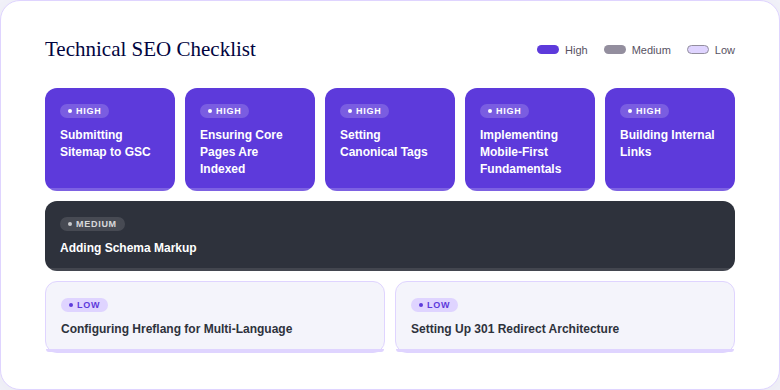
At the startup stage, technical SEO doesn’t need to be overwhelming. Many early-stage SaaS sites spend time on advanced optimizations that have minimal impact on rankings. The key is to focus on the fundamentals that ensure your site is crawlable, indexable, and mobile-friendly, while deprioritizing tasks that don’t deliver immediate value.
Focusing on these core technical elements ensures your site is ready for SEO without wasting resources on low-impact tasks.
Effective link building at the startup stage focuses on building authority without wasting time on low-impact tactics.
Start with what compounds naturally — internal links, brand presence, and high-value assets — before chasing links that are expensive, risky, or irrelevant.
To understand whether your SEO investment is on track, focus on leading indicators before pipeline revenue appears. Metrics should evolve as your startup moves from foundation-building to measurable pipeline impact.
Mind that SEO for SaaS startups is a compounding channel: expect meaningful pipeline contribution only after 6–12 months, with the first few months mostly focused on building foundations.
Track these metrics as leading indicators of success. They show that your SEO strategy is gaining traction before revenue appears, helping leadership understand progress and set realistic expectations.
Show indexed page growth, ranking movement on target terms, and impression growth on commercial pages — and connect each data point to future output. "We moved from position 31 to position 14 on our primary comparison keyword — at position 10, this page is projected to drive 80 to 120 additional monthly visits" is a forward-looking frame that turns a lagging metric into a leading one.
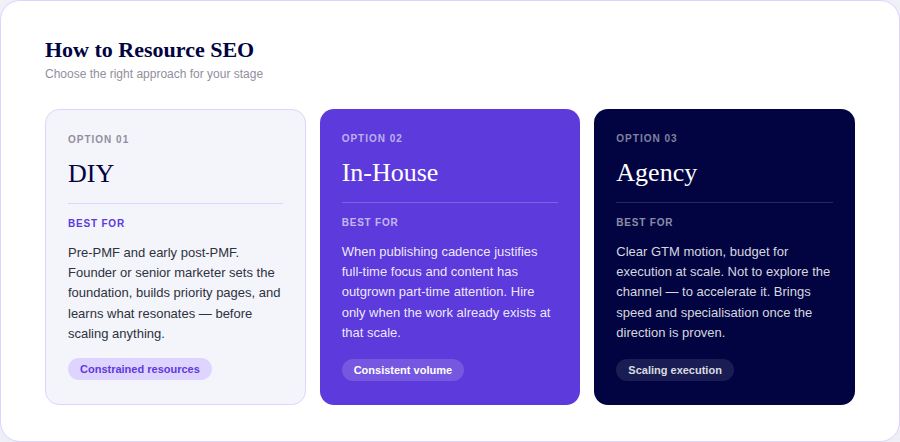
Deciding how to resource SEO early on can save time, money, and frustration—choosing the right approach depends on your stage and priorities.
For SaaS startups specifically, the agency needs to understand both traditional SEO and AI search visibility, since that's where a growing share of B2B discovery now happens.
Seen is built for exactly this: it works with SaaS teams — including YC-backed startups — to build visibility across Google and LLMs, and embeds as a team extension rather than a vendor.
Even small mistakes at the startup stage can be costly. Here are the six biggest SEO missteps we see SaaS founders make — and how to avoid them.
Avoid these pitfalls, and your SEO efforts will have the runway to grow and compound successfully.
Most SaaS SEO guides assume established teams and authority — not startups with limited time and resources. Winning startups focus on what they can realistically rank for, sequence their efforts wisely, and show up wherever their buyers are searching, not just on Google.
For startups looking for tailored guidance, Seen offers help to build organic and AI search strategies.
After product-market fit. Before PMF, you don't have stable ICP clarity or validated messaging — both of which are prerequisites for effective keyword strategy. The earliest reasonable starting point is when you can clearly articulate who your buyer is, what problem they have, and how your product solves it differently from alternatives.
Six to twelve months to meaningful pipeline contribution is the honest answer. The first three to four months are foundation-building. Months four to six produce ranking movement on lower-competition terms. Months six to nine begin generating organic-attributed signups. Month nine onward is where organic starts showing up as a real number in pipeline reporting.
Problem-and-solution content that builds authority around your core topic area, followed quickly by comparison and alternative pages. Not educational top-of-funnel content. The instinct to start with "what is X" content sounds right but produces content in the most competitive, least achievable space for a new domain.
Yes, but in the right sequence. Internal linking comes first — it costs nothing, requires no outreach, and compounds immediately. Brand mentions (even unlinked) matter significantly in the AEO era. Linkable assets like original research and free tools come next. Proactive outreach, done strategically, follows. What to avoid entirely: paid link schemes, PBNs, and mass outreach services.
Months one to four: indexed page count for core commercial pages, crawl frequency signals in Google Search Console, and ranking position movement on BOFU and comparison pages. Months four to six: impression growth on commercial pages and share of voice against named competitors on target keyword sets. Revenue attribution is a month-nine-plus metric — don't expect it sooner, and make sure leadership doesn't either.
.webp)
With 10 years of writing experience and a deep interest in SEO, AI, and content management, Anna’s here to break down big ideas and translate them into plain English for readers of all levels. She's got a Master's Degree in International Information and is a lifelong learner of writing and storytelling. Outside of work, she’s on the yoga mat, in a good book, or planning her next adventure with family and friends.
.svg)
.svg)
.svg)

.svg)
%20(1).svg)
%20(3).svg)
.svg)
.svg)