Search rankings tell you where your page sits in a list. They don't tell you whether ChatGPT recommends your product, whether Perplexity cites your blog, or whether Gemini describes your brand the way you'd describe it yourself. There's no Search Console for AI answers — no official dashboard, no position data, no impression counts.
Most brands are flying blind in AI search. They don't know if they're being recommended, ignored, or misrepresented in the answers their buyers are reading. This guide ranks 7 LLM visibility tools by engine coverage, data depth, pricing, and whether they help you optimize or just report. The right pick depends on your budget, team setup, and how far you need to go beyond monitoring.

LLM visibility is how often and how favorably your brand appears in AI-generated answers across platforms like ChatGPT, Gemini, Claude, and Perplexity.
It's a different problem from SEO. When someone searches Google, your page either ranks or it doesn't. When someone asks ChatGPT the same question, the model synthesizes an answer that may or may not reference your brand — with no official record of it either way. No clicks, no impressions, no position data. The only way to know what AI engines are saying about you is to ask them — repeatedly, systematically, across the prompts your buyers actually use.
That's what LLM visibility tools do. They run large volumes of simulated prompts, capture responses, and build a picture of how your brand appears across AI engines over time. The discipline of improving that picture is called GEO — Generative Engine Optimization — and these tools are its measurement layer.

Knowing you have an LLM visibility gap is useful. Knowing exactly where and why is what makes the data actionable.
Quantifies how often your brand appears in AI answers relative to competitors across a defined set of prompts. It's the starting benchmark — before you can improve anything, you need to know where you stand.
Goes one level deeper. It shows which of your pages AI engines cite when they mention you, and which third-party sources they pull from when generating answers about your category. That second layer matters: if AI consistently cites a competitor's review platform, a specific industry publication, or a Reddit thread you're not part of, you now have a content and distribution priority.
Captures how AI describes your brand, not just whether it mentions you. A tool that appears in AI answers but is consistently framed as expensive, complex, or suitable only for large teams has a different problem than a tool that doesn't appear at all.
Where the data starts driving decisions. Every prompt where a competitor appears and you don't is a content gap, a distribution gap, or a structural problem on a page AI can't extract cleanly. The best tools surface these gaps with enough context to act on them.
Connects AI visibility to downstream traffic and pipeline where tools support GA4 integration. It's still an emerging capability, but it's the layer that makes LLM visibility a boardroom metric rather than an SEO team metric.
Four criteria shaped the ranking.

Tracking ChatGPT and ignoring Perplexity, Gemini, and AI Overviews gives you a partial picture at best. We weighted tools that cover the engines your buyers actually use, not just the ones that are easiest to integrate.
Surface-level mention tracking tells you whether you appeared. Citation analysis tells you which pages, which sources, and which third-party domains are shaping the answer. The difference between those two outputs is the difference between a dashboard and a strategy.
Several tools in this category require a sales conversation before you can see a number. We've used verified public pricing throughout and flagged anything that requires a quote.
Some tools report what's happening. Others tell you what to do about it. We've noted which is which — because a team that needs a to-do list and a team that needs a dashboard are making different buying decisions.
One thing worth knowing before comparing tools: share-of-voice data is not standardized across this category. Tools that run more prompts, more frequently, using simulated browser behavior rather than API calls, tend to produce more representative results. That methodology difference doesn't show up in pricing or feature lists — but it materially affects how much you can rely on the numbers.

Scrunch starts where most visibility tools stop. Other platforms tell you your brand appeared in 34% of tracked prompts last week. Scrunch tells you which pages AI crawlers couldn't parse, which sources are driving competitor citations in your category, and what to change about your content and site structure to close those gaps.
The Agent Experience Platform (AXP) is the feature that sets it apart from every other tool on this list. It sits at the CDN layer and serves AI crawlers a clean, structured version of your content automatically — no developer involvement, no page changes. It's the difference between hoping AI can read your site and knowing it can.
Site Maps gives you per-page crawler accessibility scores with a prioritized fix list. Insights maps content gaps to specific prompts where you're losing ground. Together they make Scrunch the only tool here that covers tracking, optimization, and technical crawler health as a single integrated workflow.
ChatGPT, Perplexity, Google AIO, and Copilot on Core; Claude, Gemini, Meta AI, Google AI Mode, and Grok added on Enterprise.
Yes, with source attribution and competitor gap analysis included.
Yes, with persona-based filtering available on Enterprise.
Core $250/mo (125 prompts, 4 engines, 1 workspace, 5 users, 5 site audits/mo); Enterprise custom. 7-day free trial on Core.
Enterprise brands and technical SEO teams that need to move from tracking to fixing, not just reporting.
If your primary need is prompt monitoring at high volume — Core's 125 prompts fill quickly for large prompt sets, and Enterprise pricing is a significant step up.
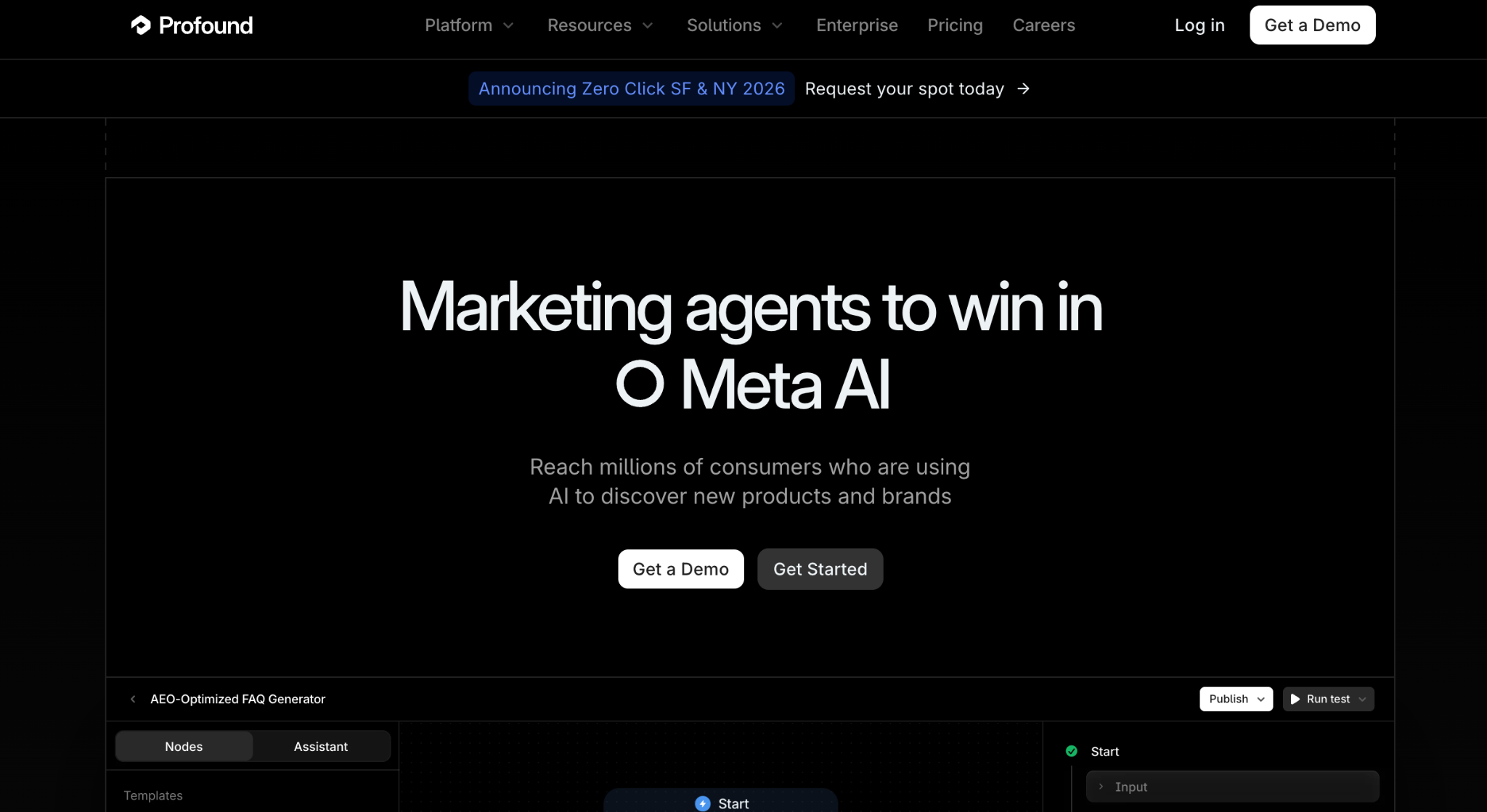
Profound is built for teams that need to understand it at scale before they act. Processing over a billion citations and ten million prompts daily, it operates at a data depth that other tools in this category don't come close to.
The Conversation Explorer is the standout feature: it estimates the volume of AI conversations happening around specific topics in your category, giving you a sense of opportunity size before you decide where to focus. That's different from tracking whether you appeared in a set of prompts you defined — it surfaces the conversations you didn't know to ask about.
Shopping Intelligence adds a layer most competitors don't have: tracking how AI engines handle product recommendations and buying-intent queries. For brands where consideration and purchase happen in AI-assisted research sessions, that's the data that connects visibility to revenue.
ChatGPT on Starter; ChatGPT, Perplexity, and AI Overviews on Growth; up to 9 on Enterprise.
Yes, your URLs and third-party sources included.
Yes, with narrative tracking included.
Starter $99/mo (ChatGPT only, 50 prompts); Growth $399/mo (3 engines, 100 prompts); Enterprise custom.
Enterprise and dedicated GEO teams that need the largest dataset and the most granular analytics available.
If you're expecting the $99 Starter to give you multi-engine coverage — it's a single-engine entry point, not a full platform trial.
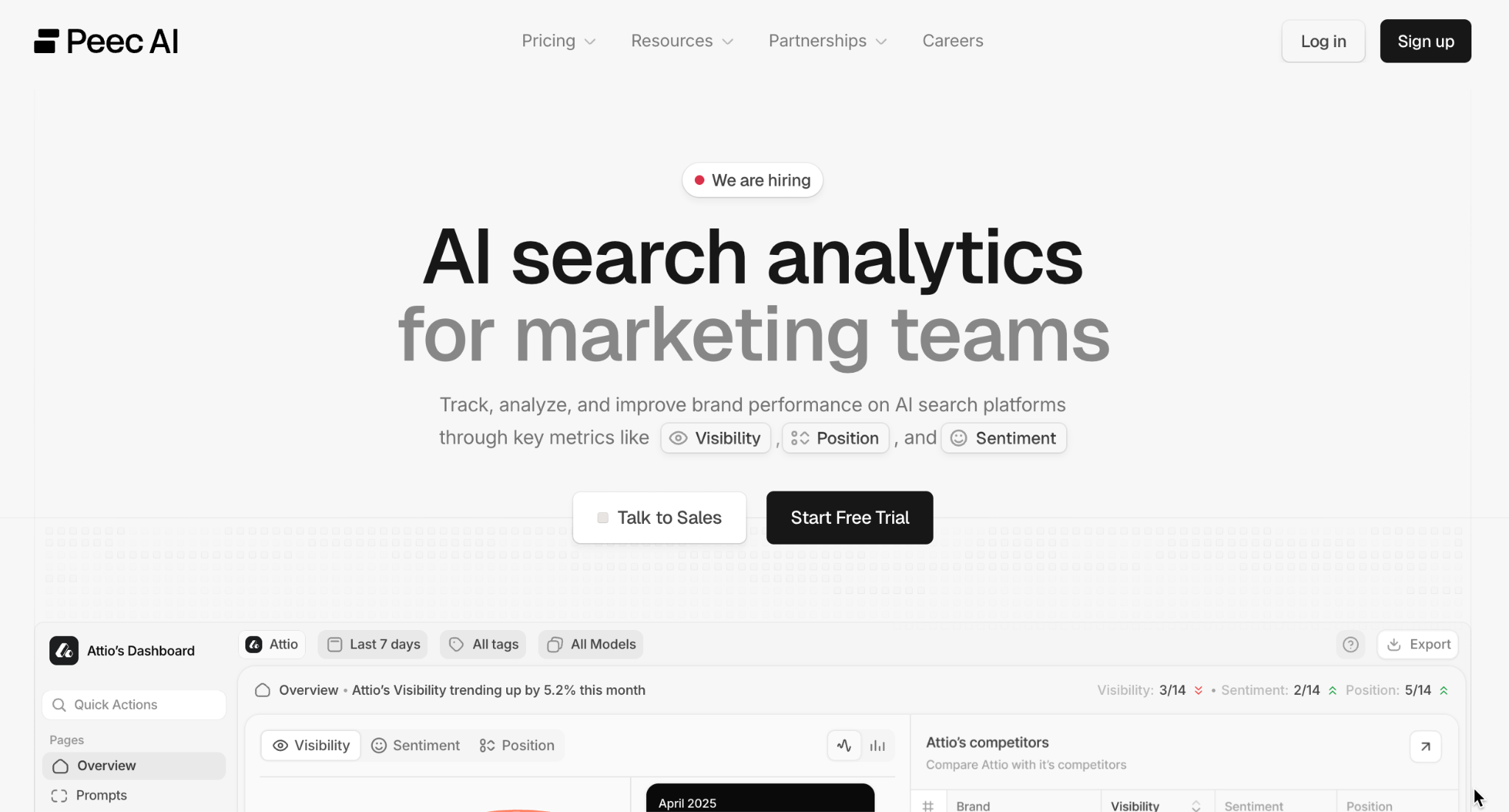
Most tools in this category bundle you into a fixed set of engines at each pricing tier. Peec does it differently: you choose which three of six available engines to track on the entry plan, and add more individually as needed. For brands whose buyers are concentrated on specific platforms, that flexibility avoids paying for coverage that doesn't matter to your audience.
Sentiment tracking is one of Peec's most consistently praised capabilities. It doesn't just log whether you appeared — it tracks how you were framed, whether AI positioned your brand as a value option, an enterprise pick, or an also-ran, and whether that framing is trending warmer or cooler week to week. Multiple independent reviewers rate it as the most credible sentiment implementation in the category. Peec also queries AI platforms by simulating real browser sessions rather than API calls, which means the data reflects what actual users see.
Choose 3 of 6 on entry: ChatGPT, Perplexity, Gemini, AI Mode, AI Overviews, Copilot. Grok available as a paid add-on from $35/mo.
Yes, with multi-layered citation decoding and entity checks. Source view shows exact domains and URLs AI cites, categorized by type.
Yes — positive, neutral, and negative framing tracked alongside raw mention counts. Sentiment trends tracked over time and against competitors.
Starter $95/mo (50 prompts, 3 engines); Pro $245/mo; Advanced $495/mo; Enterprise custom. Additional engines from $35/mo add-on.
Growing brands and analytically minded teams that want engine flexibility, clean UX, and citation depth without enterprise pricing.
No historical data backfill — tracking starts from signup, so you can't look back at last quarter. Also worth noting: full multi-engine coverage across all 6 platforms gets expensive fast with per-engine add-on pricing.

Otterly's GEO Audit is what separates it from the monitoring-only tools in this category. While most platforms surface where you're invisible, Otterly runs a 25+ factor audit covering schema, crawl accessibility, and page structure, then outputs a prioritized fix list. That shifts it from a reporting tool into something closer to a diagnostic and action tool — which is exactly what agencies need when they're billing clients on deliverables, not dashboards.
Daily automated prompt checks keep data fresh without manual intervention. The Semrush App Center integration is a practical advantage for agencies already running client SEO in Semrush — no separate login, no separate report to reconcile.
ChatGPT, Google AI Overviews, Perplexity, Copilot on all plans; Gemini from $9/mo add-on; Google AI Mode from $9/mo add-on.
Yes, with link citation analysis included.
Yes, with narrative consistency tracking included across all plans.
Lite $25/mo (15 prompts); Standard $160/mo (100 prompts); Premium $422/mo (400 prompts). Free trial available.
SEO agencies and specialists who need prioritized optimization guidance to deliver to clients, not just visibility reports.
The Lite plan's 15 prompts are enough for initial exploration but not for serious client monitoring — budget for Standard from the start.
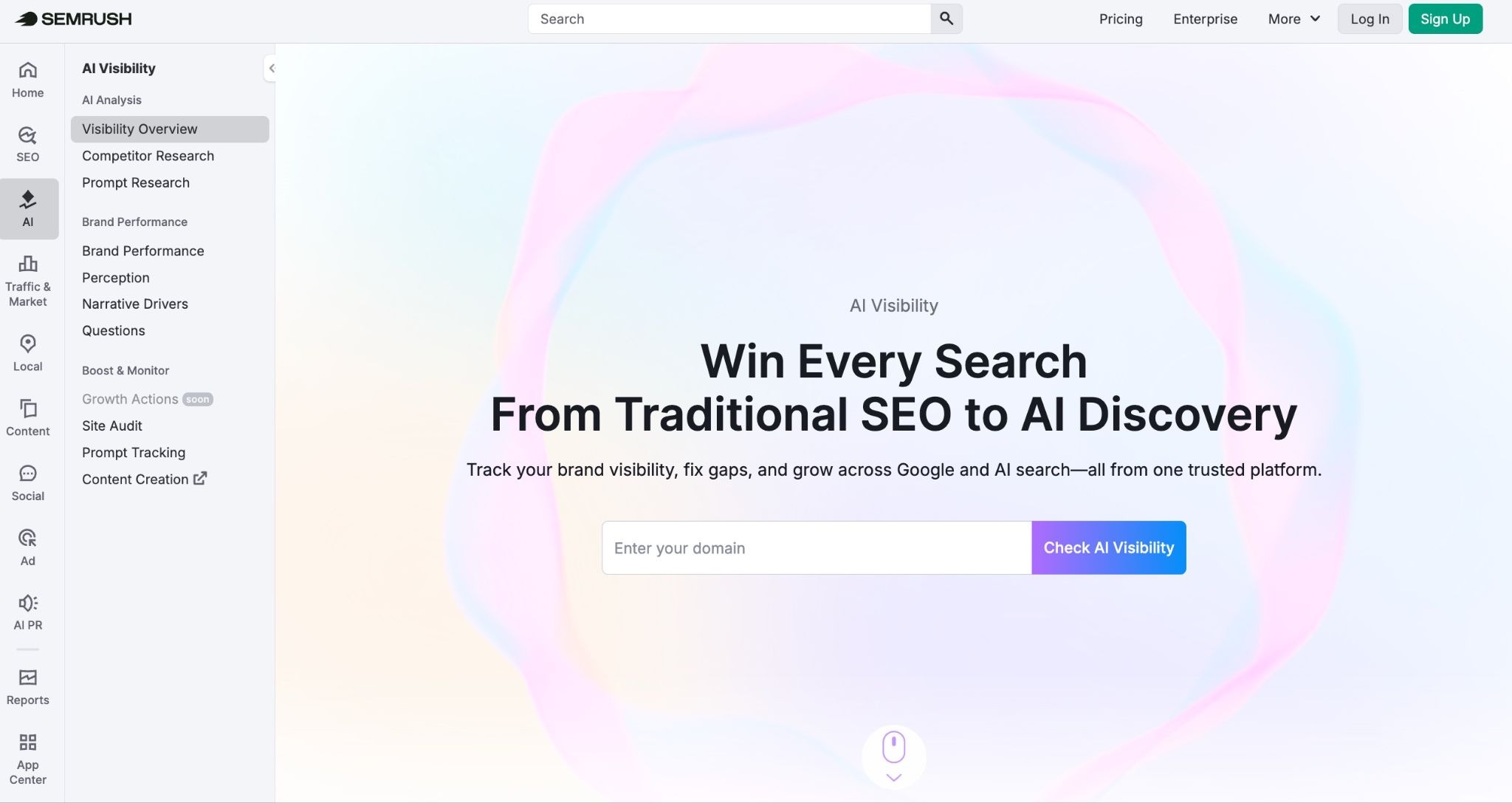
The strongest argument for Semrush's AI Visibility Toolkit isn't any individual feature — it's the absence of friction. Teams already running keyword research, rank tracking, and site audits in Semrush don't need to evaluate a new tool, onboard a new platform, or build a new reporting layer. AI visibility data lands in the same dashboard they already open every day.
The Prompt Research database covering 289M+ AI queries is genuinely useful as a starting point for building a monitoring prompt set — it surfaces what your target audience is already asking AI engines, which is a better input than building prompts from intuition. The free AI visibility audit across 289M+ prompts is a credible first check before committing to any paid tool in this category.
Google AI Overviews, Google AI Mode, ChatGPT, Perplexity, Gemini.
Yes, cited pages tracking with source attribution included.
Yes, share of voice and sentiment scores included across plans.
Included in Semrush One Pro+ at no extra cost; standalone AI Visibility Toolkit at $99/mo per domain; free audit available without subscription.
In-house teams and agencies already standardized on Semrush who want AI visibility without adding a new vendor.
If you're not on Semrush — the AI features integrate tightly with the rest of the platform and lose value as a standalone purchase.
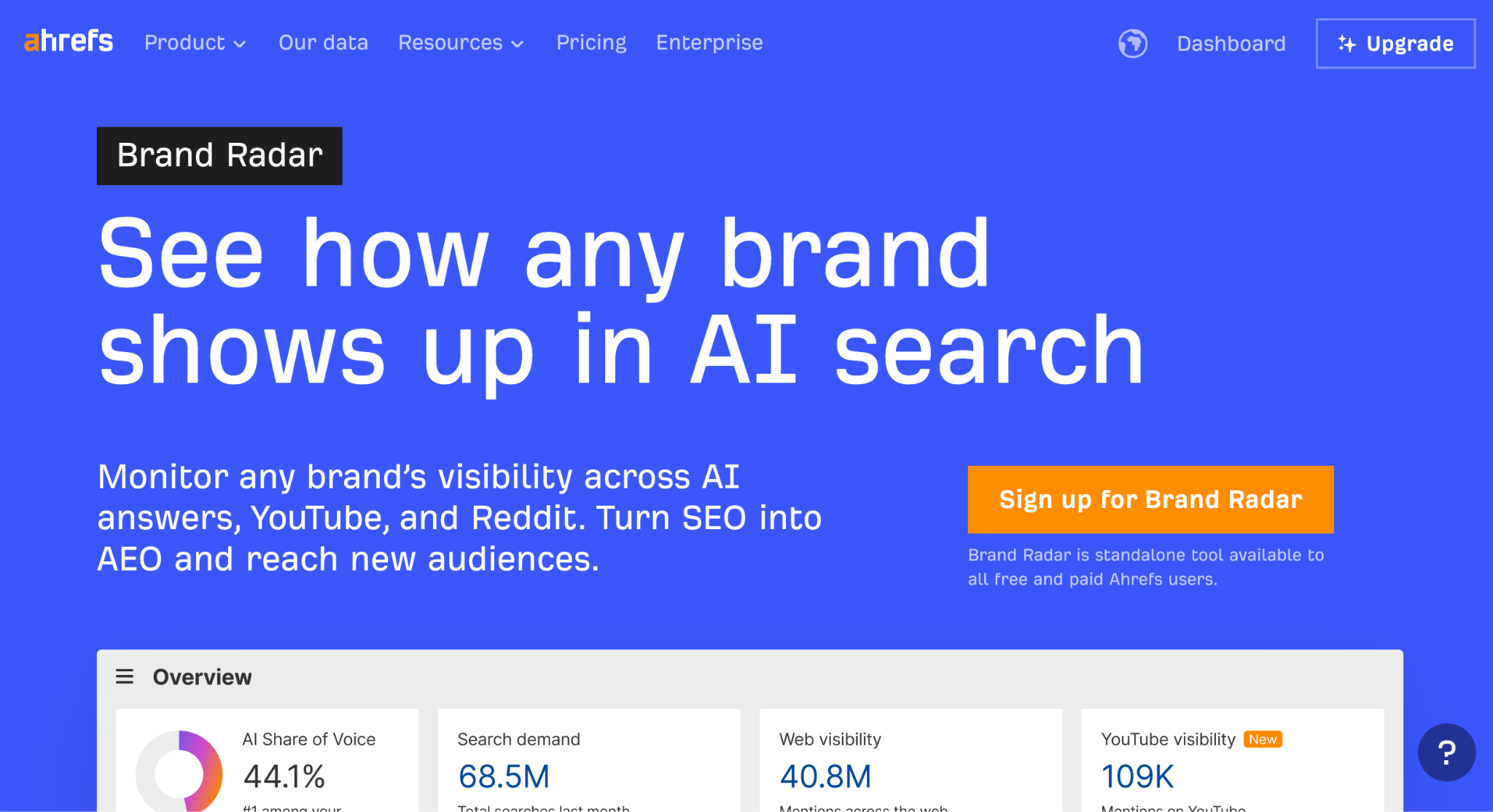
Brand Radar's methodology stands out in a category where most tools generate synthetic prompts. Ahrefs derives its prompts from real keyword search data — questions people have actually typed into search engines — which grounds the visibility signal in documented user behavior rather than the platform's assumptions about what users might ask.
The tradeoff is cost structure. Brand Radar is priced per AI platform, not as a flat monthly subscription. Tracking one engine is manageable. Tracking six means the AI visibility add-on costs as much as the base Ahrefs plan itself.
Up to 6 via bundle: AI Overviews, AI Mode, ChatGPT, Perplexity, Copilot, Gemini.
Yes, with source domain tracking included.
Qualitative context appears in response excerpts; no structured sentiment scoring feature.
Ahrefs Free permanently; Custom Prompts from $50/mo (80 prompts); per AI index from $199/mo; all 6 indexes $699/mo. Base Ahrefs plan required from $129/mo.
Existing Ahrefs users who want AI visibility data alongside SEO and backlink intelligence without switching platforms.
If you need broad multi-engine coverage at a predictable monthly cost — per-platform pricing scales steeply when you need more than two engines.
SE Ranking is where you go when you need AI visibility and traditional rank tracking in one platform without the price tag of the tools above. The AI Results Tracker — part of the AI Search add-on — covers AI Overviews, AI Mode, Perplexity, and ChatGPT, and sits alongside keyword rankings, backlink monitoring, and site audit capability in a single subscription.
It's worth knowing that SE Ranking now offers two separate AI visibility products: the AI Results Tracker (built into the SEO suite as an add-on) and SE Visible (a standalone AI visibility platform that launched with ChatGPT and AI Mode, with Perplexity, Gemini, and Claude on the roadmap). For most teams, the AI Results Tracker add-on is the relevant option — SE Visible is early-stage and priced at $189/mo for coverage that dedicated tools offer more cheaply.
AI Results Tracker covers AI Overviews, AI Mode, Perplexity, and ChatGPT. SE Visible currently tracks ChatGPT and AI Mode, with Perplexity, Gemini, and Claude listed as coming soon.
Yes, AI citation analysis included in the AI Results Tracker.
Basic GEO and AI visibility signals included in base plans; deeper AI tracking requires the add-on. Sentiment tracking confirmed in SE Visible; confirm granularity in AI Results Tracker on SE Ranking's current pricing page.
Core plan from $52/mo (annual billing); AI Search add-on $89/mo ($71.20/mo billed annually). Total effective entry for AI tracking: approximately $141/mo monthly or $123/mo annually.
Budget-conscious in-house teams and small agencies that want AI visibility alongside traditional SEO data in one subscription.
If you need more than four AI engines or daily data refreshes at entry pricing — the AI Results Tracker covers four engines, and SE Visible's broader coverage is still in rollout. Once you add the AI Search add-on, the combined cost is closer to mid-market than entry-level.
Accuracy varies by methodology. Tools that simulate real browser sessions rather than API calls — Peec AI and Otterly AI both do this — tend to capture what users actually see. No tool produces perfectly stable numbers since AI answers are non-deterministic and shift with model updates. Treat share-of-voice as a directional trend metric tracked over weeks, not a precise daily number.
Weekly is the right cadence for most teams. Daily tracking is available on most paid plans and makes sense if you're actively running a GEO campaign or in a fast-moving competitive category. Monthly is the minimum — checking less often makes it hard to connect changes to specific actions.
Yes, all seven tools include competitor benchmarking at some level. Peec AI's sentiment framing shows not just whether competitors appear but how AI positions them relative to you. Profound's share-of-voice tracks competitive positioning across a large prompt set. Otterly's GEO Audit flags specific prompts where competitors appear and you don't.
Most offer multi-language and multi-country support, but quality varies by plan. Scrunch Enterprise, Profound's higher tiers, and Peec AI (from Pro tier) explicitly support international markets. Entry plans typically default to English-language monitoring. Confirm specific language and country support before purchasing if non-English markets are a priority.
Yes, but indirectly. Strong organic authority — quality backlinks, topical coverage, high-ranking pages — influences which sources LLMs treat as credible. But ranking well on Google doesn't automatically translate to being cited in ChatGPT. Structured content, entity clarity, off-site presence on platforms AI trains on, and technical crawler accessibility all matter independently of traditional rankings.
Yes. Semrush's free AI visibility audit covers 289M+ prompts with no subscription required. Ahrefs Free includes limited Brand Radar access. Otterly AI and Peec AI both offer free trials. For a manual check, run your key buying-intent prompts directly in ChatGPT, Perplexity, and Google with AI Overviews enabled — note whether your brand appears, how it's described, and which competitors come up alongside or instead of you.

Irina is a Founder at ONSAAS, Growth Lead at Aura, and a SaaS marketing consultant. She helps companies to grow their revenue with SEO and inbound marketing. In her spare time, Irina entertains her cat Persie and collects airline miles.
.svg)
.svg)
.svg)

.svg)
%20(1).svg)
%20(3).svg)
.svg)
.svg)