Imagine opening your analytics and seeing your pipeline slow down while every metric looks fine. Traffic stable. Rankings unchanged. Ads performing. Nothing explains it until someone runs your brand through ChatGPT and Perplexity using the prompts your buyers actually type. Your main competitor appears in 11 of 15 responses. You appear in 2.
That's not a content problem or a rankings problem. It's a visibility problem in a channel your current stack can't see. This guide covers the five AI search monitoring tools worth using and how to get a working setup live in 30 days.
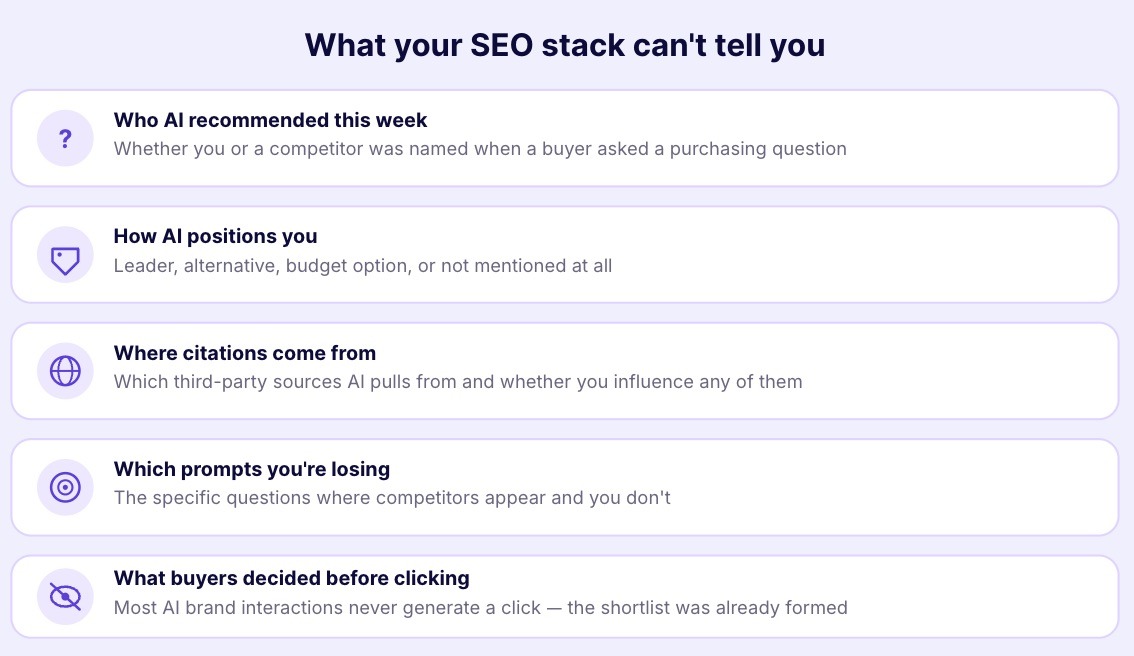
Traditional rank trackers measure position in a list of links. AI engines produce answers — and the brands showing up in those answers aren't necessarily the ones ranking highest on Google. Here's what your current stack can't tell you:
The brands monitoring this have a material information advantage. The ones that aren't are losing ground in a channel they can't measure.
Before comparing tools, it's worth being precise about what this category measures. AI search monitoring tracks how your brand appears in responses from ChatGPT, Perplexity, Gemini, Claude, and Google AI Overviews — across a defined prompt set that reflects real buyer questions.
What that produces: brand mention frequency, share of voice versus competitors, citation source analysis, sentiment and positioning, and prompt-level gaps where competitors appear and you don't.
What it doesn't produce: traffic data, conversion attribution, or any signal from AI engines themselves. Everything comes from simulating prompts and capturing outputs — which means methodology matters. Tools that run more prompts using real browser sessions produce more representative data than those sampling lightly via API. Ask about this before buying anything.

Most monitoring tools hand you a dashboard. Scrunch hands you a diagnostic. Knowing your brand appeared in 28% of tracked prompts is useful; knowing which pages AI crawlers couldn't parse, which sources are driving competitor citations, and what to change to fix both is what actually moves the number.
Three capabilities separate Scrunch from the field. The Agent Experience Platform (AXP) sits at the CDN layer and serves AI crawlers a clean, token-efficient version of your pages automatically — the only feature in this category that changes how AI agents actually consume your content, not just what you've written. Site Maps gives per-page crawler accessibility scores with a prioritized fix list — most teams discover AI bots are failing on pages they assumed were fine. Dimensions lets you filter by persona, funnel stage, geography, and competitor, so instead of an aggregate share-of-voice number you can ask how you appear when a mid-funnel B2B buyer asks a comparison question against a specific competitor in a specific market.
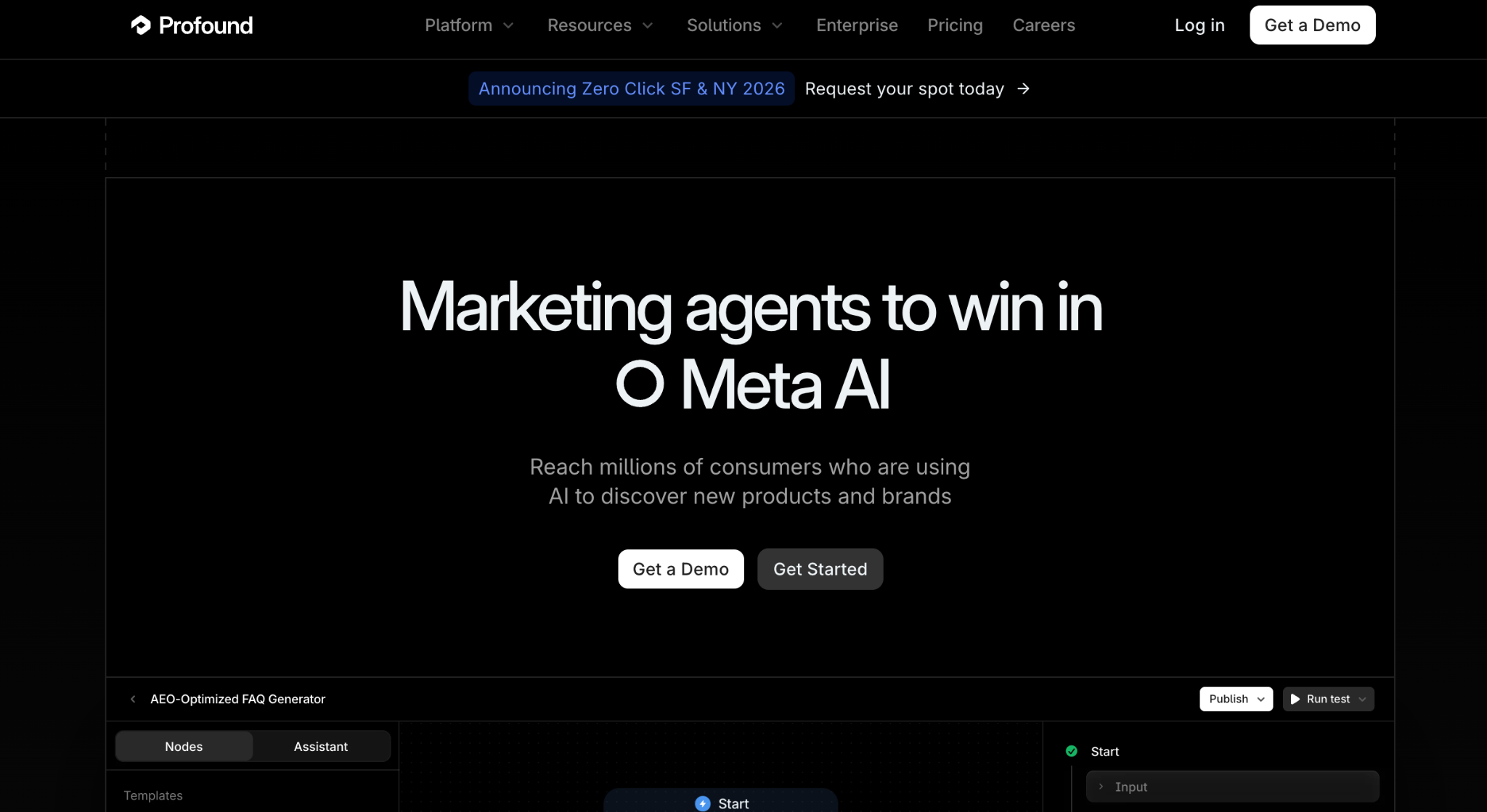
Profound's core advantage is volume. Processing over a billion citations and ten million prompts daily enables capabilities not possible at smaller scale. The Conversation Explorer estimates total AI conversation volume around specific topics — not just tracking your queried prompts, but surfacing the conversations you didn't know to look for. Shopping Intelligence tracks how AI handles buying-intent queries, a capability unique to Profound for e-commerce brands. SOC 2 Type II and SSO/SAML make it viable for enterprise security reviews that smaller tools can't clear.
Honest limitation: the $99/mo Starter covers ChatGPT only. Meaningful multi-engine coverage starts at $399/mo.
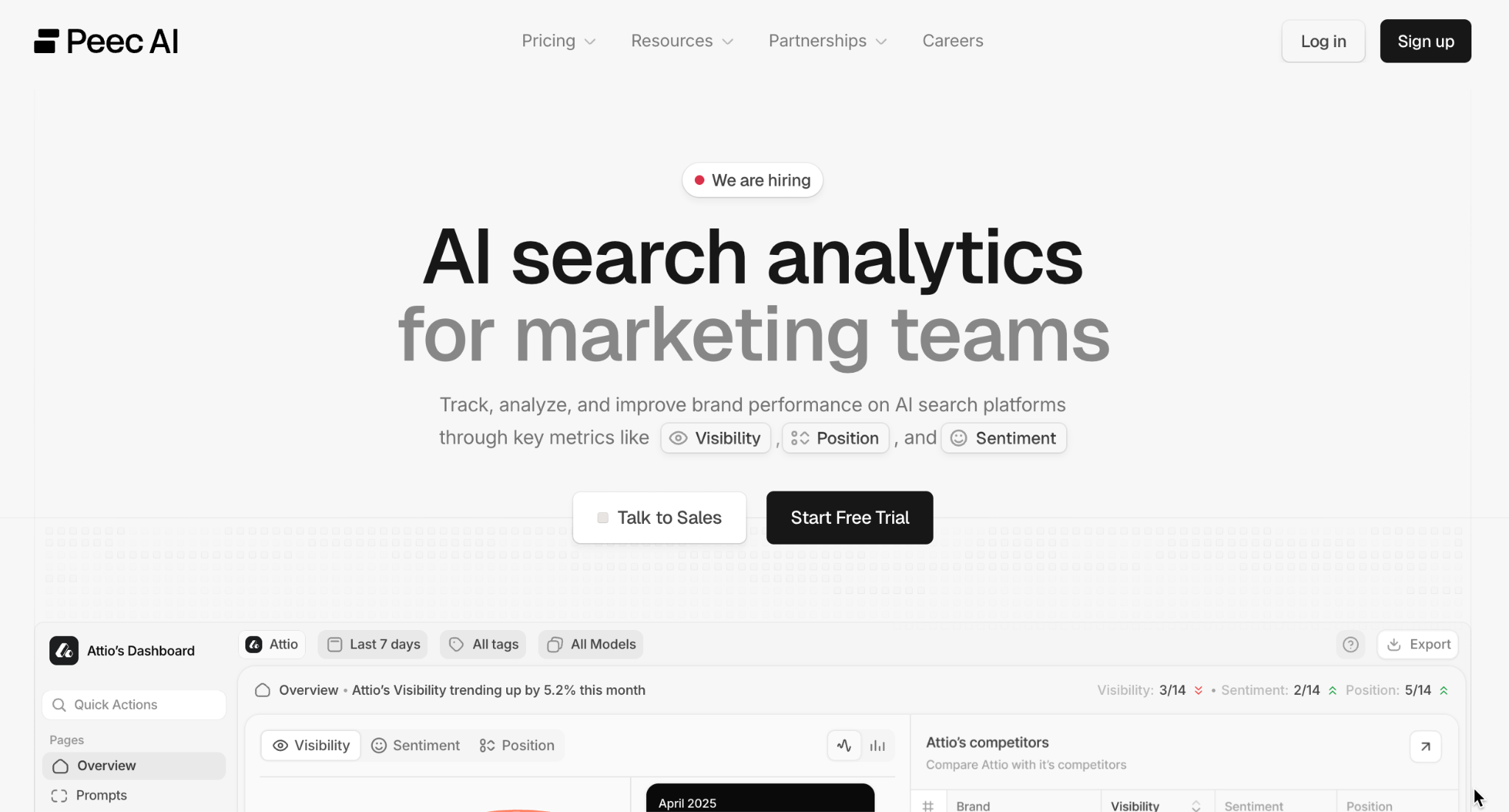
Peec's model differs from most tools here: instead of a fixed engine bundle, you choose which three of six available engines to track at the entry tier, with others available as add-ons. For brands whose buyers concentrate on two or three platforms, that flexibility avoids paying for coverage that doesn't match your audience.
The citation layer is more granular than most tools at this price: multi-layered decoding maps structural relationships between sources and entities, not just which URLs appeared. Sentiment tracking is consistently praised in independent reviews — tracking not just whether you appeared but how AI frames your brand over time and against competitors.
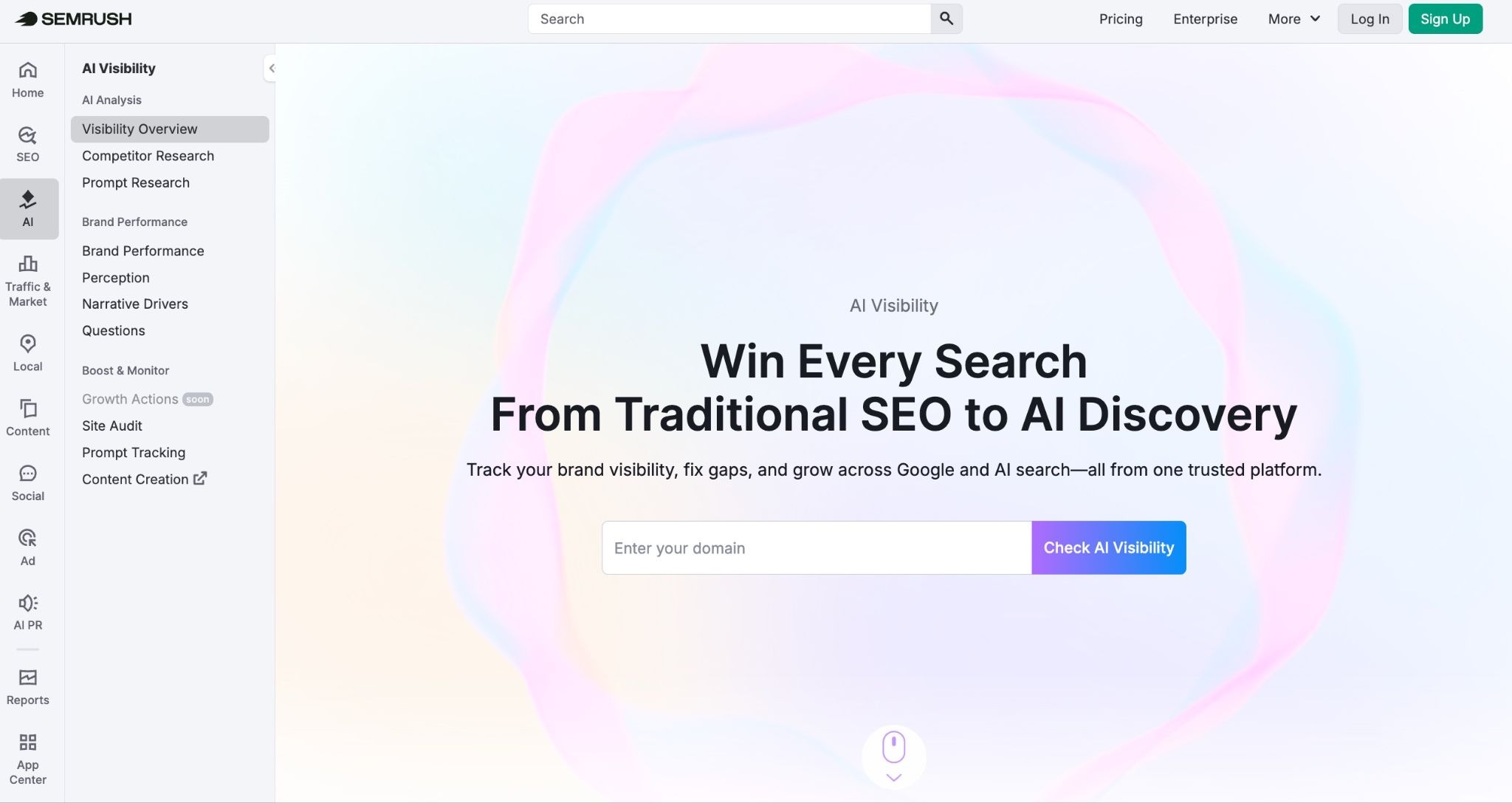
The most compelling argument here isn't any individual feature — it's the absence of friction. For teams already tracking keyword rankings and backlinks in Semrush, AI visibility data in the same dashboard removes the new login, new reporting layer, and data reconciliation that a separate tool creates.
The 289M+ AI query database for Prompt Research is a credible starting point — it surfaces actual prompts your target audience uses in AI engines, a more grounded input than building your prompt set from intuition. The free AI visibility audit is worth running before committing to any paid tool in this category.
Honest limitation: AI features are a strong addition to an existing SEO platform, not a best-in-class standalone monitoring tool. Depth doesn't match Profound or Scrunch for teams whose primary job is AI visibility.

AirOps started as an AI workflow builder and moved into the AI search visibility space — which makes it a fundamentally different kind of tool from the others on this list. Where Scrunch and Profound are monitoring-first, AirOps is content production-first: built for teams that want to generate AI-optimized content at scale and track whether it's getting cited, rather than teams focused primarily on understanding their current competitive position.
If your gap is producing content structured for AI citation rather than understanding where you currently stand, AirOps addresses that workflow more directly than anything else here.
One question before anything else: is your primary need to understand what's happening, to fix what's blocking you, or to produce content that gets you cited?
Before any purchase: ask the vendor how their share-of-voice data is generated. Real browser session simulation produces more representative results than API-based sampling. That question won't come up in a demo — you have to ask.
Most teams that start tracking AI visibility fall into the same trap: they build a dashboard of their own presence and stop there. The point isn't to know where you stand — it's to know where you stand relative to competitors who are actively displacing you.
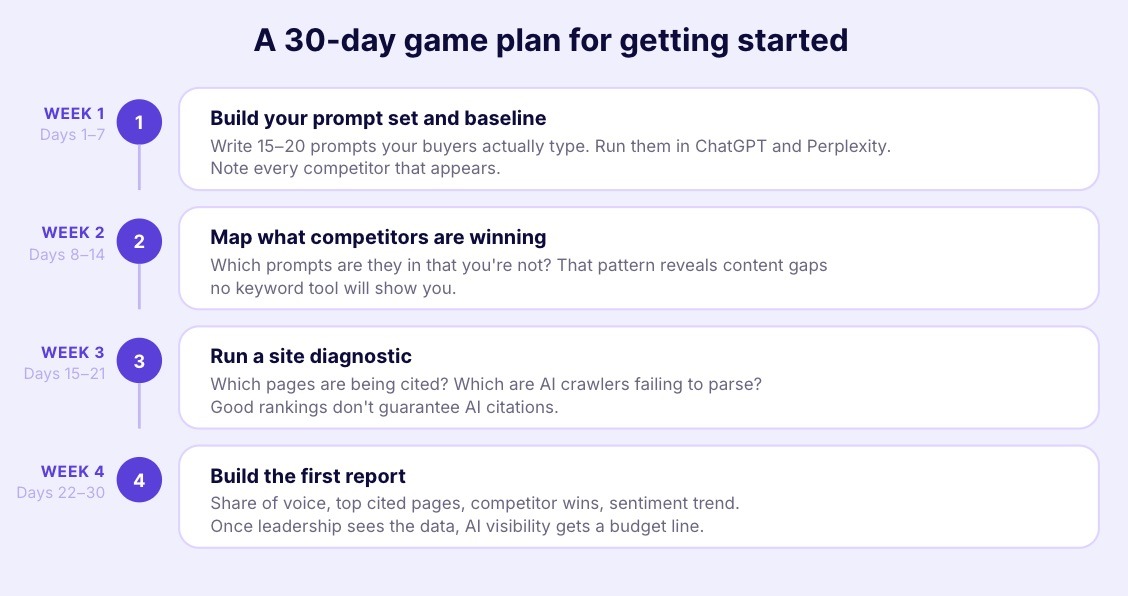
Write 15–20 prompts reflecting how your buyers actually use AI — comparison queries, problem-aware questions, category searches. Run them manually in ChatGPT and Perplexity. Note every competitor that appears. This is your baseline and your first competitive map.
Which prompts are they appearing in that you're not? Are they winning technical comparison queries, pricing queries, use-case-specific queries? That pattern tells you more about your content gaps than any keyword tool will.
Which of your pages are being cited? Which are AI crawlers failing to parse? Cross-reference your cited URLs against your highest-traffic pages. Pages that rank well on Google but never appear in AI citations have a structural problem — not a content problem.
Share of voice across your priority prompt set. Top cited pages. Competitor prompt wins. Sentiment trend. One slide per metric. Present it. Once leadership sees the data, AI visibility gets a budget line — which is when real optimization starts.
Tools like Scrunch compress this timeline significantly. You can have brand monitoring live and first competitive data in hand before the week is out.
Your competitors are either already tracking AI visibility or they will be. The cost of waiting isn't a spike in a chart — it's invisible market share loss you'll only quantify in hindsight.
Start with a free trial of Scrunch. First brand insights live in under an hour.
AI search monitoring tracks how your brand appears in ChatGPT, Perplexity, Gemini, Claude, and Google AI Overviews — measuring citations, share of voice, sentiment, and source domains. It matters because buyer research increasingly starts in AI engines, and those interactions don't generate clicks that show up in your analytics.
SEO tracking measures where your page ranks in a list of links. AI search monitoring measures whether your brand appears in a synthesized answer — no position data, no official dashboard, no guaranteed click. The optimization signals are different too: structured content, citation source quality, and entity clarity matter more than keyword placement.
Start with ChatGPT and Google AI Overviews. Add Perplexity for research-focused audiences, Gemini as Google's AI ecosystem expands, and Copilot for B2B enterprise audiences. Most entry plans limit you to three or four engines — prioritize the ones your buyers actually use.
Self-serve entry pricing ranges from $95/mo (Peec AI) to $250/mo (Scrunch Core). Meaningful multi-engine coverage clusters between $245/mo and $399/mo. Enterprise contracts are custom-quoted. Always confirm which engines and prompt volumes are included at the tier you're evaluating — entry plan pricing is frequently misleading.

Irina is a Founder at ONSAAS, Growth Lead at Aura, and a SaaS marketing consultant. She helps companies to grow their revenue with SEO and inbound marketing. In her spare time, Irina entertains her cat Persie and collects airline miles.
.svg)
.svg)
.svg)

.svg)
%20(1).svg)
%20(3).svg)
.svg)
.svg)