
.svg)
%20(1).svg)
%20(3).svg)
Back to articles
How To Do B2B Sales in 2026: Stages, Strategies, And What Actually Closes Deals
August 28, 2026
By
Anna Dovbysh
B2B sales have always been hard. But something shifted in the last few years. Buyers started showing up to sales calls already knowing your pricing, your competitors, and what your unhappy customers said in their reviews.
The teams that are winning today are not the ones with the best product or the biggest headcount. They are the ones with the clearest process.
This guide covers every stage of the B2B sales process, from generating your first qualified lead to closing the deal and handing off to customer success. Real data, real examples, no textbook theory.
Whether you are building your first sales motion or untangling a pipeline that has gone quiet, you are in the right place.
The instinct to treat B2B and B2C sales as variations of the same sport is one of the most expensive mistakes a go-to-market team can make. They are fundamentally different disciplines. Here is a clear-eyed comparison:
The single most important column in that table is Stakeholders. In B2C, you convince one person. In B2B, you are navigating a committee where each member has different goals, different fears, and different definitions of success. Your pitch to the CFO and your pitch to the VP of Engineering must share the same conclusion but travel through entirely different logic.
That committee dynamic plays out across industries in very different ways. B2B sales span an enormous range of transaction types:
What these have in common: multiple buyers, formal evaluation, and a contract. What differs is the length of the sales cycle, the nature of the relationship, and the complexity of the buying committee.
Across all those industries, the same problems surface again and again. If B2B sales were easy, every quota would be hit, and every pipeline would be full. It is not, and most teams struggle with:
Every one of these challenges is a symptom of the same root cause: operating without a defined, measurable sales process. The fix is not working harder. It is working inside a system.
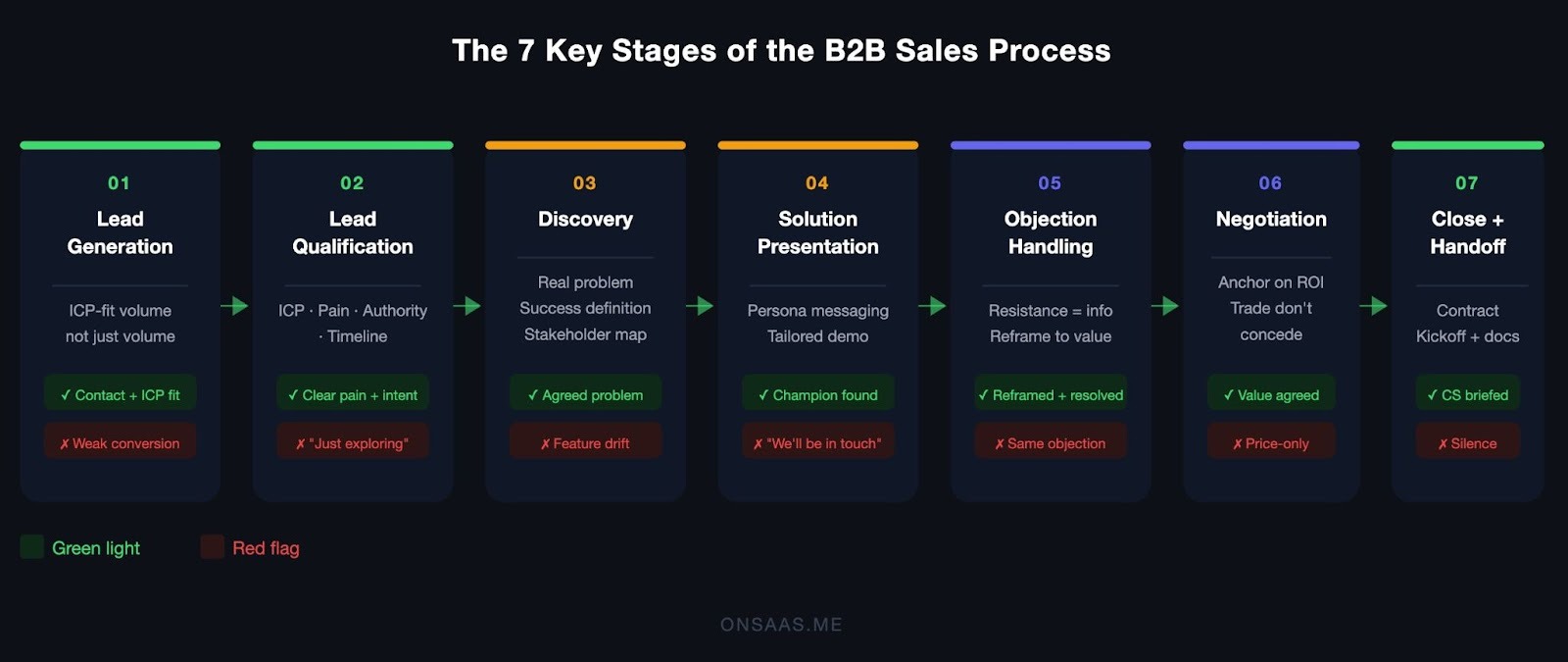
Think of the B2B sales process as a series of tollgates. You do not move forward by spending time; you move forward by meeting criteria. Each stage has a clear goal, a measurable exit point, and a diagnostic signal when something is going wrong.
According to HubSpot's State of Sales Report, reps who follow a defined sales process are 33% more likely to be high performers. It is a real structural advantage. Let's break down what strong execution looks like at each stage.
Lead generation is the top of your funnel, and for most B2B organizations, it is also the leakiest part. The goal is not to generate volume; it is to generate ICP-fit volume (ICP, or Ideal Customer Profile, means the type of company most likely to buy, stay, and grow with you). Every lead that enters your pipeline below your ideal customer profile adds drag without adding opportunity.
Green light: You have contact data, basic ICP confirmation (industry, company size, role), and a reason to engage.
Red flag: Your top-of-funnel numbers look healthy, but downstream conversion rates are weak. This means you are attracting the wrong leads, not too few of them.
Once leads are flowing, the next discipline is ruthless qualification. The discipline to say 'this is not the right fit right now' and move on is more valuable than persistence on the wrong deal. Every hour spent on an unqualifiable prospect is an hour not spent on one that could close.
The most effective qualification frameworks evaluate four dimensions:
Green light: You can articulate a clear business problem, and there is demonstrated buying intent, not just curiosity.
Red flag: Vague goals, no clear pain, or 'we're just exploring' answers. These are data points, not objections to overcome.
Qualification confirms the opportunity exists. Discovery determines whether you can actually win it. Most reps treat discovery as a formality before getting to their demo. Professional reps treat it as the most important conversation they will have.
Great discovery answers three questions:
Surface the underlying business problem (not just symptoms), understand the measurable impact of doing nothing, and map the buying process and internal stakeholders.
Green light: You and the buyer have agreed on a problem definition and a clear next step.
Red flag: The conversation drifts toward features and product specs before the problem is deeply understood.
With discovery done, you now have everything you need to make a presentation that actually lands. Because if your presentation looks like everyone else's, you have already lost.
Use persona-based messaging (the CFO cares about cost efficiency; the ops lead cares about workflow friction), tailored demo flows, and value stories that quantify impact.
Green light: Value alignment is confirmed, and you have identified an internal champion.
Red flag: Low engagement during the demo, or a polite 'we'll be in touch' that signals the buyer checked out twenty minutes ago.
A strong presentation surfaces commitment, but it also surfaces doubt. Here is how to reframe every objection you will ever hear: it is not a rejection. It is a request for more information, framed as doubt. The buyer is telling you exactly what they need to feel safe moving forward.
The most common objections in B2B sales and how to read them:
Green light: Objections are acknowledged, explored, and reframed around value and mutual fit.
Red flag: The same objection keeps surfacing across multiple calls. The concern was never resolved — it was temporarily sidestepped.
Once objections are resolved and both parties are aligned on fit, the conversation shifts to terms. Most salespeople enter negotiation mode the moment a buyer mentions price. That is a mistake. If you are negotiating before the value is confirmed, you are not negotiating. You are discounting.
Effective B2B negotiation is built on three principles:
Green light: Both parties agree on value and scope. The conversation is about structuring the deal, not justifying the price.
Red flag: The entire negotiation centers on price reduction with no value conversation. You are being commoditized, and that is a positioning problem that started long before this meeting.
Agreement on terms sets the stage for close, but the close itself is only the beginning. The signature is not the finish line. In B2B, it is the starting gun.
The most common form of churn does not happen twelve months into a contract. It happens in the first sixty days, when the handoff from sales to customer success is fumbled and the buyer suddenly feels like they have been handed off to strangers.
A clean close involves three elements:
Green light: Contract signed, kickoff call scheduled, and a handoff document with the buyer's goals and stakeholder map is in the customer success team's hands.
Red flag: Post-signature silence. If the first touchpoint after signing is a kickoff call three weeks later, you have created a churn risk before the engagement has begun.
Here is how these stages connect in a real-world SaaS scenario — a sales engagement platform selling to a 300-person technology company:
Notice how every stage fed the next. The discovery conversation directly shaped the demo. The demo built the internal champion. The champion shortened the negotiation.
That is what a working process looks like. The harder question is what to do when yours is not working — and how to tell which part is actually broken.
Knowing the stages is one thing. Knowing where your team is falling short is another. And the honest reason most processes are breaking right now is not laziness or bad reps, it is that buyer behavior changed faster than most sales motions did.
Buyers arrive informed, committees grew, and budgets got harder to move. The teams still running a 2018 playbook are feeling it. Here is where it shows up most visibly and what to do about it.
Fixing the process is only half the equation. You also need to know whether the fixes are working. These are the metrics that give you the clearest picture of process health:
The goal is not to obsess over metrics. It is to use them diagnostically. Each slip points to a specific part of the process:
Metrics tell you where the process is breaking. Fixing the process is what changes the metrics.
With a defined process and clear performance benchmarks in place, the final lever is tooling. But the sequence matters. Tools do not fix a broken process; they accelerate it, in whatever direction it is already heading. Let’s look at them in more detail.
A CRM is your process made visible. Salesforce and HubSpot dominate the enterprise and mid-market, respectively, while Pipedrive and Close serve high-velocity SMB teams.
The best CRM is the one your team actually uses, which means it must reflect your actual process stages, require minimal data entry, and surface insights your reps can act on.
Tools like Outreach, Salesloft, and Apollo allow sales teams to build structured, multi-channel cadences, sequencing emails, LinkedIn touchpoints, and calls across a defined outreach arc.
They eliminate the cognitive load of 'when should I follow up and what should I say?' and let reps focus on conversations, not task management.
The challenge with outreach at scale is the tension between reach and relevance. Automation solves the reach problem. Personalization solves the relevance problem. The goal is to combine both.
LinkedIn automation tools like Expandi or Dux-Soup allow teams to scale connection requests, profile visits, and follow-up messages while maintaining the appearance and substance of genuine outreach. For teams that want to run paid campaigns alongside organic outreach, bringing in a LinkedIn ads agency is often more efficient than trying to manage both channels internally.
Combined with AI-assisted personalization (referencing company news, role-specific pain points, or mutual connections), these tools can generate reply rates that manual outreach cannot sustain at volume. The quality of that personalization, however, depends entirely on the data behind it. Adding an AI GTM data layer that unifies verified contact intelligence, firmographics, and real-time buying signals gives automation tools the context they need to generate outreach that reads like research, not a mail merge.

With the right tools in place, the last step is putting it all together. Whether you are starting from zero or inheriting a process that has quietly stopped working, the approach is the same: systematic, one stage at a time.
The most dangerous phrase in sales management is 'we need more pipeline.' More often, the pipeline is large enough; the problem is that deals are not advancing because the process that should move them is unclear, unenforced, or absent. Fix the process. The pipeline will follow.
A well-defined B2B sales process is the mechanism by which your team converts effort into revenue, consistently and predictably. The teams that win are not the ones that work the hardest; they are the ones that work inside the best system.
Start with your diagnostic: pull your last quarter's data, find where deals stall, and define the exit criteria for your weakest stage. Fix one thing. Measure the result. Move to the next. Repeat until the process is airtight.
Lead with value, not a pitch. Optimize your profile around your buyer's problems, post content that shows you understand their world, and reach out with a specific, personalized reason to connect. Reference something real, a post, a company milestone, a shared contact, before you ever mention what you sell. LinkedIn Sales Navigator helps you find the right people faster, but it does not do the hard part. Earning the conversation does.
Start with your Ideal Customer Profile: who has the biggest problem you solve, the budget to act on it, and the authority to move? Get specific: industry, company size, growth stage, role. Then map your value proposition to the exact language that profile uses to describe their pain (G2 reviews and customer interviews are underrated sources for this). Choose your primary channel — outbound, inbound, or partner-led and build your process around how your ICP actually buys, not how you prefer to sell.
Salesforce for enterprise teams who need deep customization. HubSpot for growth-stage companies that want strong marketing-to-sales alignment out of the box. Pipedrive or Close for high-velocity teams who prioritize speed over complexity. If you are running a pipeline above $5M and need serious forecasting, add Clari or Gong on top of whichever CRM you choose.
Lead generation, qualification, discovery, solution presentation, objection handling, negotiation, and closing with a post-sale handoff. Seven stages, but what makes them work is not the stages themselves. It is the criteria that control movement between them. Without those, you do not have a pipeline. You have a list of deals you are hoping will close.
.webp)
With 10 years of writing experience and a deep interest in SEO, AI, and content management, Anna’s here to break down big ideas and translate them into plain English for readers of all levels. She's got a Master's Degree in International Information and is a lifelong learner of writing and storytelling. Outside of work, she’s on the yoga mat, in a good book, or planning her next adventure with family and friends.
.svg)
.svg)
.svg)
.svg)
.svg)