
.svg)
%20(1).svg)
%20(3).svg)
Back to articles
5 Best Brand Visibility Monitoring Tools for AI Search (Ranked)
September 2, 2026
By
Irina Maltseva
Your brand visibility score means nothing if the prompts behind it were made up. Every tool in this category claims to track the same thing: how your brand appears in AI-generated answers. The data quality gap between them is enormous and almost nobody explains it.
This guide ranks five tools by prompt methodology, engine coverage, data depth, and whether the output actually drives decisions. The right choice depends on how much you can trust the underlying data, not just the dashboard it arrives in.
Ask ten marketers how AI visibility tools work and nine will describe the same thing: the platform sends prompts to AI engines, captures responses, and tells you whether your brand appeared. What almost nobody asks is where those prompts come from.
Most tools generate synthetic prompts. The platform's team decides what questions users might ask about your category and builds a prompt library from those assumptions. The result is a visibility score that tells you how your brand appears against questions the tool invented.
A small number of tools derive prompts from actual search data — real queries from real users, pulled from keyword databases that reflect documented search behavior. The difference produces materially different results. Two tools can show completely different share-of-voice numbers for the same brand across the same AI engines, and both are technically correct based on how they source their prompts.
The question to ask any vendor before buying: where do your prompts come from?
Ahrefs Brand Radar is currently the only tool in this category with a clear answer: 300M+ real search queries from Ahrefs' keyword database, not fabricated questions. That's the methodology gap in one sentence.
Before comparing tools, it's worth being precise about what this category can and cannot tell you.
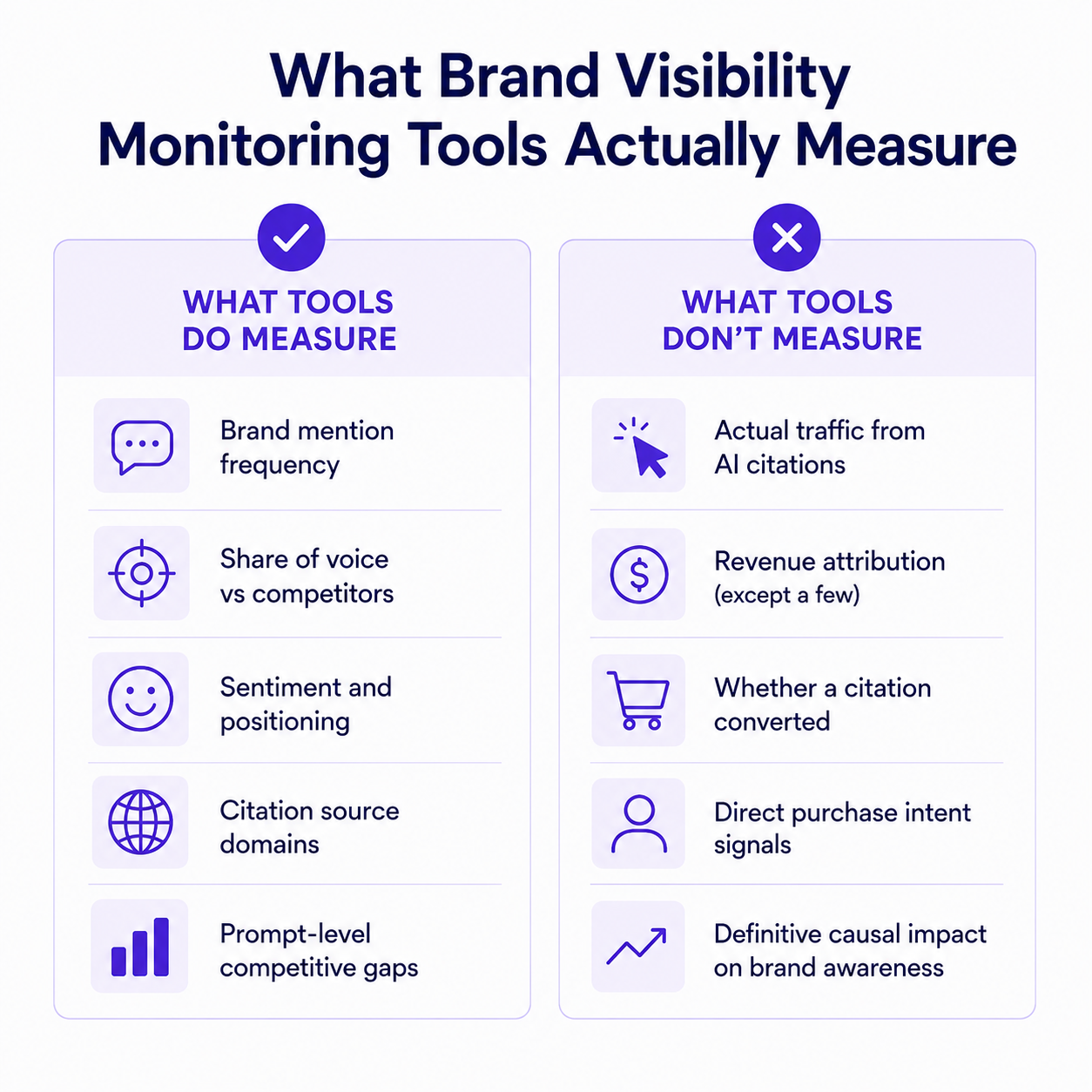
The floor of this category is mention tracking: did your brand appear in a response or not. The ceiling is source domain analysis, sentiment trends over time, and prompt-level competitive gaps that tell you specifically where competitors appear and you don't.
One honest caveat that applies to every tool on this list: AI engines are non-deterministic. The same prompt returns different answers on different runs. Treat all visibility data as a directional signal, not a precise measurement. Look for consistent trends over weeks, not daily fluctuations.
Brand Radar's core differentiator is one that most buyers never think to ask about: the prompts it uses to monitor your brand come from Ahrefs' real keyword database, not from synthetic questions the platform invented. That grounds every share-of-voice number in documented user behavior rather than platform assumptions about what buyers might search for.
In practice, that means the topics Brand Radar tracks for your category are the same topics real users are actually asking about in AI engines. Competitors appear in the results not because the tool guessed they might, but because real search demand confirms they do. For teams making content and optimization decisions based on AI visibility data, that distinction matters more than any feature on a pricing page.
Brand Radar integrates directly with the rest of Ahrefs — backlink data, keyword research, and competitive intelligence — so AI visibility lives in the same platform as the SEO research informing it.
Up to 6 platforms via bundle: AI Overviews, AI Mode, ChatGPT, Perplexity, Copilot, Gemini.
Yes, with source domain tracking included. Response excerpts provide qualitative context; no structured sentiment scoring feature.
Qualitative context in response excerpts rather than a structured sentiment score.
Ahrefs Free permanently with limited access; Custom Prompts from $50/mo (80 prompts); per AI index from $199/mo; all 6 indexes $699/mo. Base Ahrefs plan required from $129/mo.
SEO teams that want AI visibility data grounded in real search behavior, integrated with backlink and keyword intelligence in one platform.
Per-platform pricing scales steeply. Tracking all six engines costs $699/mo on top of the base subscription. If multi-engine coverage at an accessible price is the priority, the math gets difficult quickly.
Processing over 1 billion citations and 10 million prompts daily, Profound operates at a scale no other tool in this category comes close to. That scale enables two capabilities that are genuinely unique.
The Conversation Explorer estimates the total volume of AI conversations happening around specific topics in your category — giving you a sense of opportunity size before you decide where to focus. That's different from tracking whether you appeared in a set of prompts you defined; it surfaces conversations you didn't know to look for.
Shopping Intelligence tracks how AI engines handle product recommendations and buying-intent queries, a capability that exists nowhere else in this category and makes Profound the clear choice for e-commerce brands where AI search influences purchase decisions.
ChatGPT on Starter; ChatGPT, Perplexity, and AI Overviews on Growth; up to 9 on Enterprise.
Yes, your URLs and third-party source domains both included.
Yes, with narrative tracking included across plans.
Starter $99/mo (ChatGPT only, 50 prompts); Growth $399/mo (3 engines, 100 prompts); Enterprise custom.
Large enterprises, e-commerce brands, and analytics-heavy teams that need the deepest citation dataset available.
The $99 Starter covers ChatGPT only. Teams expecting multi-engine coverage at entry level will find the price jump to Growth significant.
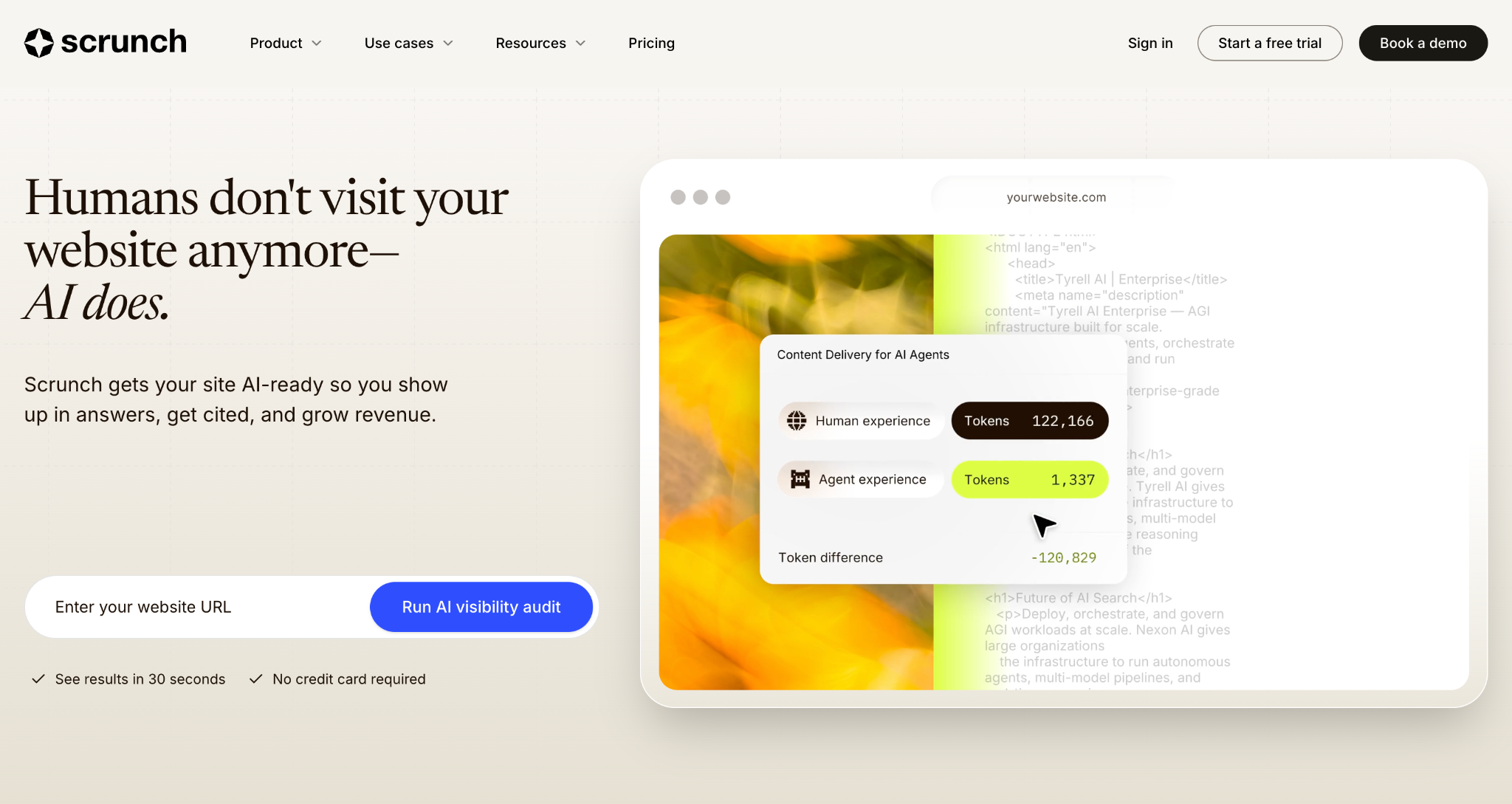
Every other tool on this list tells you where your brand stands in AI answers. Scrunch tells you why it's not standing there and gives you the infrastructure to fix it.
The Agent Experience Platform sits at the CDN layer and automatically serves AI crawlers a clean, structured version of your pages without touching the human-facing site. No developer involvement, no page redesign. Site Maps audits per-page crawler accessibility with a prioritized fix list. Insights maps content gaps to specific prompts where you're losing ground to competitors. The result is a platform that moves beyond reporting into active optimization — the only tool on this list that changes how AI agents consume your content rather than just measuring the outcome.
ChatGPT, Perplexity, Google AIO, and Copilot on Core; Claude, Gemini, Meta AI, Google AI Mode, and Grok on Enterprise.
Yes, with source attribution and competitor gap analysis included.
Yes, with persona-based filtering available on Enterprise.
Core $250/mo (125 prompts, 4 engines, 1 workspace, 5 users, 5 site audits/mo); Enterprise custom. 7-day free trial on Core.
Enterprise brands and technical SEO teams whose AI visibility gap is a technical access problem as much as a content problem.
Core's 125 prompts and 4 engines fill quickly for high-volume monitoring needs. Teams that need broad prompt coverage across many engines will hit the ceiling fast without moving to Enterprise.
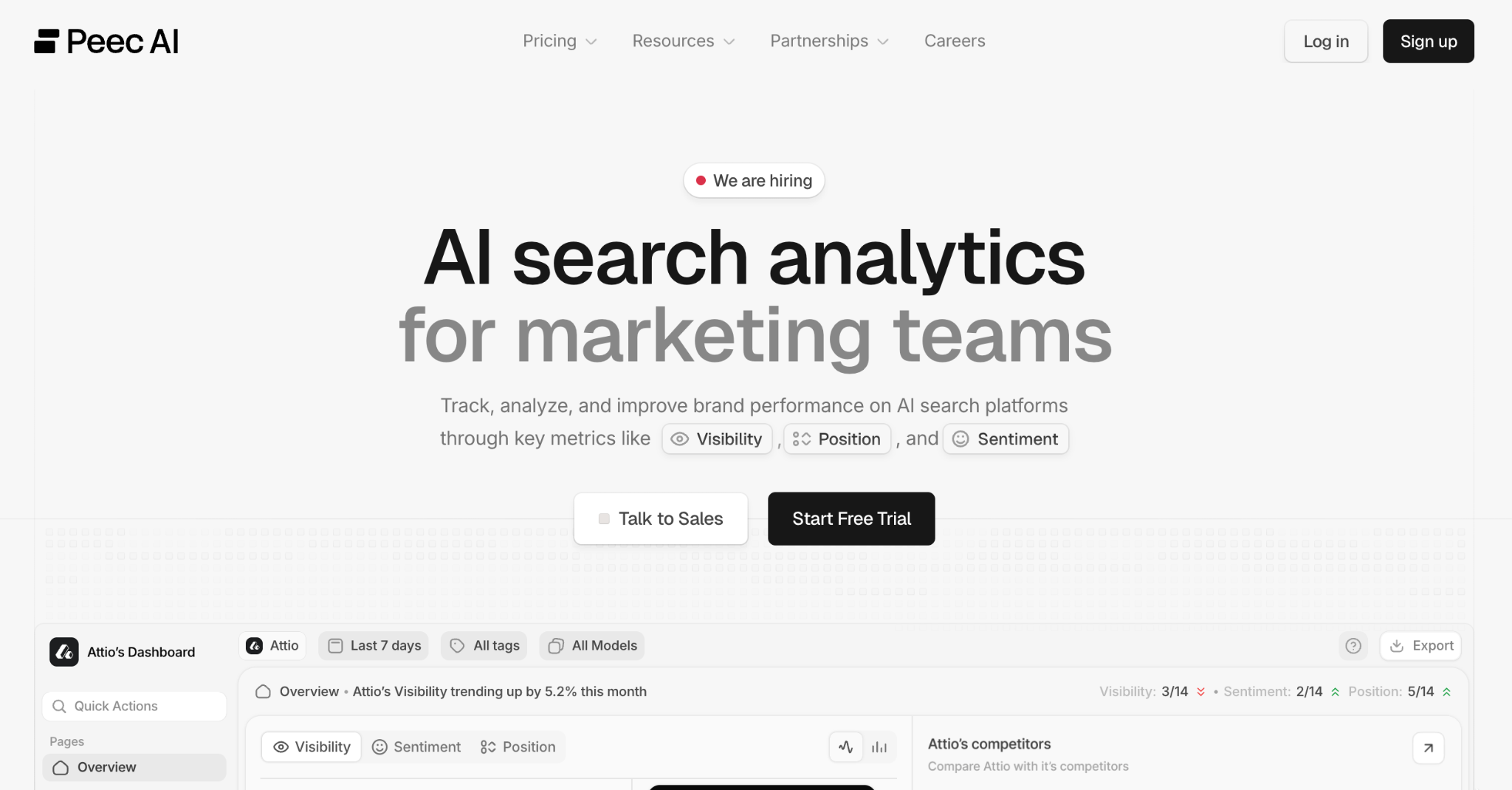
Most tools in this category bundle you into a fixed engine set at each pricing tier. Peec works differently: you choose which three of six available engines to track on the entry plan, with additional engines available as add-ons. For brands whose buyers concentrate on specific platforms, that flexibility avoids paying for coverage that doesn't map to your audience.
Peec queries AI platforms by simulating real browser sessions rather than API calls, which means results reflect what users actually see rather than what an API endpoint returns. The citation layer goes deeper than most competitors: multi-layered decoding maps structural relationships between sources and entities, not just which URLs appeared. Sentiment tracking records not just whether you appeared, but how AI frames your brand over time and against specific competitors.
Choose 3 of 6 on entry: ChatGPT, Perplexity, Gemini, AI Mode, AI Overviews, Copilot. Grok as paid add-on from $35/mo.
Yes, multi-layered citation decoding with entity checks and source categorization.
Yes, framing trends tracked over time and against competitors.
Starter $95/mo (50 prompts, 3 engines); Pro $245/mo; Advanced $495/mo; Enterprise custom. Additional engines from $35/mo.
Growing brands and analytically minded teams that want engine flexibility and citation depth without enterprise pricing.
The interface rewards users who want to dig into data. Teams looking for a simple setup with immediate out-of-box reporting will find the learning curve real.
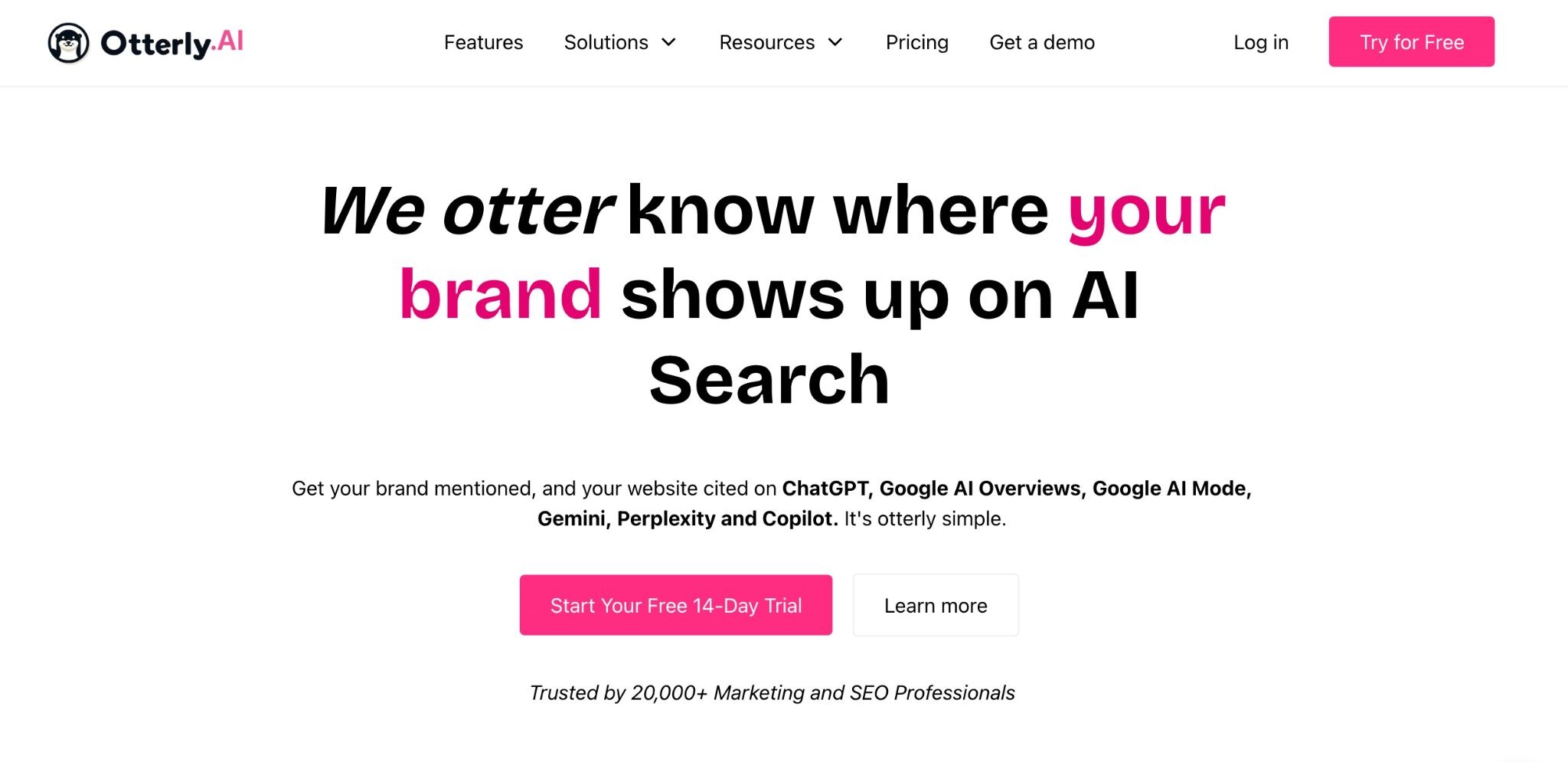
Otterly is where you go when you want structured AI visibility monitoring without committing to enterprise pricing. At $25/mo for the entry plan, it's the most accessible tool on this list by a significant margin. That accessibility doesn't mean shallow: the GEO Audit covers 25+ factors including schema, crawl accessibility, and page structure, then outputs a prioritized fix list rather than a raw score. Daily automated prompt checks keep data fresh without requiring manual intervention.
Like Peec AI, Otterly simulates real browser sessions rather than querying via API — which means the results reflect what users actually see in AI engines, not a sanitized API response.
ChatGPT, Google AI Overviews, Perplexity, Copilot on all plans; Gemini and Google AI Mode from $9/mo add-on each.
Yes, with link citation analysis included.
Yes, narrative consistency tracking included across plans.
Lite $25/mo (15 prompts); Standard $160/mo (100 prompts); Premium $422/mo (400 prompts). Free trial available.
Small teams, solo marketers, and agencies starting AI visibility monitoring who need meaningful data without a budget conversation.
The Lite plan's 15 prompts are enough to explore but not enough for serious monitoring. Meaningful coverage starts at Standard ($160/mo), which is a steeper jump than the entry price suggests.
Methodology is the variable most buyers ignore and most vendors don't explain. Here's how the five tools stack up:
More dashboards won't tell you more if the underlying data isn't trustworthy. Start with the tool whose methodology you understand and can explain to a stakeholder.
If the priority is data you can trust: Ahrefs Brand Radar — search-backed prompts, zero setup for indexed brands, grounded in the same keyword data informing your broader SEO strategy.
If the priority is depth: Profound for the largest citation dataset and conversation volume intelligence; Scrunch for optimization that goes beyond what any monitoring dashboard can surface.
If the priority is cost: Otterly AI at $25/mo or Peec AI at $95/mo — both use real browser sessions, not API calls, which puts their data quality above tools at similar or higher price points that rely on synthetic prompts.
Pick the tool whose methodology you understand. A number you can explain is worth more than a score you can only report.
AI brand visibility monitoring tracks how your brand appears in AI-generated responses across ChatGPT, Perplexity, Gemini, Claude, and Google AI Overviews — measuring citation frequency, share of voice, sentiment, and which sources AI pulls from. It matters because a growing share of buyer research now starts in AI engines, and those interactions don't generate clicks that show up in your analytics.
Synthetic prompts are questions the monitoring tool's team invented based on assumptions about your category. Search-backed prompts are derived from actual user search queries, pulled from a keyword database reflecting real demand. Both produce a share-of-voice number. Only one is grounded in how buyers actually search. Ahrefs Brand Radar is currently the only tool in this category using search-backed prompts.
Start with ChatGPT and Google AI Overviews — they have the largest reach and the clearest optimization signals. Add Perplexity for research-focused audiences and Gemini as Google's AI ecosystem expands. Microsoft Copilot matters for B2B and enterprise audiences. Prioritize the engines your buyers actually use rather than trying to cover all of them at once.
AI engines update their training data and retrieval behavior regularly, and competitive visibility shifts as other brands publish content. Weekly tracking is sufficient for most teams. Daily tracking is available on most paid plans and makes sense if you're actively running a GEO campaign or in a fast-moving competitive category.
Yes, all five tools on this list include competitor benchmarking at some level. Peec AI's sentiment framing shows how AI positions competitors relative to you. Profound's share-of-voice tracks competitive positioning across a large prompt set. Scrunch's Insights flag specific prompts where competitors appear and you don't.
Yes. Ahrefs Free includes limited Brand Radar access. Otterly AI and Peec AI both offer free trials. The most direct free check: run your 10 most important buying-intent prompts manually in ChatGPT, Perplexity, and Google with AI Overviews enabled, note whether your brand appears and how it's described, and compare that against what a paid tool surfaces in its trial period.

Irina is a Founder at ONSAAS, Growth Lead at Aura, and a SaaS marketing consultant. She helps companies to grow their revenue with SEO and inbound marketing. In her spare time, Irina entertains her cat Persie and collects airline miles.
.svg)
.svg)
.svg)
.svg)
.svg)