
.svg)
%20(1).svg)
%20(3).svg)
Back to articles
8 Best AI Visibility Tracking Tools, Ranked and Reviewed
July 30, 2026
By
Irina Maltseva
Your brand can be misrepresented in ChatGPT, praised in Perplexity, and invisible in AI Overviews — all at the same time, with no official dashboard to tell you any of it. Most teams don't know whether AI engines are citing them accurately, citing competitors instead, or describing their brand in ways that don't match reality.
This guide reviews 8 AI visibility tracking tools organized by buyer type — SEO suite users, narrative monitoring teams, and technical readiness teams each have a different best pick. The right choice depends on whether you need citation counts, narrative analysis, or crawler-readiness fixes.

AI search visibility tracking monitors how often and how favorably your brand appears in AI-generated answers, across ChatGPT, Perplexity, Gemini, Claude, and Google AI Overviews.
There's no fixed ranking position to check and no official analytics dashboard. Third-party tools fill that gap by simulating user prompts, capturing responses, and analyzing what AI engines say about your brand.
What these tools actually measure varies more than most buyers expect. The basics- citations, share of voice, and sentiment- are table stakes. The more meaningful layer is source domain analysis: which third-party sites AI engines pull from when generating answers about your category, and whether you're influencing those sources or not.
Engine coverage is the single biggest variable between tools. A platform that tracks only ChatGPT gives you a partial picture. A platform that covers ChatGPT, Perplexity, Google AI Overviews, Gemini, and AI Mode gives you a substantially different one. That variance, more than price, more than UX, drives the buying decision.

Not every AI visibility tool is solving the same problem. Before reading individual reviews, identify which category fits your team.
These bolt GEO tracking onto platforms you already use without requiring a new subscription or workflow. AI visibility is a secondary feature, not the core product — coverage and depth typically lag behind dedicated tools.
Ahrefs Brand Radar adds AI prompt tracking on top of Ahrefs' backlink and keyword data. Semrush AI Visibility Toolkit layers share of voice, sentiment scores, and a 289M+ AI query database into existing Semrush reporting.
You're already on Ahrefs or Semrush and want AI visibility data without adding another vendor.
These dedicated platforms go beyond citation counts to analyze how AI describes and positions your brand — and whether that narrative is drifting in a direction you didn't intend. Mention frequency tells you whether you're in the answer. Narrative analysis tells you whether what's being said helps or hurts you.
Scrunch sits at the center of this category for teams that want more than a dashboard. Its monitoring layer tracks not just whether your brand appears but which third-party sources AI is actually citing for your category, surfacing the off-site platforms and publications you need to be present on, not just the prompts you're winning. That source-level intelligence is what separates a monitoring tool from a strategy tool.
Other platforms in this space include AthenaHQ (narrative positioning analysis for PR teams), Peec AI (deep citation mechanics and entity checks), Profound (enterprise-scale prompt analytics), and Otterly AI (accessible entry point with daily monitoring and a GEO audit).
Brand positioning matters as much as brand presence, and you need to understand what AI is saying about you, not just whether it's saying anything.
These pair visibility data with diagnostic and optimization capability — auditing whether AI crawlers can actually reach and parse your pages, not just whether you're being cited. Most teams never check this layer. It's the upstream cause of a significant share of AI visibility gaps.
Scrunch AI's AXP sits at the CDN layer and automatically serves AI crawlers a structured version of your pages; Site Maps audits per-page crawler accessibility with a prioritized fix list. ZipTie pairs visibility reports with on-page content optimization briefs and generates llms.txt files that signal your site structure directly to LLM crawlers.
Monitoring alone isn't enough, and you need to know what's blocking your visibility and how to fix it.
Five criteria determined the ranking. For each one, here's what we checked:

Scrunch is the only tool on this list that operates at the infrastructure layer. Most AI visibility tools tell you where you stand. Scrunch tells you why you are not showing up and fixes it.
The Agent Experience Platform (AXP) sits at the CDN layer and automatically serves AI crawlers a clean, structured version of your pages without touching the human-facing site. No developer involvement, no page redesign. Site Maps gives you a global view of how AI traffic is consuming your site, with per-page scores and a prioritized optimization workflow. Insights surfaces specific content and structural fixes based on citation analysis — not generic recommendations, but gaps tied to the prompts where you are losing ground to competitors.
The result is a platform that covers all three jobs — tracking, optimization, and crawler audit — that most teams stitch together from multiple tools.
ChatGPT, Perplexity, Google AIO, and Copilot on Core; 9 engines on Enterprise including Claude, Gemini, Meta AI, Google AI Mode, and Grok
Yes, with source attribution and competitor gap analysis
Included, with persona-based filtering on Enterprise
Core $250/mo (125 prompts, 4 engines, 1 brand workspace, 5 users, 5 site audits/mo); Enterprise custom (9 engines, unlimited prompts, API access, AXP). 7-day free trial on Core.
Enterprise brands and technical SEO teams that need optimization guidance and crawler health diagnostics alongside monitoring, not just a dashboard
You only need lightweight prompt monitoring across a handful of keywords; Core's 125 prompts and 4 engines will feel limiting for high-volume needs
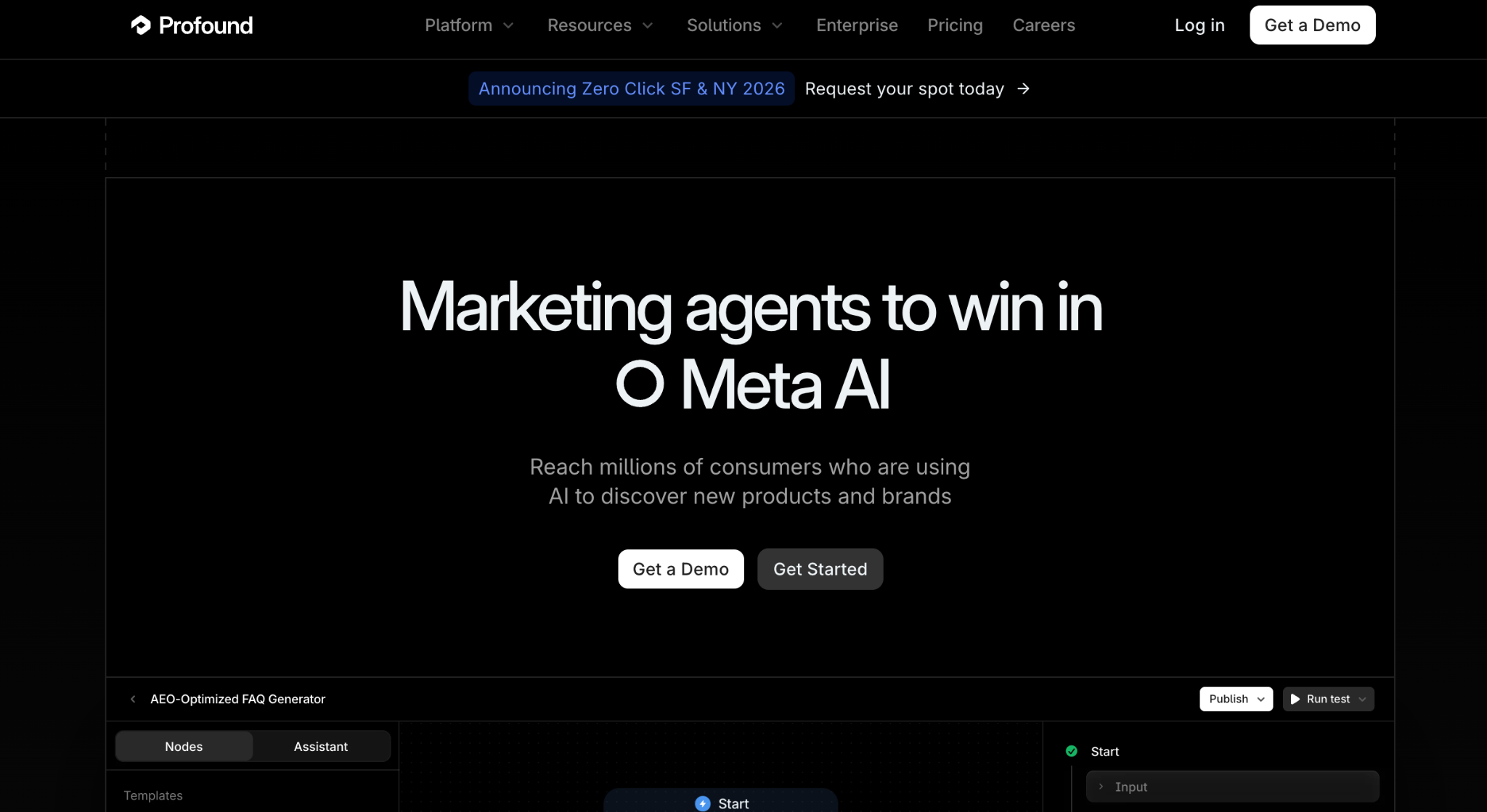
Profound processes over 1 billion citations and 10 million prompts daily, the largest dataset in the category by a significant margin. That scale enables capabilities competitors do not have: predictive analytics that estimate consumer prompt demand before you optimize for it, and Shopping Intelligence that tracks how AI engines handle product recommendations and buying-intent queries. If you need to know not just where you appear but how large the conversation opportunity is, Profound's Conversation Explorer is the only tool that attempts to quantify it.
SOC 2 Type II compliance and SSO/SAML support make it procurement-ready for large enterprises that smaller tools cannot pass through security review.
ChatGPT on Starter; ChatGPT, Perplexity, and AI Overviews on Growth; Up to 9 on Enterprise
Yes, your URLs and third-party sources
Included with narrative tracking
Starter $99/mo (ChatGPT only, 50 prompts); Growth $399/mo (3 engines, 100 prompts); Enterprise custom
Large enterprises with compliance requirements, dedicated analytics functions, and the budget to match
You are a mid-market team hoping the $99 Starter gives you meaningful multi-engine data; it covers ChatGPT only

AthenaHQ was built by former Google Search and DeepMind engineers and is backed by Y Combinator. Where most tools ask "are you appearing in AI answers," AthenaHQ asks "how is AI describing you versus your competitors." That is a more useful question for brand and communications teams who care about the quality and framing of AI mentions, not just their frequency.
The platform analyzes positioning language, whether AI engines frame your brand as a leader, an alternative, a budget option, or something more ambiguous, and tracks how that narrative shifts over time compared to competitive set descriptions. The Action Center surfaces tailored fixes including content restructuring, additional FAQs, and schema implementation based on visibility gaps and competitor positioning.
ChatGPT, Perplexity, Google AI Overviews, Google AI Mode, Gemini, Claude, Copilot, and Grok. Enterprise tier adds 60+ country and language support.
Yes, with source attribution and competitor intelligence.
Yes, brand trait analysis and narrative positioning included as core features.
Starter $295/mo (9 models, content optimization agent); API access available as a paid add-on; Enterprise custom. No free trial. Annual billing available at $245/mo on the Starter tier.
Mid-to-large PR, brand, and corporate comms teams focused on how AI describes their brand, not just citation volume.
You are a small team or agency managing multiple clients; per-brand pricing and no free trial make it expensive to test, and the best features are locked to Enterprise.
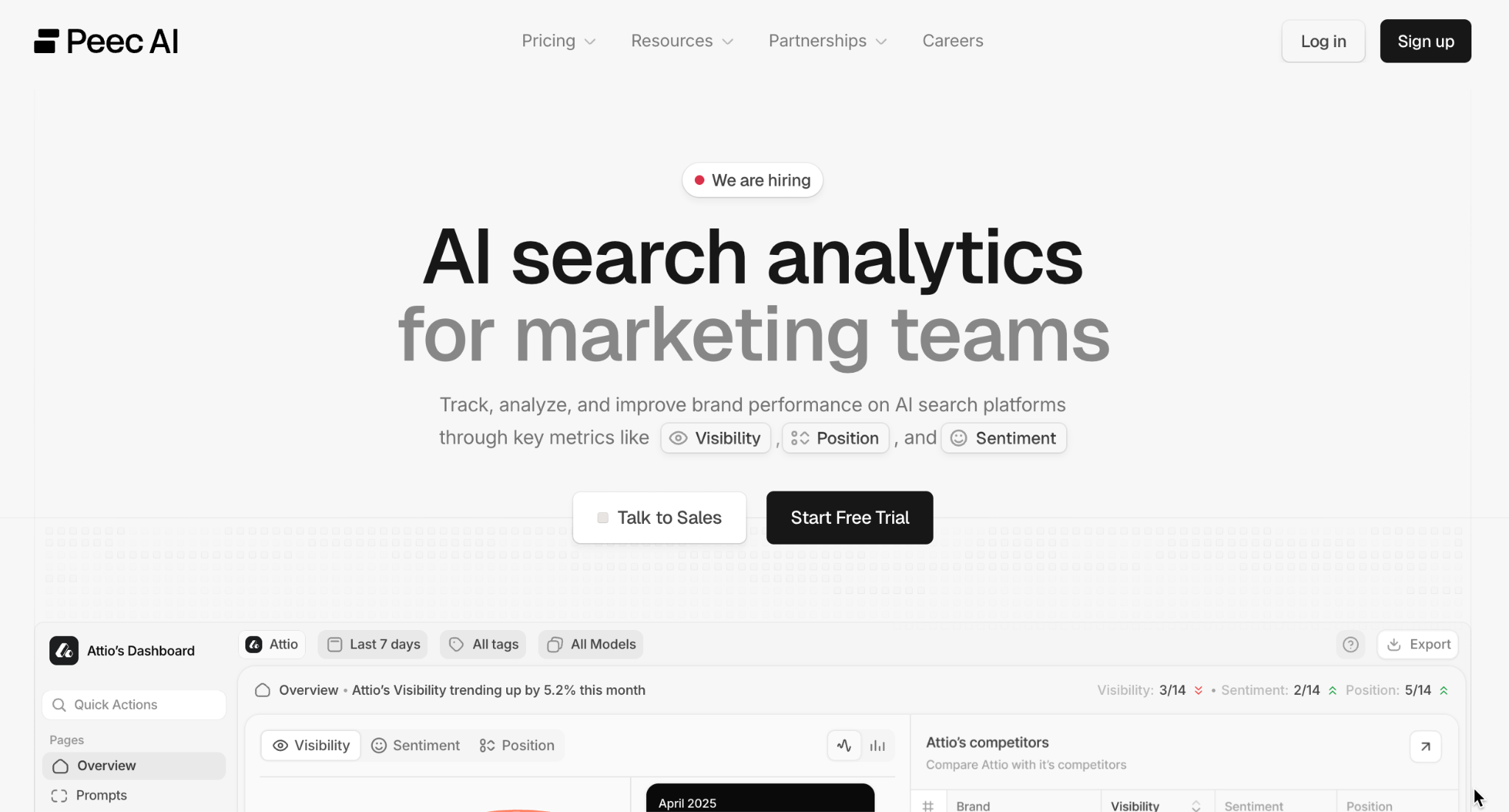
Peec goes deeper on citation mechanics than most tools in this category. Multi-layered citation decoding maps not just which sources AI cites but the structural relationship between those sources and the specific entities they reference, useful for understanding why you are being cited, not just whether you are. The entity check layer surfaces gaps in how AI represents your brand attributes, which maps directly to content fixes.
The ability to choose 3 of 7 supported engines on entry plans is a genuine differentiator: you pay for the engines that matter to your audience, not a fixed bundle.
Choose 3 of 6 on entry; options include ChatGPT, Perplexity, Gemini, AI Mode, AI Overviews, Copilot. Grok available as a paid add-on from $35/mo.
Yes, multi-layered citation decoding with entity checks
Competitor benchmarking included
Starter $95/mo (50 prompts, 3 engines); Pro $245/mo; Advanced $495/mo; Enterprise custom. Additional engines from $35/mo add-on.
Analytically minded marketing and SEO teams who want to understand citation mechanics, not just monitor mention frequency.
You need a gentle onboarding experience; the interface is data-dense, and the prompt-volume-based pricing model takes some getting used to.

Otterly is the most accessible entry point in the category for teams that want structured monitoring without enterprise complexity or pricing. The GEO Audit with SWOT analysis is a standout feature at this price point, providing a structured prioritization framework rather than just surfacing raw mention data. Daily automated prompt checks mean you do not have to remember to look.
The Semrush App Center integration is worth noting for teams already in that ecosystem: it surfaces GEO data alongside traditional SEO metrics in a single view.
ChatGPT, Google AI Overviews, Perplexity, Copilot on all plans; Gemini available from $9/mo add-on; Google AI Mode available from $9/mo add-on.
Yes, with link citation analysis.
Included with narrative consistency tracking.
Lite $25/mo (15 prompts); Standard $160/mo (100 prompts); Premium $422/mo (400 prompts). Free trial available.
Solo marketers, small teams, and Semrush users who want automated AI visibility monitoring at a low entry cost.
You need more than 15 prompts on the entry plan; meaningful monitoring requires the $160/mo Standard tier at minimum.
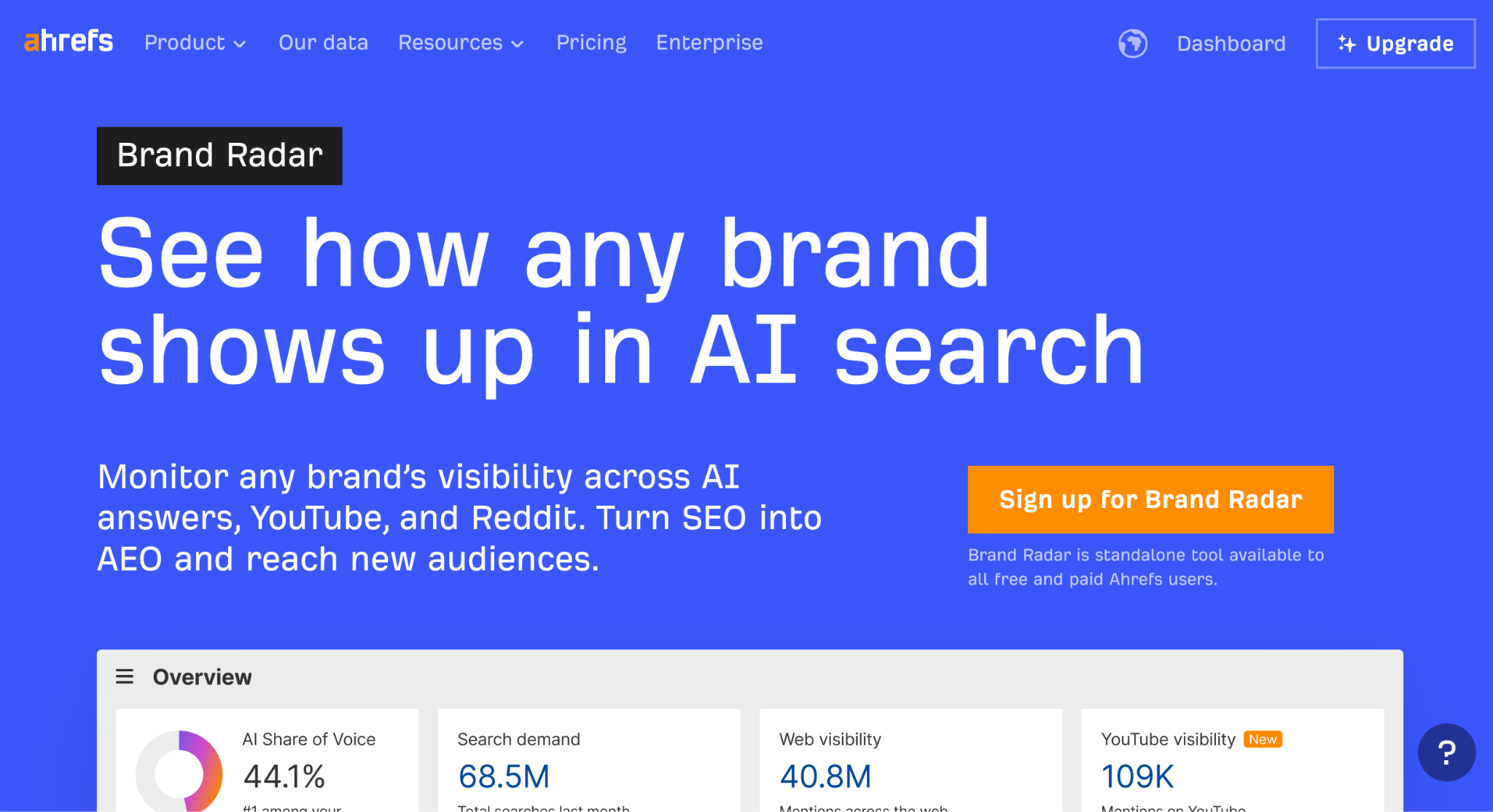
Brand Radar's core differentiator is methodology: prompts are derived from Ahrefs' actual keyword database, real search queries from real users, rather than fabricated synthetically by the platform. That makes the visibility data more grounded in actual user behavior, which matters when you are using it to prioritize content investment.
The tradeoff is pricing structure. Brand Radar charges per AI platform, which means tracking six engines costs as much as the base Ahrefs subscription itself.
Up to 6 platforms via bundle: AI Overviews, AI Mode, ChatGPT, Perplexity, Copilot, Gemini.
Yes, with source domain tracking.
Response excerpts include qualitative context; not a dedicated structured sentiment scoring feature.
Ahrefs Webmaster Tools free permanently; Custom Prompts from $50/mo (80 prompts); per AI index from $199/mo; all 6 indexes $699/mo. Base Ahrefs subscription required separately from $129/mo.
Teams already using Ahrefs for SEO who want AI visibility data without adopting a new tool.
You want affordable multi-engine coverage; full six-platform tracking at $699/mo plus a base subscription is a significant commitment.
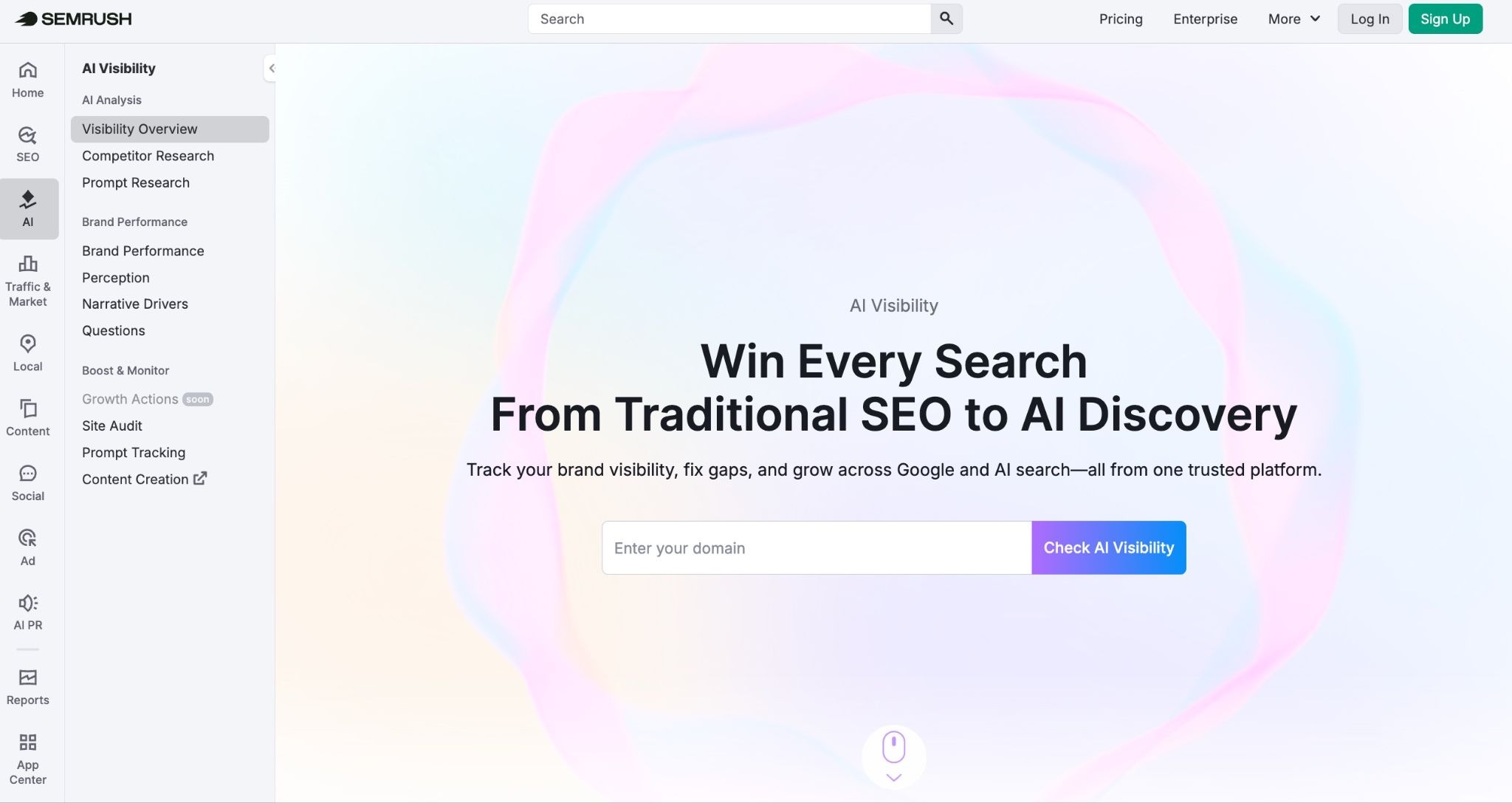
Semrush’s strongest argument is integration. For teams already running keyword research, rank tracking, and competitive analysis in Semrush, adding AI visibility data in the same dashboard removes meaningful friction: no new login, no new reporting layer, no reconciling data from two platforms.
The 289M+ AI query database for Prompt Research surfaces the specific prompts your target audience is already using in AI engines, a more actionable starting point than building a prompt set from scratch. The free AI visibility audit across 289M+ prompts is worth running before committing to any paid plan in this category.
Google AI Overviews, Google AI Mode, ChatGPT, Perplexity, Gemini.
Yes, cited pages tracking with source attribution.
Share of voice and sentiment scores included.
Included in Semrush One Pro+ at no extra cost; AI Visibility Toolkit standalone at $99/mo per domain; free AI visibility audit available without subscription.
In-house teams and agencies already running Semrush who want AI visibility in one place without a separate subscription.
You are not on Semrush and want a best-in-class dedicated AI tracking tool; the AI features are stronger when the rest of the Semrush stack is doing the heavy lifting around them.

ZipTie was built by the team behind Onely, a respected technical SEO agency, and that heritage shows in its approach. Where most monitoring tools stop at telling you where you are invisible, ZipTie pairs visibility reports with on-page content optimization briefs that map directly to implementation tasks. The output is a to-do list, not a dashboard to interpret.
The AI Success Score blends mention frequency, citation presence, answer placement, and sentiment into a single number designed for stakeholder reporting. ZipTie also detects results by simulating real browser behavior rather than API calls, which means results reflect what actual users see rather than what an API endpoint returns.
Google AI Overviews, ChatGPT, and Perplexity. Does not currently track Claude, Gemini, Google AI Mode, Copilot, Grok, or DeepSeek as of May 2026.
Yes, with source attribution and content optimization briefs tied to citation gaps.
Yes, sentiment is factored into the AI Success Score alongside mention frequency, citation presence, and answer placement.
Plans start from $69/mo; 14-day free trial available. Annual billing saves approximately 15%. Standard plans are limited to one seat; agency plans available at higher pricing.
Technical SEO and content teams that want implementation guidance alongside monitoring, not a reporting dashboard to interpret themselves.
You need to track more than three AI engines; ZipTie's coverage is limited to Google AI Overviews, ChatGPT, and Perplexity, which is a meaningful constraint for brands whose audiences use Claude, Gemini, or Copilot.
Yes. Semrush's free AI visibility audit covers 261M+ prompts with no subscription required. Ahrefs Webmaster Tools is free permanently with limited Brand Radar access. Otterly AI offers a free trial. All three are credible starting points before committing to a paid plan.
AI engines are non-deterministic — the same prompt returns different answers on different runs. Tools handle this by running high prompt volumes and aggregating results. Treat output as directional signal, not precise measurement, and look for consistent trends over time rather than point-in-time snapshots.
Yes. Rank trackers measure where you appear in classic search results. AI visibility tools measure whether you're cited in AI-generated answers. The signals are related but don't substitute for each other. Teams serious about search visibility need both.
An llms.txt file gives AI crawlers structured guidance about your site's content — analogous to robots.txt but designed for LLMs. Early evidence suggests it improves how AI systems index your content. ZipTie generates these as part of its optimization workflow. For manual creation, it's a plain text file at your domain root listing key content with brief descriptions.
Weekly is sufficient for most teams. Fast-moving competitive categories or active GEO campaigns warrant daily tracking, available on most paid plans. Monthly is the minimum — checking less often makes it hard to connect visibility changes to specific actions.
No single tool covers all engines with equal depth. Most specialize in two to five and offer others as add-ons. For most brands, ChatGPT, Google AI Overviews, and Perplexity covers the essentials. Profound and Scrunch Enterprise come closest to comprehensive multi-engine coverage.

Irina is a Founder at ONSAAS, Growth Lead at Aura, and a SaaS marketing consultant. She helps companies to grow their revenue with SEO and inbound marketing. In her spare time, Irina entertains her cat Persie and collects airline miles.
.svg)
.svg)
.svg)
.svg)
.svg)