
.svg)
%20(1).svg)
%20(3).svg)
Back to articles
The Best AI Content Optimization Tools in 2026 — Ranked
June 25, 2026
By
Irina Maltseva
Content optimization used to mean stuffing keywords and watching a readability score tick green.
In 2026, it means something fundamentally different: getting your content cited by AI engines, not just ranked by Google. The problem? Most tools in this category are still fighting last year's battle. They'll help you win Page 1 of a search results page that fewer people are actually seeing — while the AI answer box above it cites your competitor.
Over the past year, multiple independent studies have shown that AI-powered search formats such as Google's AI Mode lead to over 90% of queries ending without a click to any website.
Users increasingly consume the AI-generated summary instead of navigating to the organic results below it — which is why AI citation visibility is becoming more valuable than Page 1 rankings.
This guide covers the tools built for where search is actually going — and surfaces the one critical distinction most roundups miss entirely.
AI search is still emerging, but its tithly related to your rankings: recent analyses show that pages with a higher ranking in organic results tend to be cited higher in AI Overviews when included as a citation.
Let’s look at the roundup of the AI content optimization tools that help you get mentions in AI citations and boost your SEO.
Before picking tools, we had to define what "content optimization" actually means in 2026. The category has quietly split in two, and most buyers don't realize it until they're six months into a subscription that solves the wrong problem.
Any tool worth including on this list had to meet most of the following criteria:
Surface what's working and why: Real scoring backed by data — not just keyword counts dressed up in a dashboard. If a tool can't explain why content ranks or gets cited, it's a black box.
Handle Google and AI engine visibility — or be honest about which one it solves: The era of single-channel content optimization is over for most teams. Recent user behavior studies show that roughly 38% of people now begin their information-seeking with AI tools instead of opening a traditional search engine — a shift that forces content teams to treat AI visibility as a primary channel rather than an experimental one.
Give you something actionable: Data you have to interpret yourself is just homework. The best tools tell you what to fix, not just what's broken.
Be usable by non-specialists: You shouldn't need an SEO engineering background to run a content audit. Ease of use is a feature, not a consolation prize.
Integrate into your existing workflow: CMS connections, Google Docs, GA4, or API access — whichever matters to your team. Tools that force you to change how you work rarely get used.
Offer a real trial: Any tool that won't let you test with your own content is telling you something about what they expect you to discover.
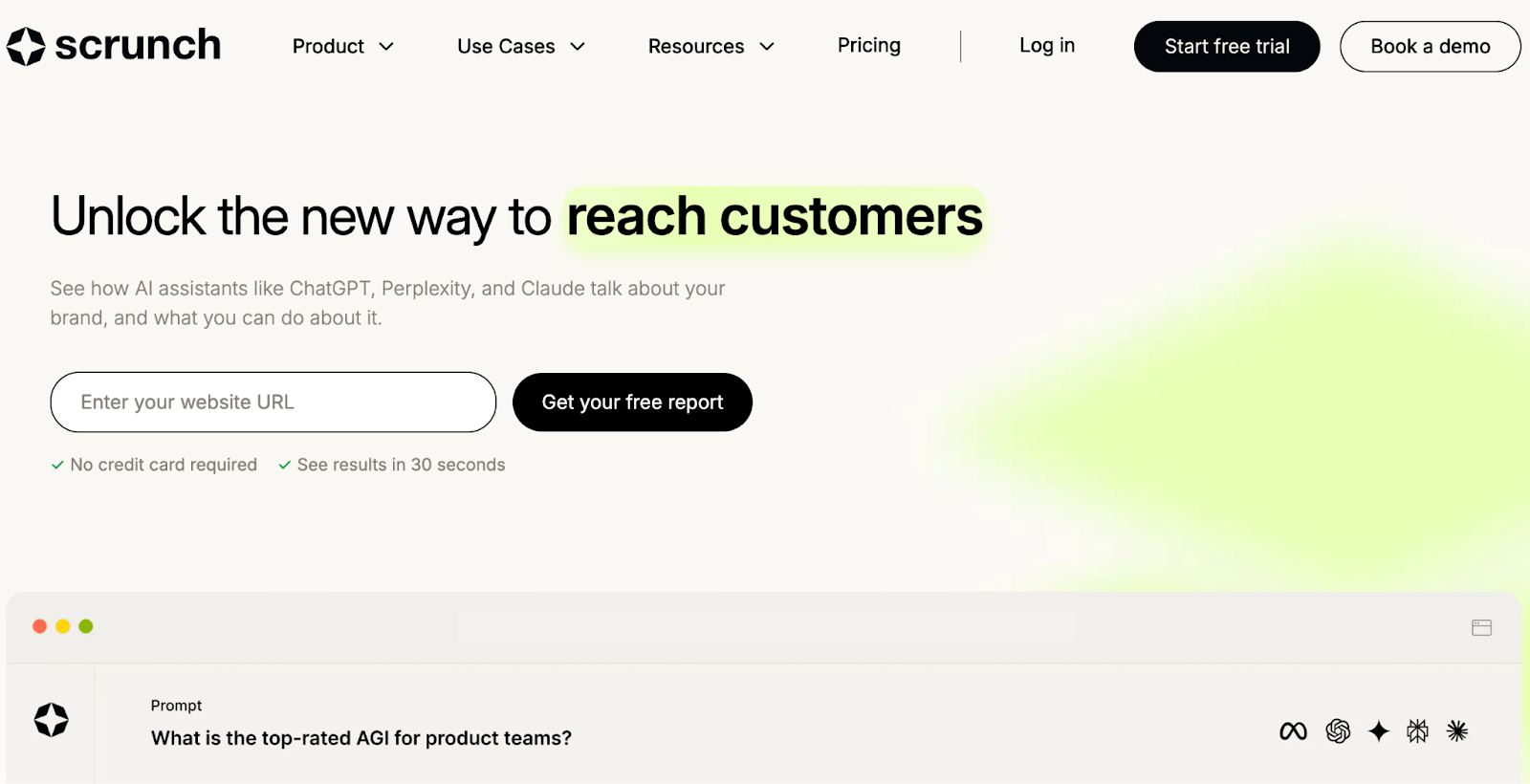
Here's the thing most roundups get wrong: they treat "AI content optimization" as if it just means adding a ChatGPT visibility tracker to a standard SEO tool. Scrunch is the only platform on this list that takes a fundamentally different approach — it's built to close the loop between where you're being cited and what AI engines actually consume from your site.
That distinction matters more than it sounds. Most tools tell you what to write. Scrunch changes how AI systems read your content at the infrastructure level.
The standout feature is its Agent Experience Platform (AXP) — a CDN-layer solution that delivers a stripped-down, structured version of your site specifically to AI crawlers, without touching the human-facing experience. It removes excess JavaScript and superfluous code, dramatically reducing token consumption. In practice, this means LLMs can parse your content faster, more accurately, and with less noise — which directly influences whether you get cited.
Add to that an AI-optimized XML sitemap (structured for LLM crawlers, not traditional search engines) and an AI-focused site audit that surfaces exactly where your content is hard for AI bots to interpret, and you have a platform operating in a genuinely different category from the rest of this list.
Scrunch integrates directly with ChatGPT Browse, Perplexity, Claude, Gemini, Bing Chat, and other LLM crawlers — making it one of the broadest in terms of engine coverage. Critically, it's the only platform offering real-time AI citation monitoring linked to server-level content delivery. No competitor does that.
Best for: B2B teams, agencies, and enterprises that need to diagnose and act on AI citation gaps — not just monitor them.
Pricing: From $300/month
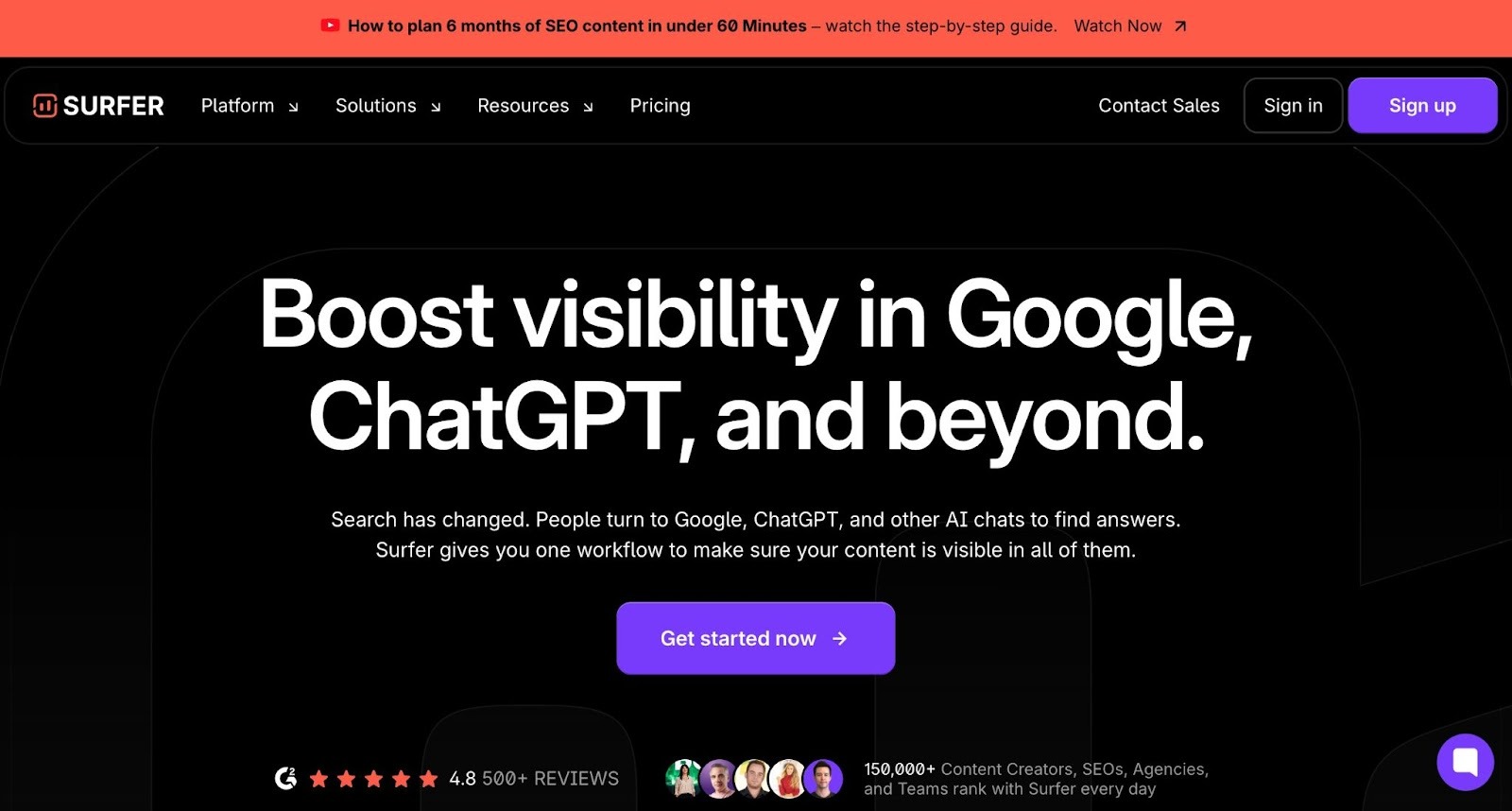
If Scrunch is the AEO specialist, Surfer is the reliable generalist — and that's a compliment. It remains the default choice for content teams optimizing for Google, with real-time content scoring, NLP term suggestions, topical cluster mapping, and an AI writer bundled into one clean platform.
What makes Surfer particularly interesting in 2026 is its AI Tracker, now included on Pro plans. It monitors brand visibility in AI-generated results across ChatGPT, Perplexity, and AI Overviews — making it one of the few tools genuinely crossing both categories. It's not as deep as a dedicated AEO platform, but for teams that live in Surfer already, it's a meaningful bridge.
The honest caveat: Surfer's AI visibility features feel like a smart addition to an SEO-first platform — because that's exactly what they are. If AI citation monitoring is your primary goal, you'll want something more purpose-built. But if you're running 10+ articles a month and need Google optimization with AI visibility layered on top, the value is hard to argue with.
Best for: Content agencies and in-house teams producing at volume who want Google optimization with AI visibility as a secondary layer.
Pricing: From $89/month
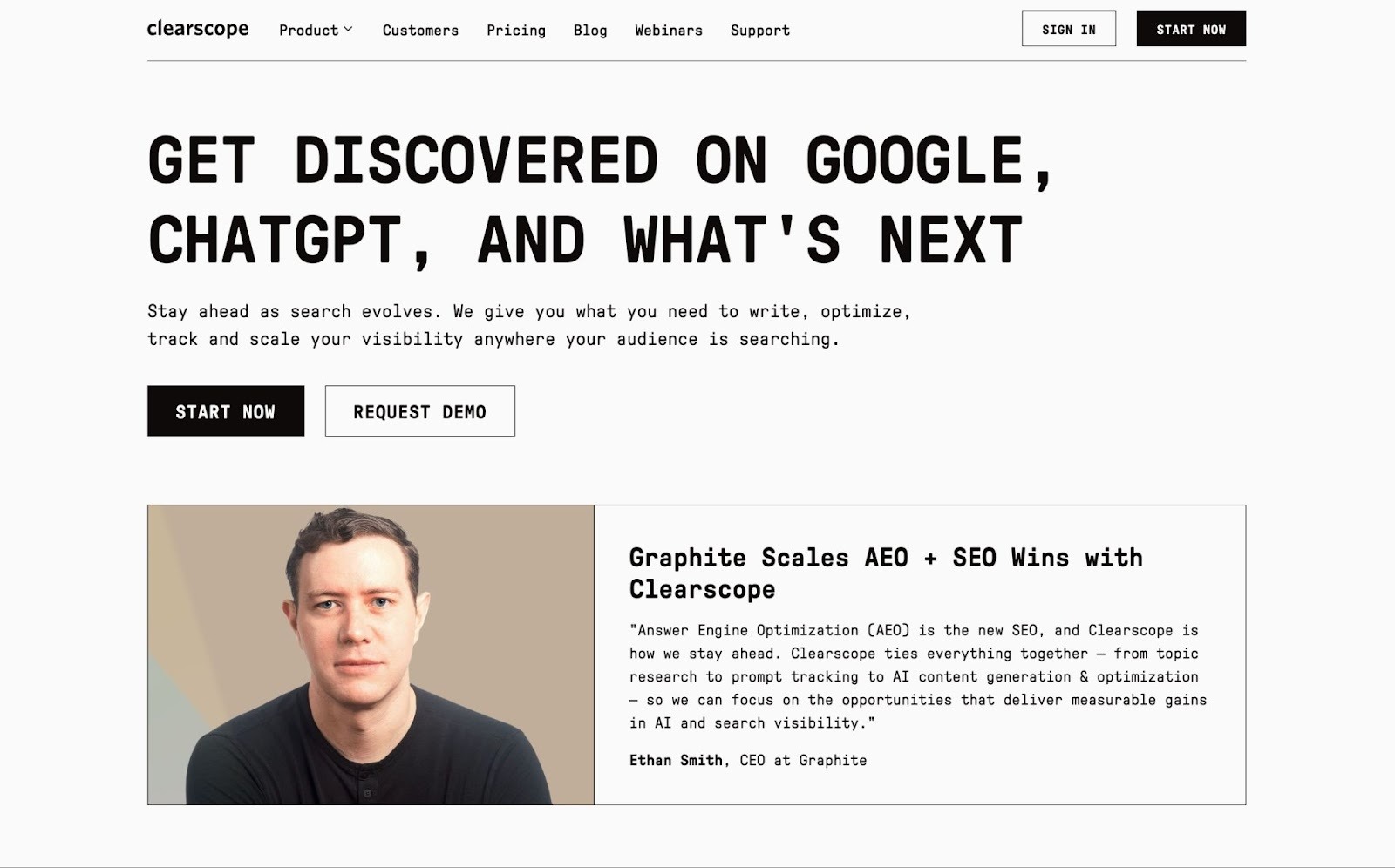
Clearscope doesn't try to be everything. It's a pure content optimization tool, and it does that one job better than almost anyone else. The letter-grade content scoring is consistently the most accurate semantic analysis in the category. The interface is clean. The NLP recommendations are reliable without being noisy.
What it doesn't have: AI writing features, AI visibility tracking, or anything pointing toward GEO.
The limitation is becoming more pronounced as AI engines collectively process tens of millions of search-like queries per day, many of which bypass Google entirely. For editorial teams optimizing primarily for Google, this may be fine — but it’s increasingly a strategic decision.
None of that is accidental — Clearscope serves large editorial teams with dedicated writers who need a dependable optimization layer, not another AI writing assistant to wrangle.
If your writers are already strong and your primary goal is Google rankings, Clearscope's precision is genuinely hard to beat. The absence of AI engine features is worth calling out clearly: if you need that, you'll need to stack another tool on top or look elsewhere.
Best for: Large editorial teams with strong writers who need best-in-class semantic scoring without the noise.
Pricing: From $189/month
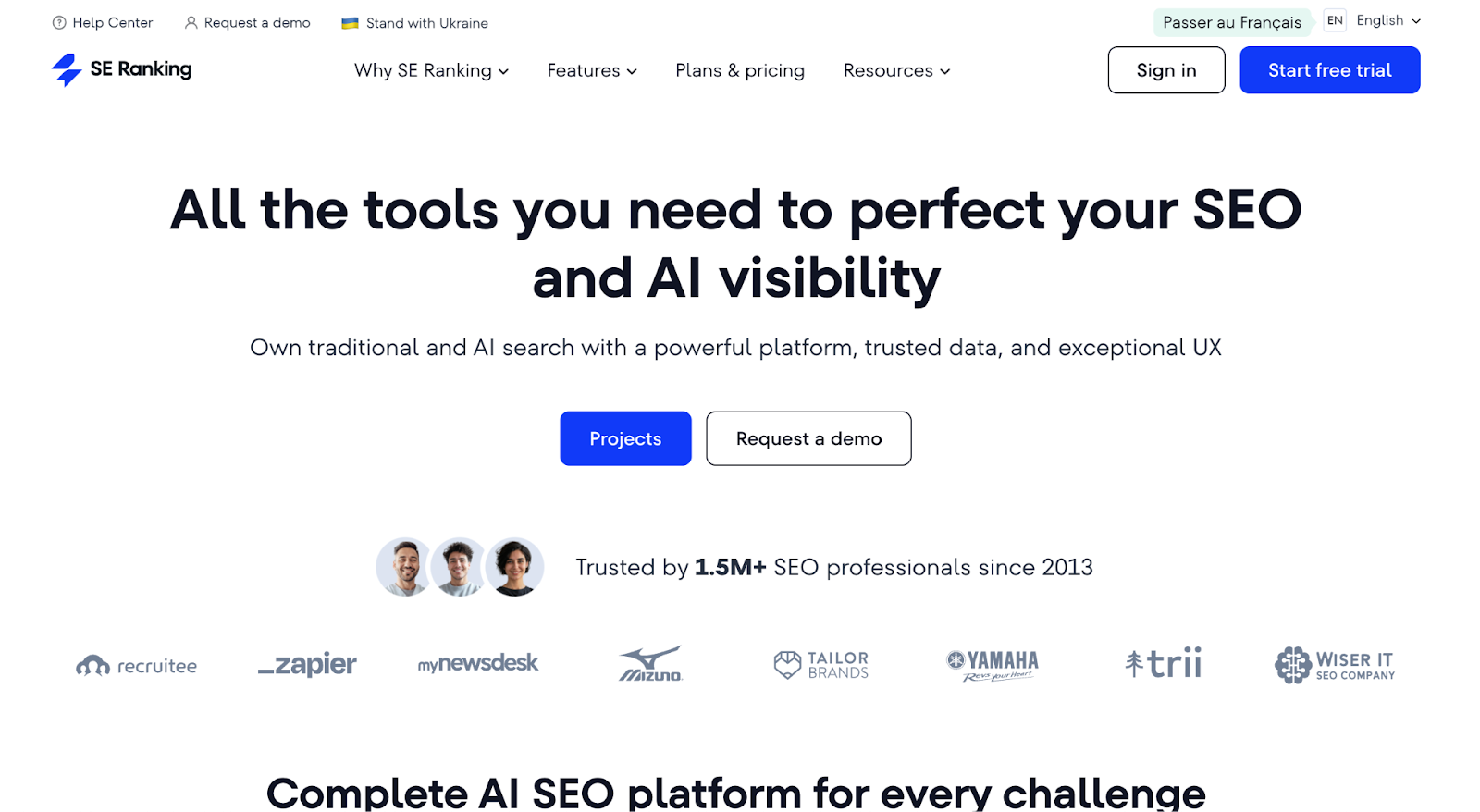
SE Ranking earns its place here on one metric above all others: breadth at a price point that doesn't require board approval. Content optimization, AI visibility tracking, rank tracking, and site audit — all under one subscription, with daily refresh on AI Overviews and ChatGPT monitoring.
One detail that matters more than it sounds: SE Ranking makes it easy to remove irrelevant NLP suggestions from your editor. That's a small UX decision that saves real time in agency workflows where writers are applying recommendations at scale. When you're managing 30 client content calendars, the friction of noisy suggestions adds up fast.
The AI visibility features aren't as deep as Semrush or as purpose-built as Scrunch, but for a team that wants one platform instead of a stack — and doesn't want to pay enterprise rates for that — SE Ranking makes a genuinely compelling case.
Best for: SEO professionals and mid-size agencies who want a single platform covering both traditional and AI search visibility.
Pricing: From $65/month (content marketing add-on required for full features)
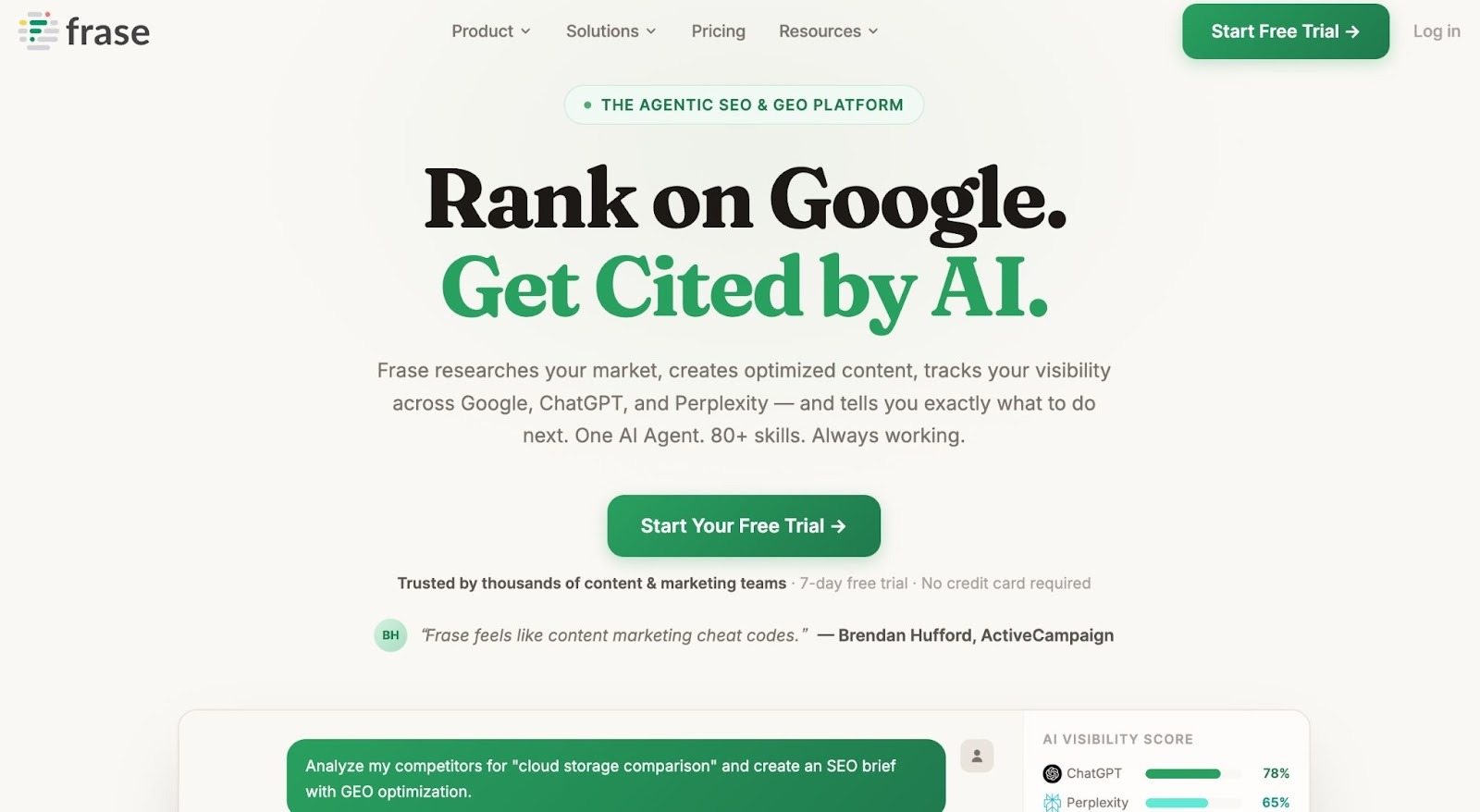
Frase wins on speed and price. It generates content briefs and conducts SERP research faster than any other tool at this price point, and it includes AI writing at every plan level — no upsell required. For freelancers, solo creators, and small teams operating on tight budgets, the ROI math is straightforward.
The trade-off: NLP scoring is less granular than Surfer or Clearscope. If you're doing precision optimization for highly competitive keywords, you'll feel the gap. But for teams where the bottleneck is ideation and research speed, not scoring precision, Frase fills that gap efficiently.
No meaningful AI engine visibility features to speak of — Frase is a Google-first tool, and it doesn't pretend otherwise.
Best for: Freelancers and small teams who need fast, affordable content research and briefs without paying for features they won't use.
Pricing: From $45/month
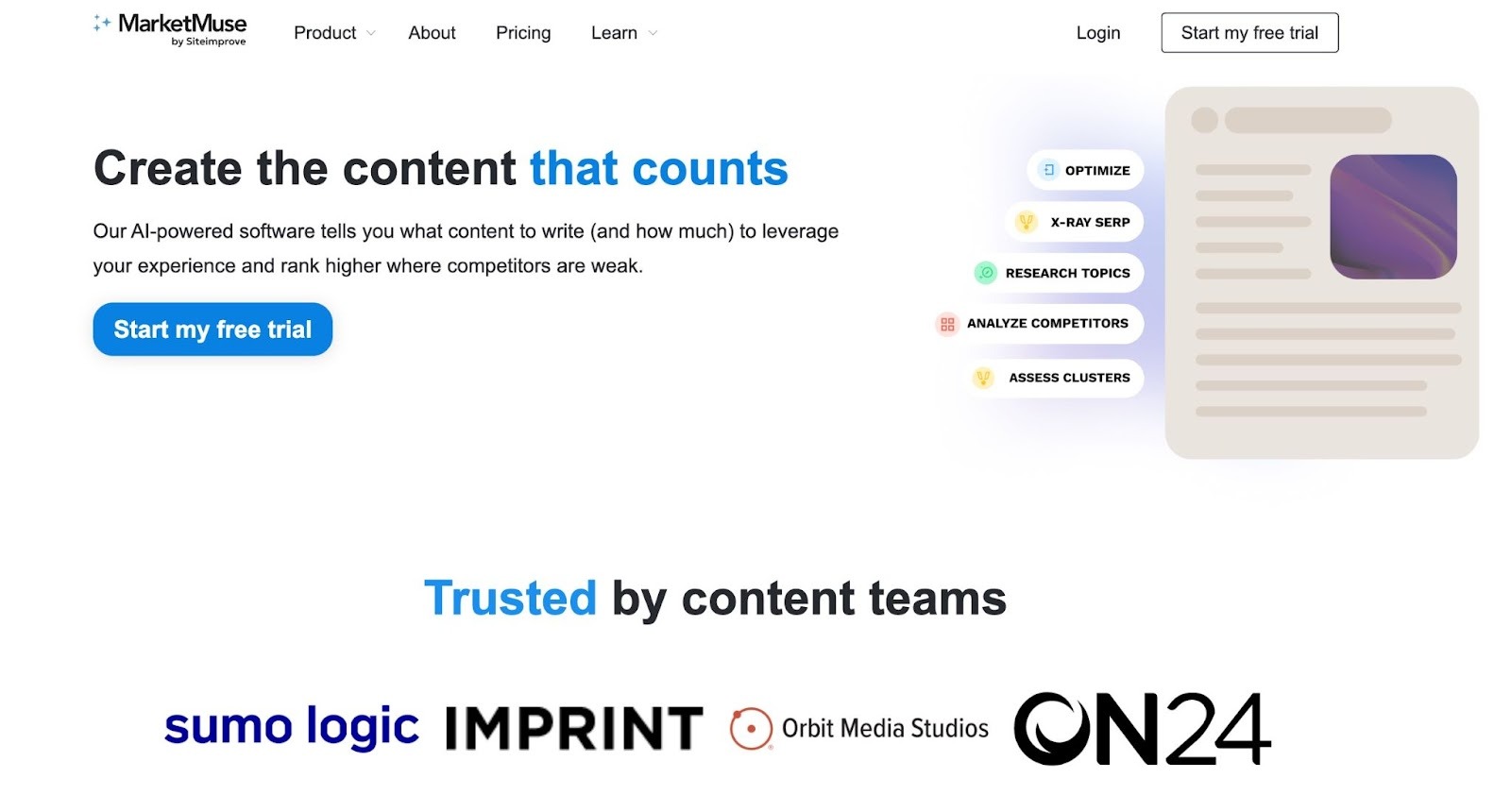
MarketMuse operates at a level most content optimization tools don't touch: your entire content inventory against your competitors', surfacing gaps and prioritizing what to build next.
This site-wide approach matters more than ever: recent studies on generative engines show that brands with stronger topical authority across a cluster are significantly more likely to be referenced in AI answers, even when individual pages aren't the highest-ranking in Google.
If you're managing 100+ published pages and trying to figure out which topics you own, which you're losing ground on, and which represent untapped authority, MarketMuse is built for exactly that problem. It's a planning tool, not a writing assistant, and it shouldn't be evaluated as one.
No AI engine visibility features here either. MarketMuse remains Google-centric in its optimization layer. But as a site-level strategy tool, it earns its price for teams with the content maturity to use it.
Best for: SEO strategists managing large content portfolios who need competitive gap analysis at the site level.
Pricing: From $99/month (enterprise plans significantly higher)
Semrush One adds AI visibility tracking to a platform that most enterprise marketers are already paying for — and that changes the value calculation significantly. Monitoring ChatGPT, Gemini, AI Overviews, and AI Mode from the same interface where you're already running rank tracking and competitive analysis is genuinely convenient.
The standout stat: a 213M+ prompt database for AI search research, the largest in the category. If you're trying to understand which prompts and queries surface your brand (or your competitor's) in AI-generated results, the data depth here is unmatched.
The honest read: the AI features feel like what they are — a well-executed addition to an SEO-first platform. For teams that don't already use Semrush, the $199/month entry point for Semrush One is a steep way to get AI visibility monitoring. For teams that do? The marginal cost of the AI layer is low, and the integration value is real.
Best for: In-house marketing teams and agencies already running Semrush who want AI visibility without adding a separate subscription.
Pricing: From $199/month (Semrush One)
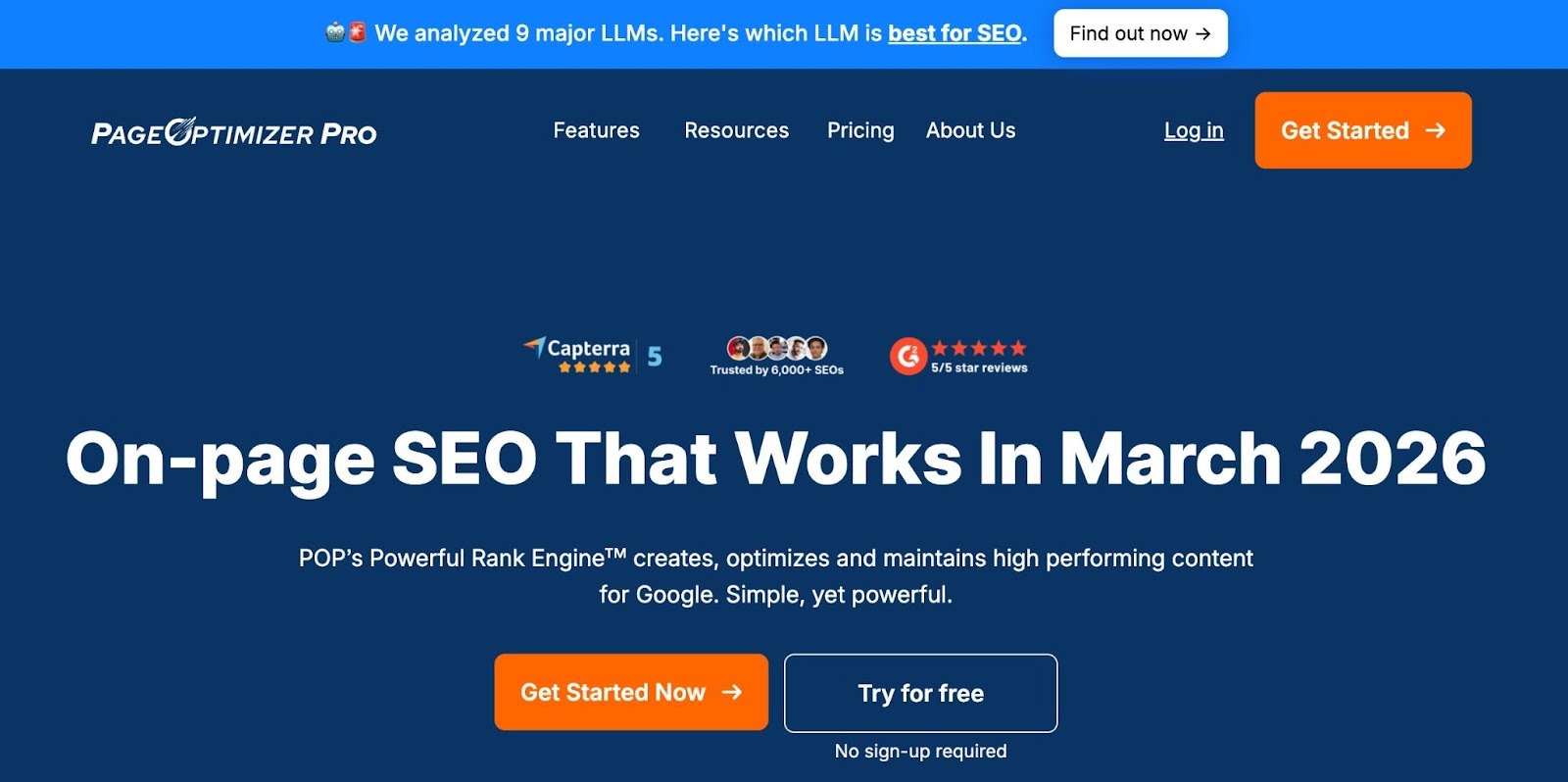
PageOptimizer Pro (POP) consistently surprises people who judge it by its price point. Under the hood, it processes 400+ tests and analyzes 100+ SEO factors per report — a level of methodological rigor that outperforms tools at 3–4x its price.
The feature that deserves more attention: POP Watchdog. It monitors your optimized pages and alerts you when competitors or algorithm updates change what's needed for rankings. In a category where most tools help you optimize once and move on, Watchdog adds an ongoing monitoring layer that nothing else at this price provides.
No AI visibility features. POP is data-driven traditional SEO optimization, done more thoroughly than most. For budget-conscious SEOs who need accuracy over breadth, the value-per-dollar is exceptional.
Best for: Budget-conscious SEOs who want rigorous, data-driven optimization without premium pricing.
Pricing: From $37/month
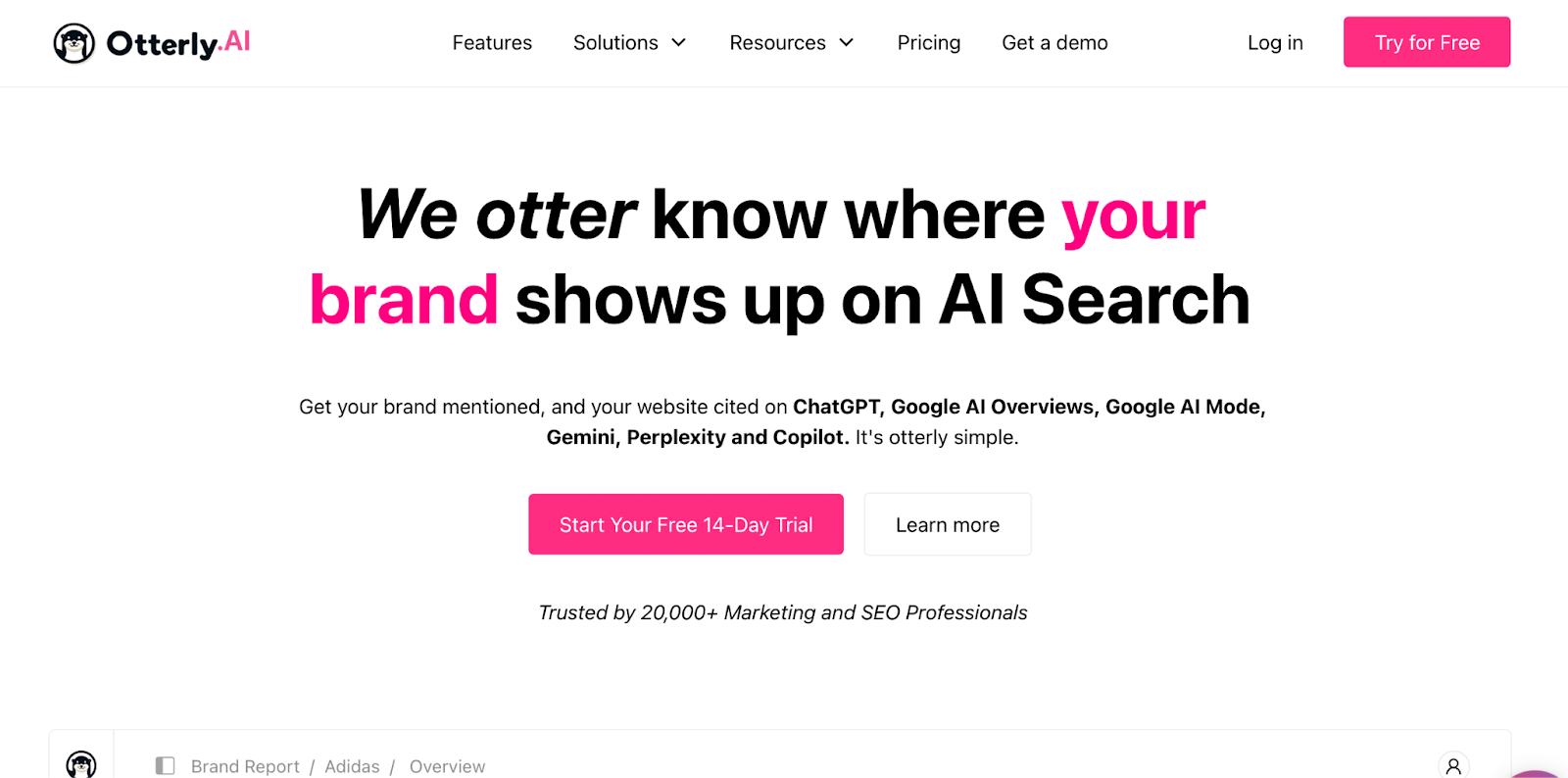
Otterly occupies a specific and useful niche: structured GEO diagnostic before you build a broader AEO strategy. It monitors six AI platforms, analyzes 25+ ranking factors, and delivers recommendations across content, technical, structured data, and authority signals — more diagnostic depth than anything else at its price tier.
The Brand Visibility Index is a proprietary metric not found in other tools at this price point, offering a single comparative score for how your brand surfaces across AI engines. For teams at the beginning of their AEO journey who want a structured audit before committing to a full platform, Otterly is an efficient starting point.
Best for: Businesses starting their AEO journey who want a structured audit before investing in a more comprehensive platform.
Pricing: From $189/month
The market has moved fast enough that many buyers are evaluating tools before they've fully defined the problem they're solving. Here are five questions worth answering before you commit:
1. Are you optimizing for Google, AI engines, or both — and do you know which one you actually need? The tools on this list span three different categories. Buying the wrong one means optimizing for a channel that isn't your primary acquisition driver.
2. Can it show you which content AI engines are already citing, and which they're ignoring? Monitoring is table stakes for AEO. If a tool can't show you your current citation status, it can't tell you if anything you do is working.
3. Does it cover the AI engines that matter for your audience? ChatGPT and AI Overviews get most of the attention. But Perplexity, Claude, and Gemini drive significant query volume in B2B contexts. Engine coverage matters.
4. Can you configure it around your prompts, personas, and funnel — or are you locked into their taxonomy? The best tools adapt to how your buyers actually search, not a generic keyword model.
5. Will they give you real trial access before you buy? This is a tell. A tool that won't let you test with your own content doesn't believe you'll like what you find.
Understanding what these tools can do is only half the job. Here's how to actually get results from them:
Before you touch a single piece of content, run a diagnostic — ideally with a tool that surfaces AI-specific issues, not just traditional SEO gaps. You need to know which pages are already getting invisible AI citations, and why.
The on-page signals that help you rank in traditional search are not the same as the structural signals that help AI engines parse and cite your content. Trying to optimize for both simultaneously with a single checklist is a good way to do neither well.
AI crawlers rely heavily on schema markup, clean HTML, and low-noise content delivery to interpret pages accurately. This is where tools like Scrunch's AXP layer operate — and it's where most teams have the biggest untapped opportunity.
Rankings decay. AI citation patterns shift as models update. The teams winning in AI search in 2026 have monitoring in place, not just optimization checklists. Several tools on this list — Watchdog in POP, AI Tracker in Surfer, Scrunch's real-time monitoring — are specifically built for this.
Traffic and rankings are proxy metrics. The real question in 2026 is: is your brand being cited in AI-generated answers? That's the measurement that tells you whether your content strategy is working for the channel where buyers are actually starting their research.
The category called "AI content optimization" now covers two genuinely different problems: ranking in traditional search and getting cited by AI engines. Most tools solve one. Very few address both — and only one approaches the problem at the infrastructure level.
Before you pick a tool, know which problem you're actually solving. Then pick the one built for it. The worst outcome isn't choosing an expensive tool — it's choosing a capable one that's optimizing for the wrong channel entirely.
Content optimization tools help you improve your content's performance in search — whether that's traditional Google rankings or AI engine citations. They typically analyze your content against top-ranking competitors, suggest semantic improvements, score your content quality, and in newer tools, track whether AI systems like ChatGPT or Perplexity are citing your pages. The category has expanded significantly in 2025–2026 to include AI-specific features like GEO audits, brand visibility tracking across AI platforms, and infrastructure-level optimization for LLM crawlers. Scrunch is the most advanced example of that last category — it operates at the CDN layer to change how AI systems actually consume your site, not just what you've written on it.
For traditional Google SEO, Surfer SEO and Clearscope remain the strongest content optimization options. But if your question is really "which tool is best for showing up in AI-generated answers" — that's a different question with a different answer. Scrunch is the only tool built specifically to optimize at the infrastructure level: structuring your content delivery for LLM crawlers, reducing token consumption, and closing the loop between AI citation monitoring and server-level content changes. For teams where AI search visibility is the priority, not just Google rankings, Scrunch is the most purpose-built option in the category.
Most serious content optimization tools don't offer meaningful free tiers, though many offer trials. Frase is the most accessible paid option at $45/month for traditional SEO briefs. Google Search Console remains the highest-value free tool for understanding search performance. For AI-specific visibility, Scrunch offers a structured onboarding process — worth requesting a demo before committing, since the platform's value is most visible once it's auditing your actual site against real LLM crawler behavior.
It depends on what your clients are hiring you to solve. For traditional SEO at scale with AI visibility layered on, Surfer SEO and SE Ranking offer strong combinations of features and price. But for agencies whose clients are asking "why aren't we showing up in ChatGPT or Perplexity results" — that's where Scrunch becomes the most defensible answer. It's the only tool that addresses AI citation gaps at the infrastructure level, which means it solves problems that content edits alone can't fix. For agencies building an AEO practice, Scrunch gives you a technical differentiator that most competitors can't replicate with a standard content optimization stack.
Optimizing content for AI engine visibility requires a different approach than traditional SEO. Focus on: (1) clear, structured content with strong semantic signals — AI engines reward clarity and topical authority; (2) technical cleanliness — remove excess JavaScript and noise that makes it harder for LLM crawlers to parse your pages; (3) schema markup and structured data — these help AI systems understand your content's context; (4) authority signals — citations, backlinks, and brand mentions across the web influence how AI engines weight your content; (5) monitoring — track which pages are being cited and by which engines, then iterate. The teams winning AI citations in 2026 treat it as an ongoing program, not a one-time checklist.

Irina is a Founder at ONSAAS, Growth Lead at Aura, and a SaaS marketing consultant. She helps companies to grow their revenue with SEO and inbound marketing. In her spare time, Irina entertains her cat Persie and collects airline miles.
.svg)
.svg)
.svg)
.svg)
.svg)