Writesonic's credit system was manageable when you were publishing twice a week. It gets painful fast when you're scaling. Restrictive monthly credits, outputs that need heavy editing before they're usable, and GEO features locked behind a $249/month tier are sending teams to look for alternatives.
The problem is that switching tools is real friction — and most comparison guides rank tools without telling you which one actually fits your workflow. This guide covers six alternatives organized by job-to-be-done, with honest tradeoffs and cost math included.
Decision framework at a glance:
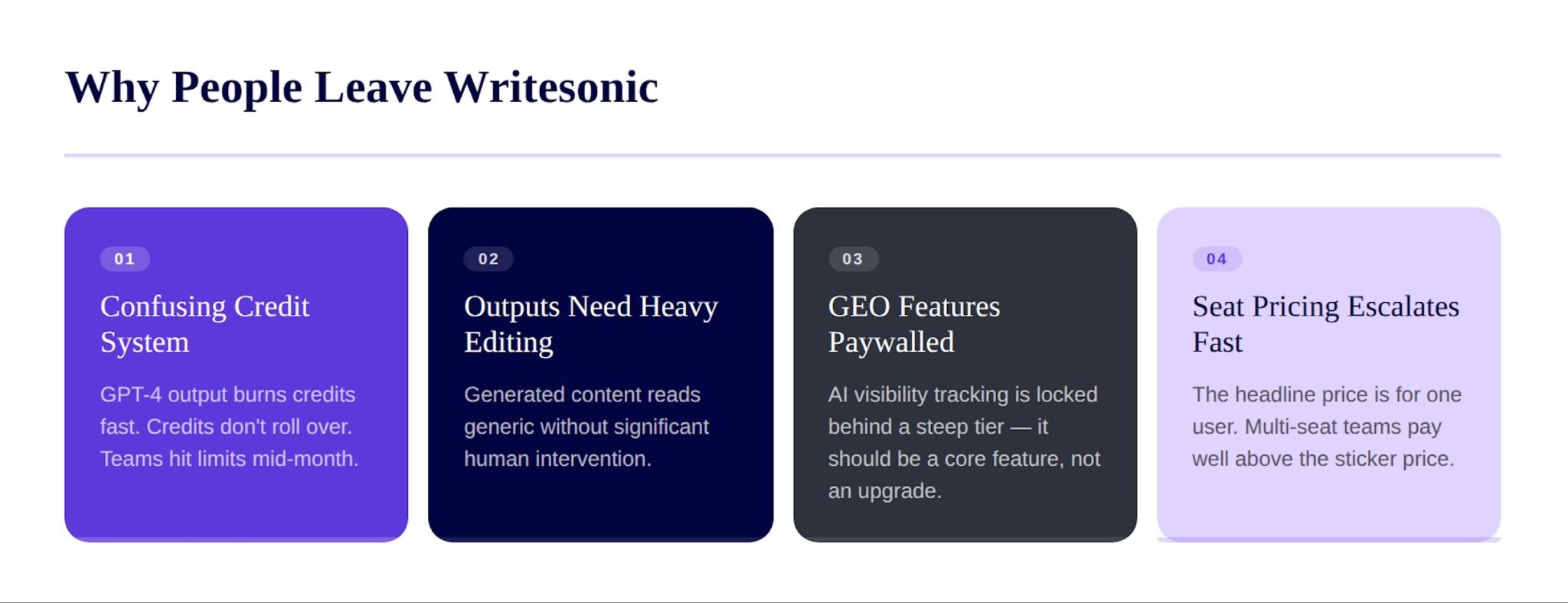
Writesonic is a capable platform, but the friction points are consistent across G2, Capterra, and Reddit.
The credit system is confusing and punishing. Superior quality (GPT-4) output burns credits significantly faster than standard quality, and credits don't roll over. Teams routinely hit limits mid-month — over 30 G2 reviews cite this as their primary frustration.
Outputs require heavy editing. Generated content reads generic without significant human intervention. If you're building thought leadership, a tool that produces first drafts that still sound like AI won't get you there. In fact, 86% of marketers using AI tools report spending time manually editing the content generated — suggesting that output quality, not just output speed, is where most tools still fall short.
GEO features are paywalled steeply. AI search visibility tracking starts at $249/month and only covers three AI platforms. The $499/month plan adds a fourth. That's a steep price for what should be a core feature in 2026.
Seat pricing escalates fast. The headline price applies to one user. Multi-seat teams quickly discover the real monthly bill is well above the sticker price.
When evaluating a replacement, the right question isn't "which tool is best overall" — it's: what is my primary job-to-be-done? SEO content, GTM copy, AI visibility tracking, or budget-first output? The answer determines your shortlist.

Scrunch isn't a content creation tool — it's the layer that controls whether your content gets cited in AI-generated answers. If you're leaving Writesonic because you want better GEO functionality, Scrunch is the purpose-built alternative.
The core product monitors how your brand appears across ChatGPT, Perplexity, Google AI Overviews, Gemini, and Copilot at the prompt level — tracking citation frequency, share of voice against competitors, and the sentiment of how AI describes your brand. The Insights feature goes further, surfacing actionable recommendations for improving citation rates, not just reporting the current state.
The Agent Experience Platform (AXP) is the most technically distinctive feature: it sits at the CDN layer and automatically serves AI crawlers a clean, token-efficient version of your pages without touching the human-facing site. Teams with JavaScript-heavy pages that AI agents struggle to extract from can fix that problem at the infrastructure level rather than rebuilding pages.
Strengths:
Weaknesses:
When to use: You're optimizing for AI search visibility, tracking share of voice against competitors in AI answers, or diagnosing why AI agents aren't citing your content despite good traditional SEO.
Pricing: Core plan from $250/month (4 AI engines). Enterprise custom pricing. No free trial — demo-based onboarding.
Best for: Marketing teams and agencies that have content creation covered and need a dedicated GEO monitoring and optimization layer.
Jasper does one thing very well: produce brand-consistent marketing content at scale across a team. The Brand Voice feature trains on your existing copy and maintains that voice across everything the AI generates — for teams managing multiple brands or multiple writers, that's the feature that justifies the price.
The 2025 multi-agent system is a genuine differentiator for enterprise teams: multiple AI agents collaborate on campaign planning, content creation, and quality review. A campaign brief can turn into briefs, drafts, social copy, and email sequences within a single workflow. Jasper integrates natively with Semrush for SEO scoring, which partly compensates for the lack of native SERP analysis.
Strengths:
Weaknesses:
When to use: You run a marketing team that produces multi-format content across channels and needs brand consistency enforced at the tool level, not the editorial level.
Pricing:
Best for: Enterprise marketing teams and agencies that need brand-consistent, multi-format campaign content at scale.
Surfer is a content optimization tool, not a content generation tool. You bring the topic; Surfer tells you how to optimize it against the pages currently ranking at the top of the SERP, scoring your draft in real time against NLP terms, keyword density, heading structure, and word count benchmarks.
The friction point is pricing. The entry Discovery plan at $49/month includes zero AI visibility tracking. Getting basic ChatGPT tracking requires the Standard plan at $99/month. Multi-platform AI tracking (Perplexity, Gemini, Google AI Mode) requires Pro at $182/month. The AI article generation add-on costs $19 per article. For teams that want Writesonic's all-in-one convenience at a lower price, Surfer is actually more expensive once you add the features you need.
Strengths:
Weaknesses:
When to use: You have a content production workflow and need to optimize what you write for SERP performance — and you're willing to pair Surfer with a separate tool for keyword research and backlinks.
Pricing:
Best for: Content teams and SEO agencies focused on on-page optimization and SERP ranking, who already have keyword research covered elsewhere.

Frase compresses the most time-consuming part of content production — competitive research, topic modeling, and brief writing — into a single workflow. Enter a keyword, Frase pulls the top 20 SERP results, analyzes what those pages cover, and generates a structured brief. The AI draft builds from that research rather than a blank prompt.
For solo SEO writers and small content teams, this is the most practical workflow tool on this list. The research-to-draft pipeline is genuinely faster than doing it manually, and the SEO scoring keeps you calibrated against SERP performance throughout the writing process. Frase also now offers AI visibility tracking across 8 platforms, which is notably broader than Surfer and substantially cheaper for the equivalent coverage.
Strengths:
Weaknesses:
When to use: You need to accelerate the research and brief phase of content production, and you have a writer (human or AI-assisted) who will edit and finalize the output.
Pricing:
Best for: SEO content teams and freelancers who want a faster research-to-draft workflow at a lower price than Surfer.
Copy.ai is no longer a general writing tool — it's a GTM AI platform built for sales and marketing teams automating the process of finding and winning customers. That pivot is either exactly what you need or completely wrong for your use case, with little in between.
It's not built for SEO blog production — no briefs, no SERP scoring, no long-form.But for GTM teams, the value is real: Copy.ai integrates natively with Salesforce, HubSpot, and 2,000+ apps via Zapier, and can automate workflows like processing inbound leads, enriching CRM data, and generating personalized sales sequences at volume. The Workflow Builder lets teams create custom automation without writing code. It's LLM-agnostic, pulling from OpenAI, Anthropic, and Google Gemini models depending on the task.
Strengths:
Weaknesses:
When to use: Your primary content need is sales sequences, ad copy, outbound emails, and GTM short-form — and you want that integrated with your CRM rather than running separately.
Pricing:
Best for: Sales and marketing teams that need GTM workflow automation and short-form copy generation integrated with their CRM stack.
Rytr is the right answer for one specific use case: maximum content output at minimum cost. The $7.50/month Saver plan gives you 100,000 characters per month across 40+ use case templates. The Unlimited plan at $24.16/month removes all caps. No credits, no quality tiers, no mid-month surprises.
AI writing tools save marketers an average of 5+ hours per week — and at flat-rate pricing, that efficiency doesn't come with a bill that grows as you use it more. For solo creators and small teams, that combination of time saving and cost predictability is the whole value proposition.
Strengths:
Weaknesses:
When to use: You're a solo creator or budget-constrained team that needs a reliable short-form and outline generator without the overhead of a full platform.
Pricing:
Best for: Solo creators, freelancers, and small teams that need maximum output per dollar and are willing to handle research and SEO scoring separately.
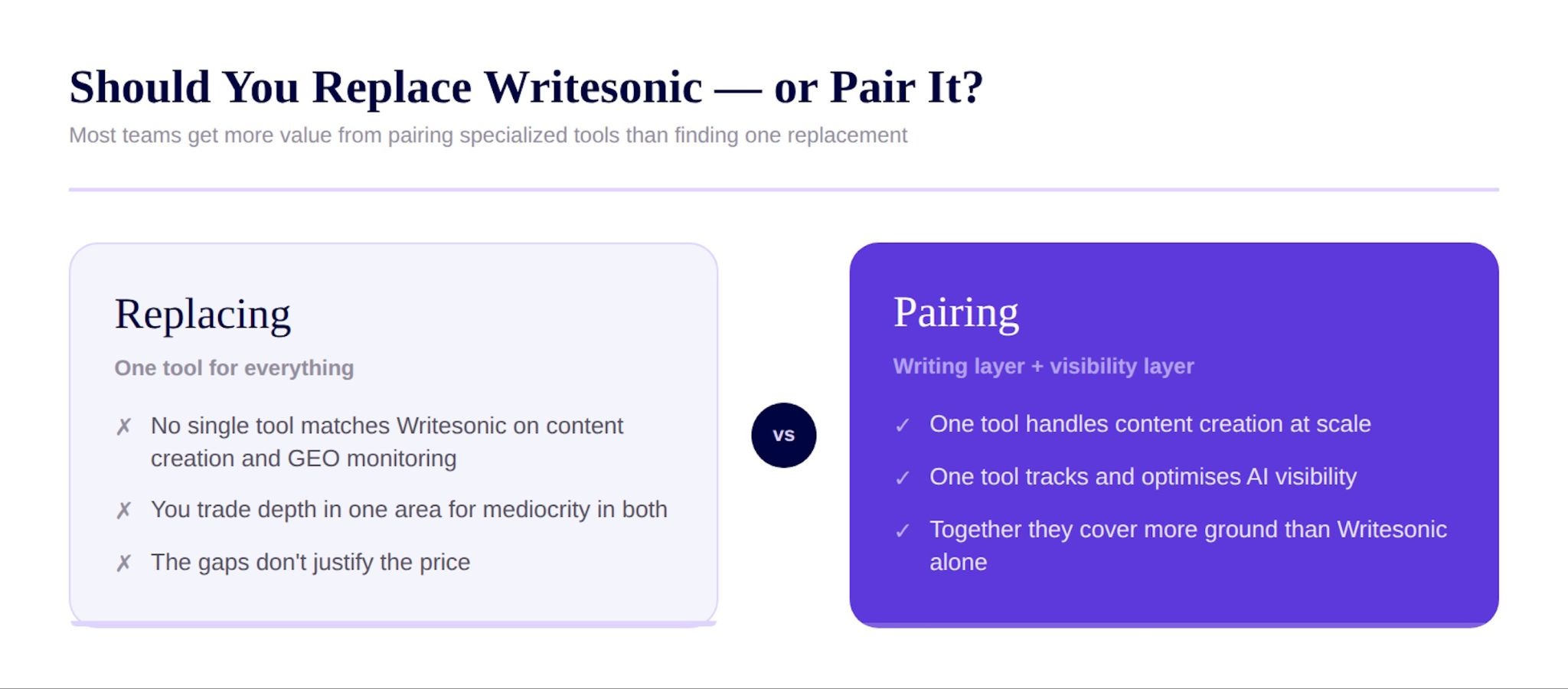
Pick one tool based on your primary job-to-be-done. Don't try to find the all-in-one that does everything better than Writesonic — it doesn't exist at a price point that makes sense.
Most teams benefit from pairing rather than replacing: a content creation tool (Jasper, Frase, or Rytr for the writing layer) alongside a visibility tool (Scrunch for the GEO layer) covers more ground than any single platform at Writesonic's price point.
The data supports this: only 25% of bloggers report strong results from fully AI-written drafts — suggesting the teams getting real value from these tools are using AI for speed while keeping humans in the editing loop.
Migration friction is real — factor in trained brand voices, saved templates, and active projects before committing. Run a 14-day trial on your actual workflow before migrating fully.

Irina is a Founder at ONSAAS, Growth Lead at Aura, and a SaaS marketing consultant. She helps companies to grow their revenue with SEO and inbound marketing. In her spare time, Irina entertains her cat Persie and collects airline miles.
.svg)
.svg)
.svg)

.svg)
%20(1).svg)
%20(3).svg)
.svg)
.svg)