7 ProtonMail Alternatives You Can Trust for Private Communication
January 14, 2026
By
Cindy Graciella
Data exposure risks have increased, and email remains one of the most common entry points. SaaS email platforms, like Microsoft 365, Google Workspace, and Slack, are targeted because many organizations don’t thoroughly audit the login activity or implement strict access controls.
As per Varonis, around 62% of breaches not involving an error, misuse, or physical action involved the use of stolen credentials, brute force, or phishing. And approximately 87% of organizations have sensitive data that is accessible to every employee.
When your inbox holds everything from business logins to bank alerts, the idea of it ending up in the wrong hands is not fun. More users are rethinking where they host their email. ProtonMail is great, but is it the only privacy-focused option out there? No, there are many ProtonMail alternatives that you can consider if ProtonMail isn’t the right fit for you.
Top 7 ProtonMail Alternatives that You Can Consider
Let’s just jump straight to the point. Here are the top 7 alternatives that you can consider if ProtonMail doesn’t suit you and your business structure:
1. Neo Mail
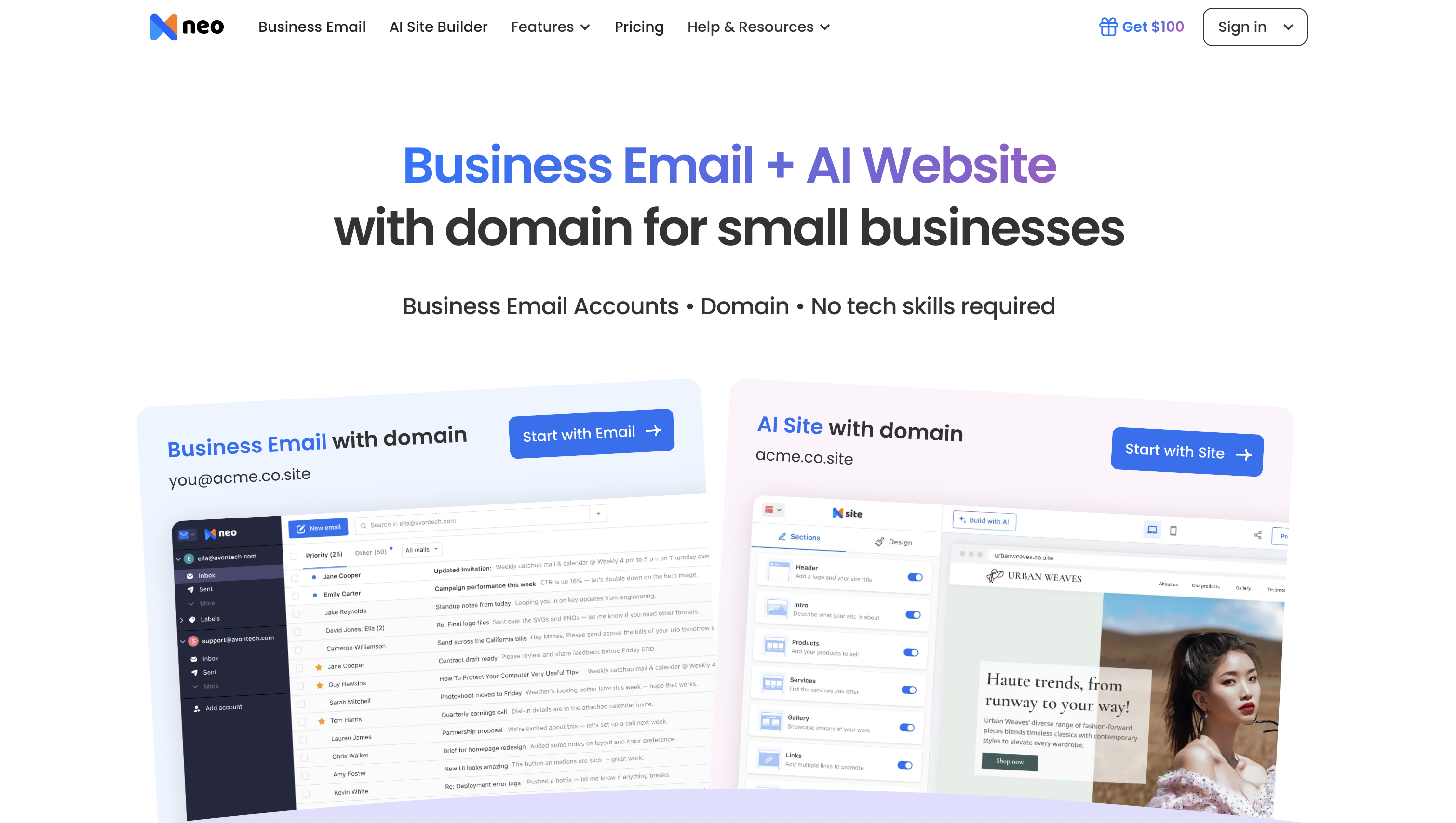
Neo Mail is one of the best business email providers, specifically designed for small business owners, solopreneurs, and professionals who want to build an online presence at cost-effective rates. It offers tiered plans that scale from basic emailing to more advanced business functionality, so it supports professional communication with a balance of productivity tools and essential security.
How’s the Security?
Neo Mail protects user data using standard industry encryption, both in transit and at rest, with 256-bit encryption, and integrates additional safeguards to keep inboxes secure. Here are the core security features:
256-bit encryption: All data is encrypted during transfer and when stored.
Two-factor authentication (2FA): The platform adds an extra layer of login protection beyond passwords.
Anti-spam and anti-virus protection: Neo Mail supports built-in filtering to reduce malicious and unwanted content.
Custom DKIM & authentication protocols: It helps secure email authenticity and improve deliverability.
Email Productivity Features
Free domain name registration (with .co.site domain name extension) with yearly plans for users who don’t have a domain name.
Integrated calendar and access on web, Android, and iOS
SmartWrite is an AI-powered writing assistant to draft emails and replies within seconds
Supports a range of email management tools, like templates, turbo search, priority inbox, read receipts, labels, auto-reply, and scheduling
Business suite includes tools for email marketing and boosting email productivity, like campaign mode, appointment booking, AI email writer, signature designer, and analytics
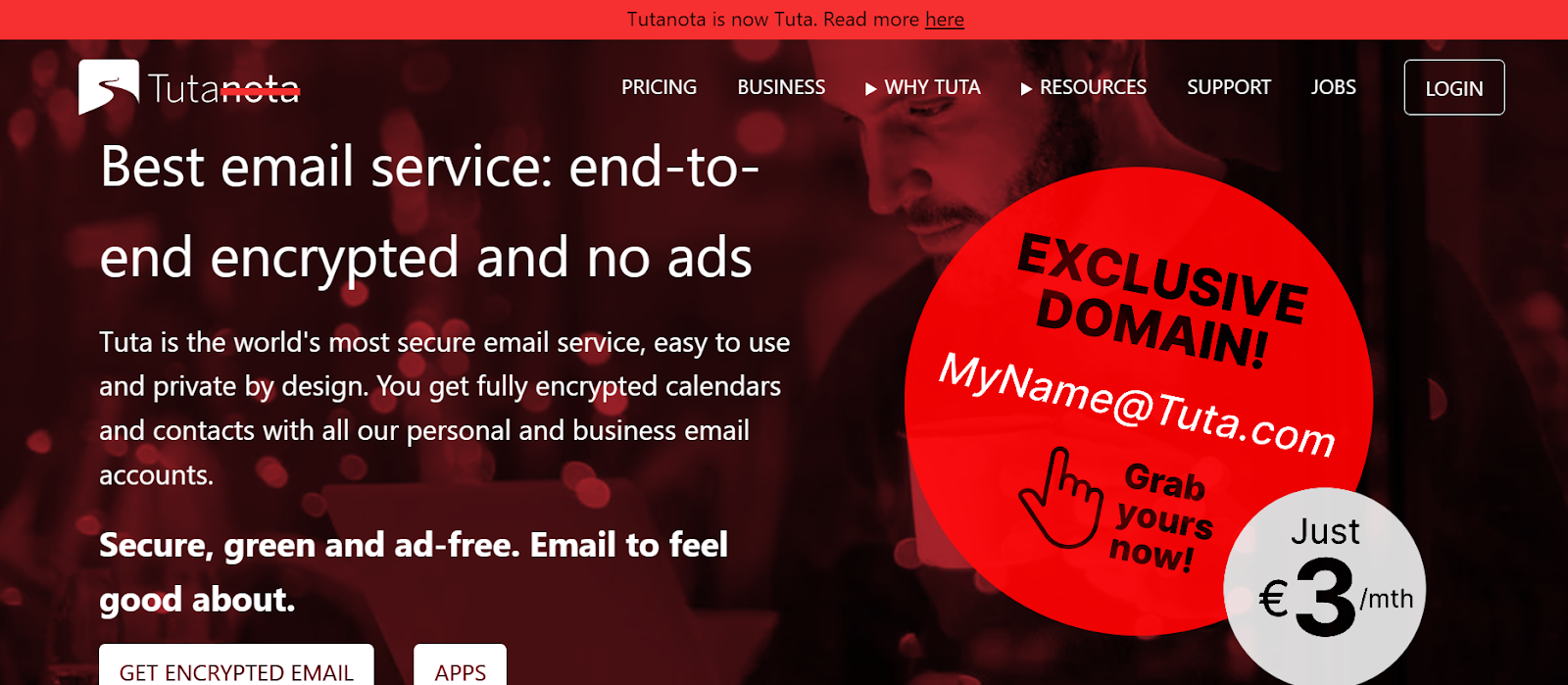
Tuta Mail is a privacy-first encrypted email service that automatically protects your mailbox, calendar, and contacts with end-to-end encryption. Unlike many providers, it encrypts virtually all data, including subject lines, message bodies, attachments, calendars, and address books, by default. The only bare minimum required for delivery (such as email addresses) remains unencrypted.
How’s the Security?
Based in Germany and under GDPR protection, Tuta implements TutaCrypt encryption, combining quantum-resistant algorithms (K-1024) with proven methods, like RSA 2048 and AES 256. Here are some other security features:
Protocol protections: It offers two-factor authentication (TOTP/U2F) and hashes passwords with strong algorithms before transmission.
Zero-Knowledge architecture: Tuta holds no decryption keys on its servers, meaning even the service itself cannot read your content.
Privacy-centric defaults: Blocks external tracking content by default and strips IP addresses from outgoing mail headers to preserve privacy.
Encrypted search and metadata minimization: Users can search encrypted content locally; minimal metadata (just email addresses for routing) is exposed.
Email Productivity Features
Email storage options range from 1GB to 500GB
Free tier includes 1GB storage, one calendar, three email labels, and full encryption
Supports creation of email addresses with custom domains
Paid users without a custom domain can use an @tuta.com address for a professional presence
No built-in AI tools for writing assistance or productivity
3. Posteo
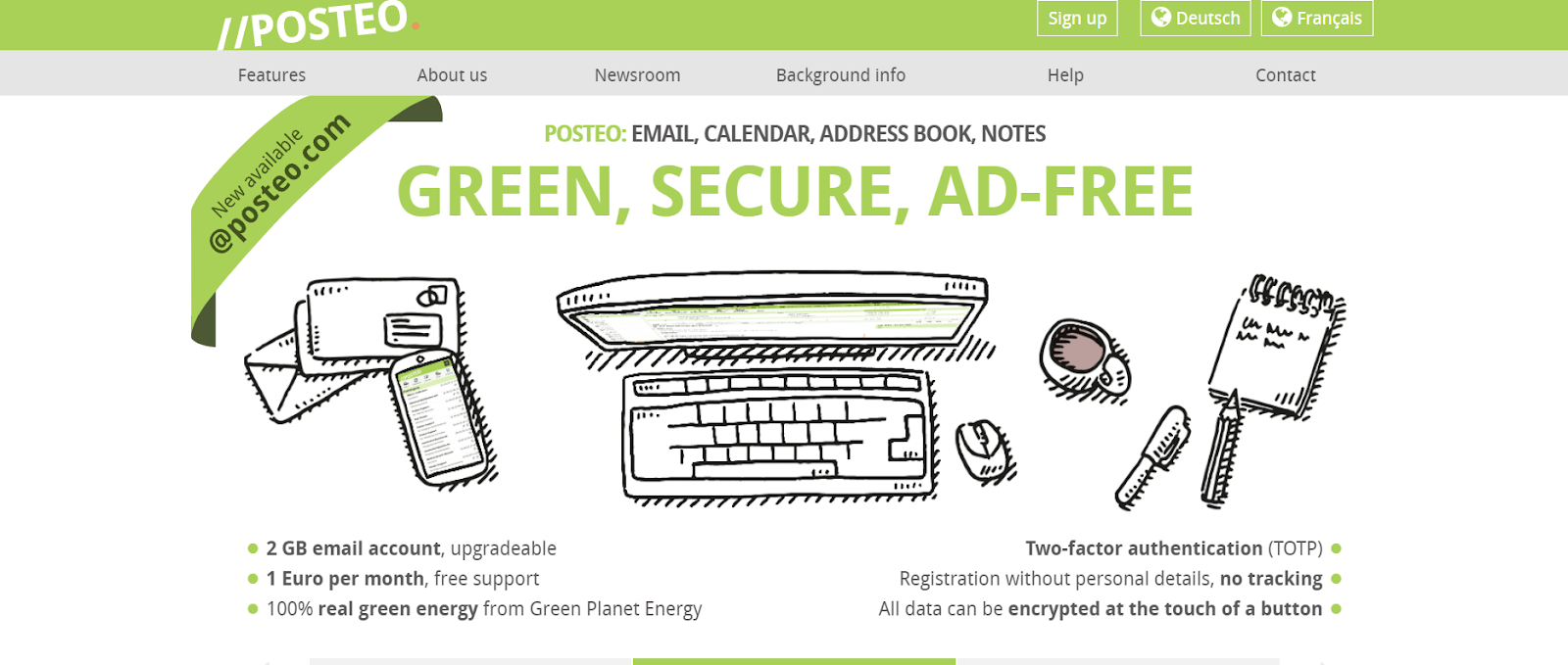
Posteo is a privacy-first email provider from Germany which offers secure and sustainable email accounts with an address book, notes, and calendar. Instead of tiered plans, Posteo offers a single €1/month base account with essential features included for email communication.
How’s the Security?
Posteo’s objective is to protect the user’s data and not sell it highest bidder in the advertising industry or data brokers. So, here are its security features:
Encrypted data in transit and at rest: All access and transmissions use TLS with Perfect Forward Secrecy (PFS) and DANE/TLSA to protect contents and metadata.
Optional end-to-end encryption: Users can enable PGP or S/MIME encryption for emails, though this often requires additional setup called MailVelope.
Ad-free: Posteo is free of advertisements and free of tracking.
Data reduction policy: It promises not to collect any user data or retain any traffic data, like IP addresses, in connection with an account. It also anonymizes all subscription payments.
IP stripping: Posteo guarantees that neither your local nor public IP addresses are attached to an outgoing email.
Email Productivity Features
2 GB of base email storage with the ability to add up to 20 GB of higher capacity
Two aliases are included; additional aliases are available as add-ons
Supports email addresses ending with .net, .org, .de, .jp, but it doesn’t allow .com email addresses
Calendar and contacts sync via standard protocols (CalDAV/CardDAV)
IMAP/POP3 support lets you use standard email clients like Thunderbird, Apple Mail, or Outlook
Spam and virus filtering with whitelist options
4. Mailfence
Mailfence is a comprehensive, privacy-focused email service from Belgium that combines secure email with calendars, contacts, documents, and collaboration tools. It uses OpenPGP end-to-end encryption that’s executed in the browser, so messages are encrypted before they ever leave your device. Mailfence doesn’t show ads, doesn’t use trackers, and benefits from strong Belgian privacy protections, including GDPR requirements and transparency practices.
How’s the Security?
Mailfence uses industry-standard OpenPGP encryption and digital signatures to protect your data and authenticate your messages. Besides, here are some other security features:
Integrated keystore: The built-in keystore lets users generate, import, and manage multiple OpenPGP keys within the platform.
Two-factor authentication (2FA): It also adds a second layer of login security beyond user passwords.
Authentication & validation standards: Works with SPF, DKIM, and DMARC on custom domains to improve email authenticity and deliverability.
Secure transport protocols: All connections use TLS with Perfect Forward Secrecy and HTTP Strict Transport Security to protect data in transit and mitigate eavesdropping and tampering.
Email Productivity Features
Personal plans start with a free tier, but business email plans start with $3.50/month
For business plans, the email storage ranges between 40GB to 225 GB
Depending upon the business email, users can create 50 - 200 aliases
Mailfence for business allows you to use your domain name for a professional look
Also, it allows customizing the control panel, graphical adaptation, integration of external services, and storage and features as per your needs.
It provides access to messages, calendars, documents, and groups.
5. HushMail
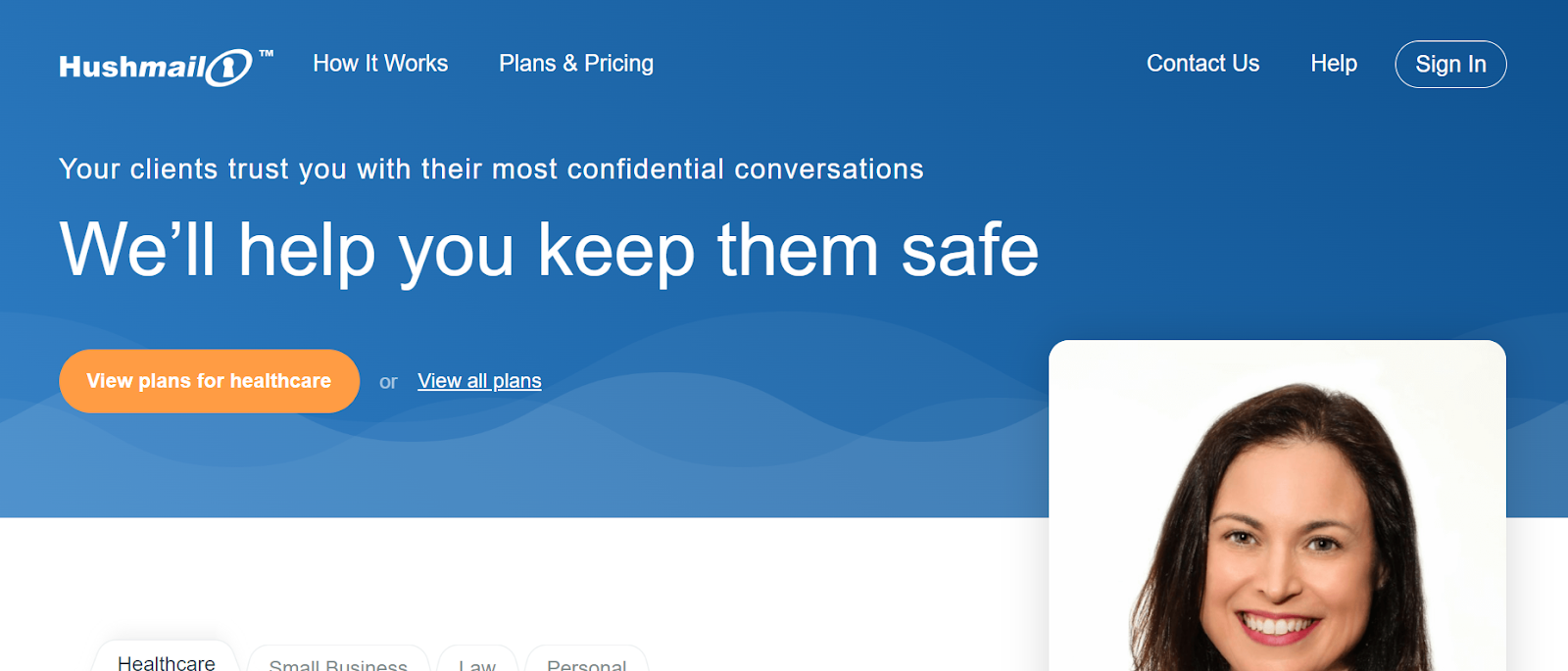
HushMail is a long-standing secure email provider based in Canada that’s especially popular with professionals in healthcare, legal, and business settings. It combines industry-standard encryption with easy-to-use interfaces and features like encrypted forms and e-signatures designed for compliance workflows. HushMail’s plans are tailored to use cases where handling sensitive client or patient information is essential.
How’s the Security?
HushMail uses established encryption protocols and compliance tools. However, it differs from other privacy-centric providers in how some protections are implemented. For instance:
Optional one-click encrypted messages: Users manually toggle encryption when composing the email; a lock icon indicates protected mail.
Encrypted communication with non-users: Recipients without HushMail accounts can access encrypted messages via a secure webpage link.
Compliance-oriented protections: Certain business email plans (e.g., healthcare) support HIPAA and other regulatory standards.
Server-side encryption storage: Messages are stored encrypted on HushMail servers, though encryption is not always end-to-end by default, and subject lines are not encrypted in the same way as the body.
OpenPGP and TLS/SSL encryption: Emails and attachments can be encrypted using OpenPGP, and connections are protected in transit with TLS/SSL and Perfect Forward Secrecy.
Email Productivity Features
Different business email plans as per industry use, like healthcare (HIPAA-compliant), small business, law, and personal use.
The plans, features, and pricing vary as per the HushMail plan chosen.
15 GB storage for personal plans with options for more on business tiers.
Built-in encrypted forms and e-signatures let users collect secure input and signatures directly via email
IMAP/POP/SMTP support lets you connect HushMail to common email clients like Outlook or Apple Mail.
6. StartMail
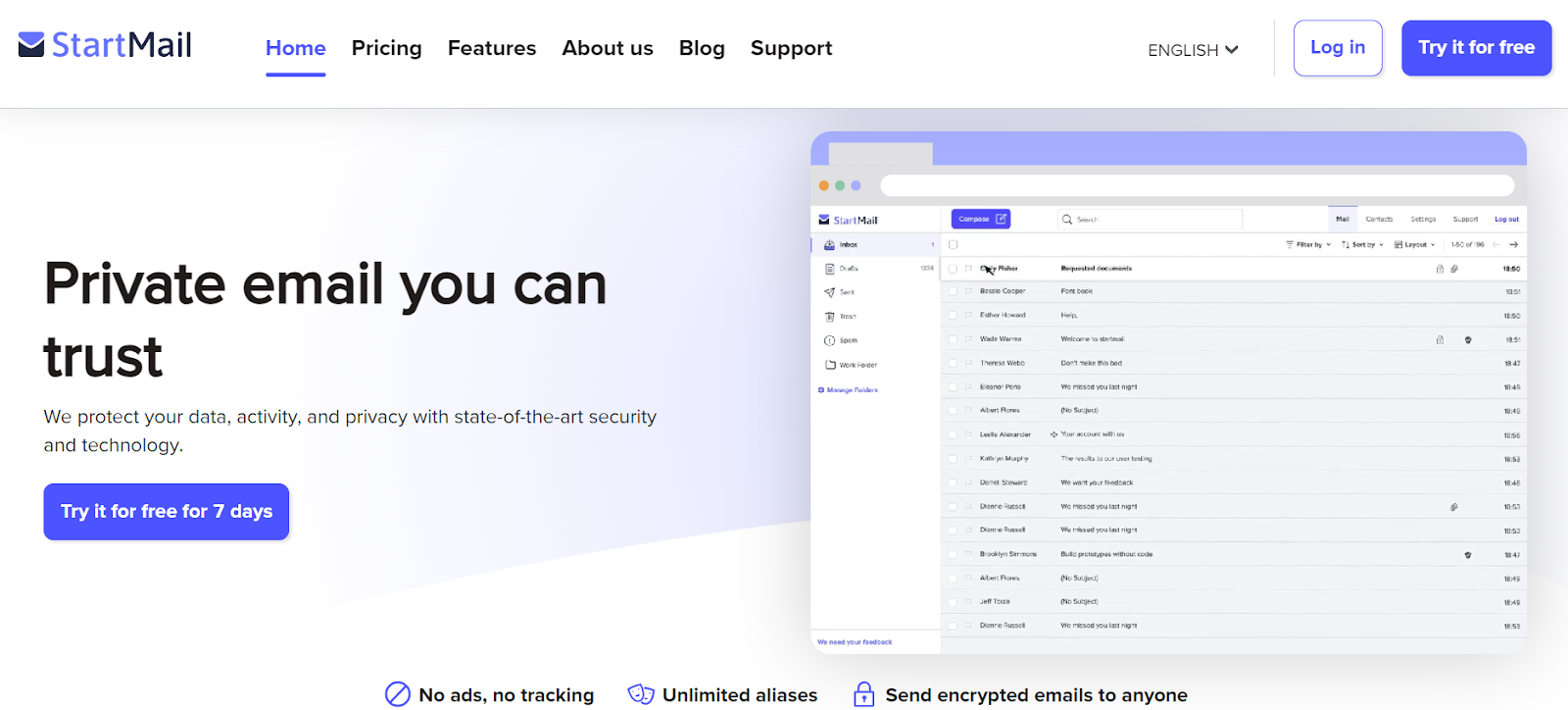
StartMail is a premium encrypted email service based in the Netherlands and adheres to strict European data-protection standards. StartMail focuses on anonymity and unlimited email aliases for identity protection. Unlike free email service providers, StartMail requires a paid subscription. The personal plans start at $4.99 per month (billed annually) with 20 GB of storage, while business plans are around $6.99 per month with 30 GB of storage and support for unlimited custom domains.
How’s the Security?
StartMail combines strong encryption with privacy-focused operational practices to keep your communications protected:
PGP encryption: Full support for OpenPGP lets you send encrypted and signed messages that only intended recipients can read.
Password-protected emails: You can send encrypted messages to recipients who aren’t using encryption by protecting messages with a password.
Encrypted data storage and transit: Emails are encrypted in a personal vault and TLS is used for secure transmission.
No tracking or ads: StartMail doesn’t collect user data for advertising or analytics purposes.
Email Productivity Features
20 GB (Personal) and 30 GB (Business) storage for email and attachments
Personal plans allow one custom domain, while business plans support unlimited domains.
Supports auto-responders and organizational tools such as filters and contact groups.
Advanced spam filtering and malicious-link protection to keep inboxes tidy and safer.
7. Canary Email
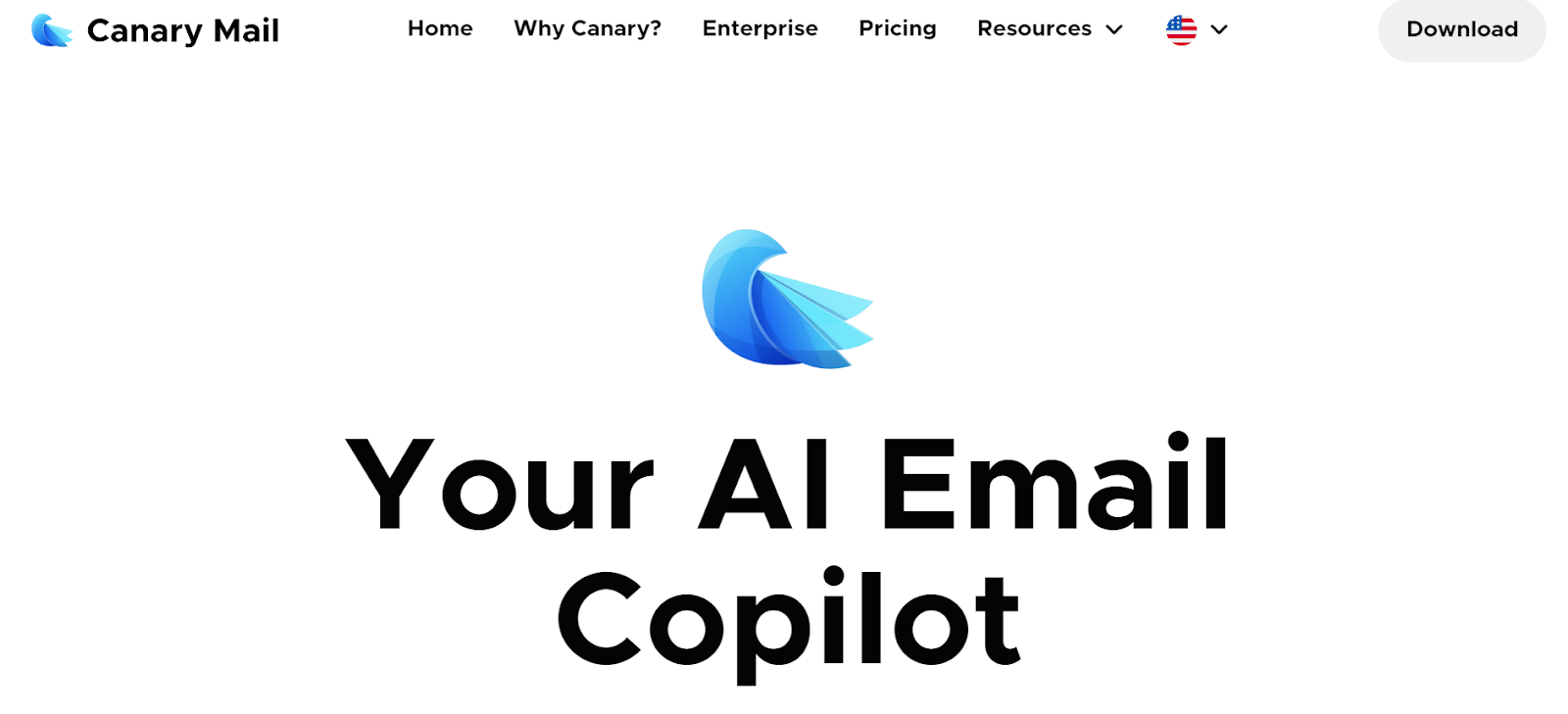
Canary Mail is a modern email client that combines strong built-in security with productivity features and AI-powered tools. Instead of being a standalone hosted email service, it works as a secure client that connects with your existing email accounts (Gmail, Outlook, iCloud, IMAP/POP3, etc.) and adds automatic encryption, phishing protection, and unified inbox management across platforms, including macOS, Windows, iOS, and Android.
How’s the Security?
Canary Mail focuses on seamless, automatic protection and built-in safeguards:
End-to-end encryption: Encrypts messages automatically with PGP and SecureSend for confidential emailing without manual key setup.
Tracker blocking: Blocks invisible pixels and email trackers by default to keep your location and device data private.
HIPAA-ready SecureSend: Password-protected and expiring messages for sensitive healthcare, legal, or financial communication.
Phishing and impersonation protection: Scans and warns about suspicious links, spoofed senders, ransomware, and business email compromise threats.
Email Productivity Features
Unified inbox to manage all email accounts in one place without switching apps
AI Copilot and summaries to assist with drafting replies, summarizing long threads, and helping with prioritization
Built-in scheduling tools help plan and manage appointments from your email client
Customized themes, actions, advanced sorting, and quick filters for personalized inbox control
Why the Security-First Principle is Important in Business Emails?
Many users and businesses are moving toward privacy-centric email services, like ProtonMail, because traditional inboxes no longer offer the control, transparency, or protection needed for sensitive communication.
It is because when the platform behind the business emails doesn’t enforce strong security practices, like end-to-end encryption, two-factor authentication, or multi-factor authentication, it can make the business account vulnerable.
Here’s how it happens:
Weak encryption, outdated authentication methods, limited access monitoring, and inconsistent data-handling policies can create openings for attackers.
Unencrypted mailboxes leave room for internal misuse, faulty backups, or server-side leaks.
Even excessive logging creates an unnecessary trail of metadata that can reveal who contacted whom, when, and from where, which is very valuable information for attackers.
Misconfigured servers, insecure integrations, and poor spam or phishing filters also raise the chances of compromise.
In this uncertain world where a data breach could happen to any business, at any time, and through any channel, it is best to strengthen your overall security posture.
Major retailers like The North Face, Victoria's Secret, and Cartier have reports breaches that exposed customer email addresses through credential stuffing, misconfigured systems, and unauthorized backend access. If we take the example of The North Face, in April, they disclosed a credential stuffing breach that compromised the customer account data, like emails, names, and order history.
The attackers basically used email/password combinations from earlier leaks to access accounts with weak authentication protections.
This is the kind of risk that can spill over into any business. So, privacy-focused email providers offer services that minimize data collection, enforce stronger authentication, and prioritize security at the infrastructure level, not just at the user level.
That’s where ProtonMail shines.
Businesses should start by choosing an email platform that prioritizes encryption, access control, and transparent data-handling practices to create a professional email address.
What Makes ProtonMail Best When it Comes to Privacy and Security?
ProtonMail is an encrypted email service which is based in Switzerland. So, apart from all the robust security features, its headquarters are based in a region known for strong data protection laws; the Swiss privacy rules act as an additional legal layer of protection for user data. That jurisdictional stance has factored into Proton’s legal and operational decisions.
Let’s understand in detail about ProtonMail’s privacy and security-focused email service:
End-to-end and zero-access encryption: ProtonMail encrypts email content and attachments so only senders and recipients can read them. The service uses a “zero-access” design, meaning Proton cannot decrypt mailbox contents on its servers.
Encrypted storage and protected mailboxes: Messages stored in a ProtonMail mailbox remain encrypted at rest. Password-protected messages are also stored end-to-end encrypted, which limits exposure from server-side incidents.
Strong account protections (2FA and security keys): Proton supports two-factor authentication via authenticator apps and FIDO/U2F security keys. Physical security keys reduce the risk of phishing and account takeover. Proton also offers its own Authenticator app.
Open-source cryptography and public documentation: Proton’s code behind its apps is published on the Internet, and also, how encryption works is open-source. So, it is easily available for third-party review and builds trust in implementation.
However, it is important to note that ProtonMail doesn’t fully encrypt your emails. Like, its encryption covers message bodies and attachments, but some metadata is not end-to-end encrypted. Subject lines, certain headers, and delivery metadata can remain visible in specific scenarios.
Understanding the security features is important so that you can find similar and cost-effective ProtonMail alternatives because you know what privacy and security-first principles an email platform should have to reduce the risk of data breach.
Why are Business Users Looking for ProtonMail Alternatives?
ProtonMail delivers on security, but for heavy email users, it always becomes the privacy-vs-speed tradeoff. Here are the limitations because of which business users are looking for ProtonMail alternatives:
1. Storage and Access Restrictions
Accounts based on the free tier have restricted email storage (max. 1GB)
Free accounts have a daily limit of sending 150 messages
No native IMAP or POP3 support; a Bridge application is required
Limited aliases and custom domain options
2. Performance Gaps
Slower user interface (UI) as compared to other modern email clients
The search feature hardly works due to the encryption architecture
Bulk actions are limited to 50 emails at once
Mobile apps struggle with folder management
3. Missing Productivity Features
Limited third-party integrations, like Calendly or Zoom Calendar sync
Premium tier starts at $9.99/month for unlimited plans
No AI productivity feature, except for the recent Scribe launch for writing assistance
Go Beyond ProtonMail Without Compromising on Security
When it comes to business email, security is just one of the prioritized aspects. Professionals and business owners need to consider other aspects as well to streamline communication and boost productivity.
ProtonMail may provide the best security features, but it might not fully match your workflow or your feature needs. So, you can try ProtonMail alternatives to get almost all the features you need in an email service provider without compromising on security, and affecting your business budget.
Have questions
No items found.
By clicking “Accept All Cookies”, you agree to the storing of cookies on your device to enhance site navigation, analyze site usage, and assist in our marketing efforts. View our Privacy Policy for more information.
Cindy is an Outreach Manager and SEO Specialist at ONSAAS who helps SaaS companies grow through strategic link building and SEO. Outside of work, she loves spending time in nature, especially hiking in the mountains.
By clicking “Accept”, you agree to the storing of cookies on your device to enhance site navigation, analyze site usage, and assist in our marketing efforts. View our Privacy Policy for more information.

.svg)
%20(1).svg)
%20(3).svg)

.svg)
.svg)
.svg)
.svg)
.svg)