
.svg)
%20(1).svg)
%20(3).svg)
Back to articles
10 Best Email Service for Small Business (Our Top Picks)
September 8, 2026
By
Cindy Graciella
One of the things that help business owners build credibility with their target audience is a custom professional email address that uses their business name rather than “@gmail.com.”
To get this, however, you need a dedicated email service provider. But with so many options out there, picking the right one can easily become confusing. That’s where we come in!
In this guide, we’ve rounded up the six top email services for small businesses. Whether you need something budget-friendly, feature-packed, or easy to use, there’s one for you on this list!
Before diving into the list, it's worth knowing what to actually look for. The right email service depends on your team size, budget, and how you work. Here are the key criteria to evaluate:
Custom domain support A professional email like name@yourbusiness.com builds credibility and trust with clients. Nearly every provider on this list supports custom domains, but some (like Fastmail's Basic plan) restrict it to higher tiers. Always confirm this before committing.
Storage capacity Consider how many emails and attachments your team handles. Solo users may be fine with 5–10GB, but growing teams benefit from pooled or higher-storage plans. Microsoft 365's 1TB OneDrive and Google Workspace's expandable plans are strong options if storage is a concern.
Security features At minimum, look for two-factor authentication (2FA), spam and phishing protection, and data encryption. If you handle sensitive client data or operate in a regulated industry, look for providers with compliance certifications (HIPAA, SOC 2) and advanced threat protection.
Integration with your existing tools If your team lives in Microsoft Office, Microsoft 365 is a natural fit. Google-first teams will benefit most from Google Workspace. For businesses wanting standalone email without ecosystem lock-in, Fastmail or Zoho Mail are solid choices. Whatever you choose, pair it with a reliable email finder to keep your contact data accurate across whichever ecosystem you land on.
Pricing tiers and scalability Pricing ranges from free (Zoho Mail for up to 5 users) to $6–7/user/month for full productivity suites. Pricing ranges from free; Neo Mail starts at $1.25 per mailbox per month and includes professional email with built-in business growth tools. Factor in how quickly your team may grow—some providers charge per user, which adds up fast.
Email migration ease Switching providers? Look for built-in migration tools or import assistants. Google Workspace and Microsoft 365 both offer guided migration. Providers like Neo Mail and Zoho Mail also include migration support, though the process varies in complexity.
Once you know what matters most to your business, the list below becomes a lot easier to navigate. Here's how each provider stacks up.
We assessed each provider across pricing and value, security features, storage, and ease of setup. We prioritized providers that don't require IT expertise to manage, and noted which ones suit specific needs — privacy, budget, collaboration, or new businesses — to help you narrow down quickly.

Google Workspace delivers a robust email experience through Gmail for Business, offering professional custom domain email addresses that provide a polished corporate identity.
It also offers a generous 30GB of storage per user and powerful spam and phishing protection powered by Google's advanced AI.
Google Workspace includes advanced email management tools like scheduled sending, and confidential mode, which lets you set expiration dates and revoke access to sensitive emails, while preventing recipients from forwarding, copying, downloading, or printing emails.
Google guarantees 99.9% uptime, and two-factor authentication is available on all plans, including support for hardware security keys. Storage scales from 30GB per user on the Starter plan up to 5TB on higher tiers. For teams migrating from another provider, Google's free Data Migration Service supports imports from Microsoft Exchange, Office 365, and other IMAP-based providers.
A 99.9% uptime guarantee means no more than ~8.7 hours of downtime per year — the industry standard for business-grade email.
.svg)
Familiar and intuitive interface
Excellent spam and malware protection
Reliable uptime and cloud-based accessibility
.svg)
Higher cost compared to some competitors

Microsoft 365 is perfect for businesses that rely on Microsoft Office tools such as Word, Excel, and Outlook.
The platform provides professional custom email hosting, advanced spam filtering, 50GB mailbox storage, and seamless integration across Office applications. Its email hosting service offers advanced email security, compliance features, and scalability.
Unlike Google Workspace tools, which are more cloud-driven, Microsoft 365 allows for both online and offline access, making it ideal for businesses that require a mix of web-based and desktop applications.
Each user also gets 1TB of OneDrive cloud storage — one of the most generous allocations at this price point. Security includes multi-factor authentication, AI-powered threat detection, and compliance tools suited to regulated industries. Teams integration is native, covering both email and real-time chat and video in one place.
Best for businesses already using Microsoft apps
Strong data security and compliance options
Offers both desktop and cloud-based productivity tools
Can be overwhelming for beginners due to feature complexity
Slightly higher cost for advanced plans

Zoho Mail is an excellent choice for small businesses looking for an affordable and privacy-focused email service.
It offers a clean, ad-free interface with strong encryption. It also provides essential business applications like Zoho Docs and Zoho Cliq for team collaboration.
Zoho Mail’s other features include custom domain emails, 5GB storage, and built-in encryption for secure, professional communication at an affordable price point.
Notably, Zoho Mail offers a forever free plan for up to 5 users with custom domain support — making it the strongest no-cost option for very small teams. Paid plans include solid spam filtering and integrate with the broader Zoho ecosystem (CRM, Projects, Cliq) if you use those tools.
Very affordable pricing compared to competitors
Strong security and privacy features
Forever free plan available for small teams
Limited third-party integrations outside the Zoho ecosystem
User interface may take some time to get used to

Neo Mail is a modern email and website platform designed specifically for small businesses, solopreneurs, and freelancers who want to establish a professional online presence quickly. Unlike traditional email providers, Neo Mail bundles business email with a custom domain and even includes an AI website builder—making it a one-stop solution for growing your brand online.
Every Neo Mail account includes a free custom domain, making it easy to get started without additional overhead. Its clean interface, AI-powered email tools, and inbuilt email tracking make it stand out from legacy business email solutions.
Neo Mail also comes with features like read receipts, priority inbox for lead capture, and a simple website builder, ensuring users don’t just communicate professionally—but also convert visitors into customers.
Neo Mail is particularly well suited for new businesses that don't yet have a website — the included one-page site builder removes the need for a separate platform. Migration from an existing IMAP provider is supported, though it's better suited to simple setups than complex enterprise migrations.
All-in-one solution: domain, email, and website in one place
Email tracking built-in—no third-party tools required
Designed for ease of use, ideal for non-technical users
Limited third-party integrations compared to enterprise email platforms

Spacemail is a modern business email service designed for simplicity, speed, and affordability. Built by Spaceship, one of the world’s largest domain registrars, it offers a seamless experience where domains, email, and security are all managed in one place.
Security is at the core of Spacemail, with encrypted storage, two-factor authentication, and password-protected emails included by default on every plan. To further protect your inbox, Spacemail includes Jellyfish, its intelligent, machine-learning spam filtration system, at no extra cost. It continuously learns from user behavior to effectively block spam, phishing attempts, malware, viruses, and spoofing attacks before they reach your inbox.
With the Unboxing tool, you can connect your custom domain and start using a professional email in just a few clicks, no technical setup required. The clean interface, built-in calendar, and AI-powered email drafting help make daily communication easier. Whether you're working from your desktop or on the go, Spacemail iOS and Android apps keep your inbox fully synced and easy to manage wherever you are.
Key Features:
Secure and professional email with competitive pricing
Simple and user-friendly interface
Fast activation and easy management
No free domain registrations
Starts at $0.98 per month. Available monthly, yearly and bi-yearly billing cycles. A 30-day free trial is included for all plans, so you can test the service before committing.

Proton Mail is designed for businesses that prioritize security and privacy above all else. It follows strict data privacy regulations and offers end-to-end encryption, ensuring that emails remain private and inaccessible to third parties.
It provides support for custom email domains, anonymous email hosting, hide-my-email aliases, and Swiss privacy protection, offering businesses a highly secure communication platform.
What makes Proton genuinely different is zero-access encryption — even Proton itself cannot read your emails. The service is based in Switzerland, which offers some of the world's strongest legal privacy protections. Higher-tier plans include Proton Calendar, Drive, and a VPN. Note: Proton Mail is not the best fit for teams needing deep integration with Google or Microsoft tools, or who prioritize collaboration features over privacy.
Best-in-class security and privacy features
No ads, tracking, or data mining
Intuitive and clean user interface
Limited storage on lower-tier plans
Fewer third-party integrations compared to Google and Microsoft

Namecheap Private Email is a great option for small businesses looking for a simple, budget-friendly email hosting solution.
It provides secure, reliable email with custom domain support and impressive spam protection at an affordable cost. Namecheap Private Email supports two-factor authentication and includes built-in spam and virus filtering on all plans. While it doesn't offer advanced threat protection or compliance certifications, it covers the security basics that most small businesses need. It only offers the email service, making it the perfect choice for businesses that only need professional email addresses without additional software.
Overall, it’s a great option for small businesses that need a low-cost solution while establishing their brand.
One of the most budget-friendly options
Easy to set up and manage
Good email performance with reliable uptime
Lacks productivity and collaboration tools
Limited storage compared to other providers

Fastmail is an independent email service provider that offers a fast, privacy-focused alternative to mainstream providers. It prides itself as the “fastest email money can buy.”
The platform focuses solely on providing a clean, reliable private email experience. It’s best for businesses that want an ad-free, no-tracking email service with solid spam protection and reliable performance.
Of course, it offers custom domain email hosting along with excellent email organization features, as well as email masking for added protection. Note that custom domain email is not available on the Basic plan — you'll need the Standard plan ($5/user/month) or above
No ads, tracking, or data mining
Highly customizable email management
Fast and intuitive interface
“Undo send” up to 20 seconds
No free plan available
Lacks deep integration with business productivity suites
Custom domain email not available on Basic plan
Starts at $3 per user/month (Basic plan).

Spike eliminates messy email threads by organizing conversations like messaging apps, while AI tools help summarize long discussions and draft responses. The platform includes free custom domain hosting, SSL certificates, and DNS management, making it easy to maintain professional branding. On the security side, Spike uses AES-256 encryption and supports two-factor authentication across all plans. Spam protection is built in, and all data is transmitted over encrypted connections.
In addition to business email hosting with custom domains, Spike combines email, team chat, video calls, and collaborative documents in one unified platform.
All-in-one workspace eliminates app switching
AI assistance for productivity and organization
Free tier for small teams
Learning curve for traditional email users
Starts at $4 per user per month, annually.
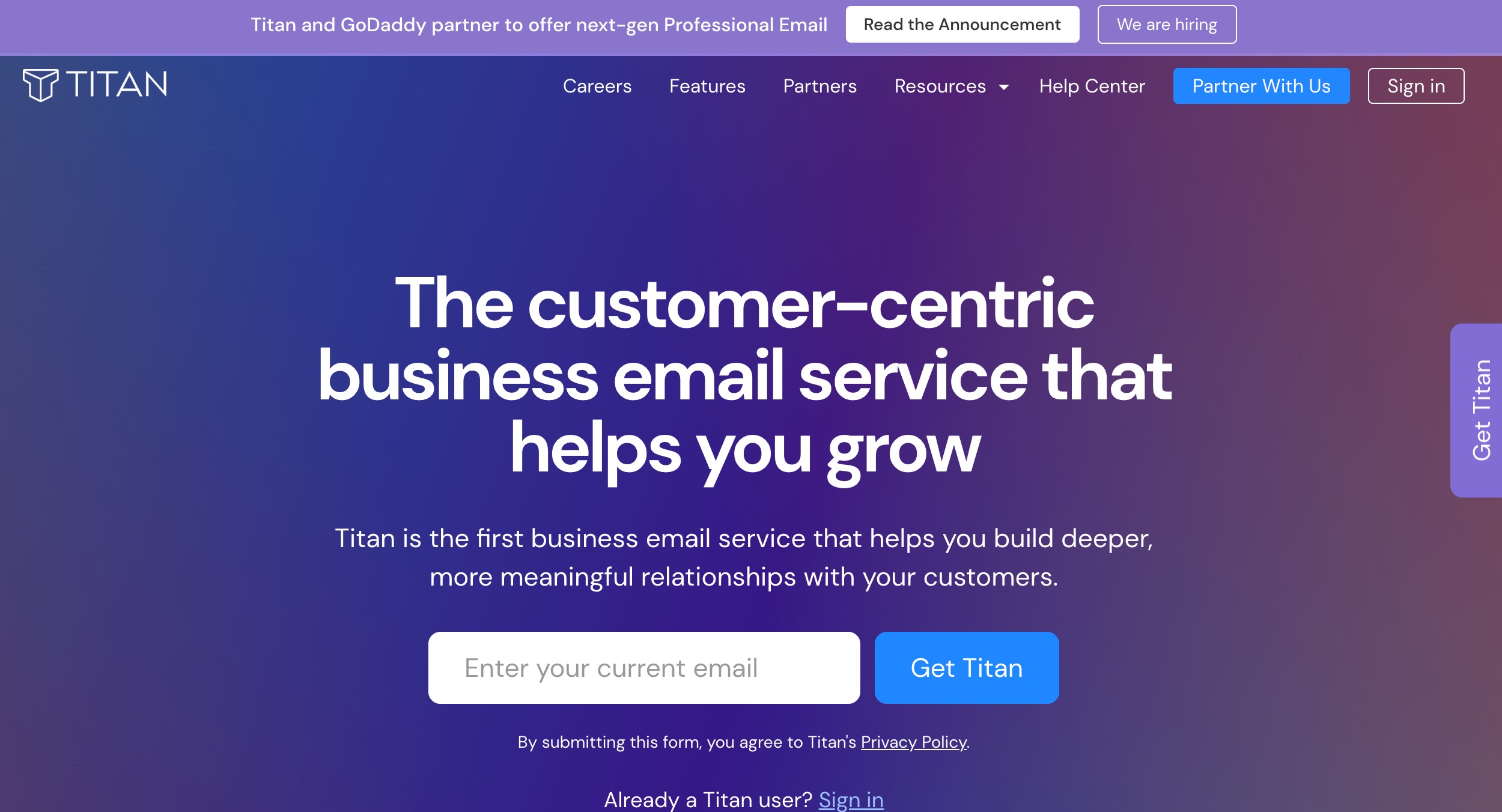
Titan is a business email platform built specifically for small businesses and entrepreneurs just getting started. It's widely available through major domain registrars like GoDaddy and Namecheap, making it easy to add professional email when you purchase your domain — no separate setup required.
Beyond basic email, Titan includes practical productivity features like email templates, follow-up reminders, read receipts, and scheduling. It's a clean, modern option if you need solid email fundamentals without paying for a full productivity suite.
Very easy to set up when bundled with a domain registrar
Good feature set for the price
Clean, modern interface
No built-in productivity suite
Less established than Google or Microsoft
Starts at $1.99/user/month.
When evaluating email hosting solutions, it is important to prioritize pricing strategies that align with your business budget constraints and operational requirements.
Look for providers that offer:
Email security is paramount for protecting sensitive business communications and confidential information. A trusted email hosting solution should provide multiple layers of security protection, including:
An effective email hosting service extends beyond basic communication capabilities. It should offer connections and integrations that help it serve as a central hub for business productivity.
Try to go for solutions that offer:
Ease-of-use and a visually appealing interface are essential features an email service provider should offer so new users can easily pick it up with little to no technical guidance.
The best platforms typically offer:
The right pick depends on what matters most to you:
If you're a solo founder or brand-new business, Neo Mail or Titan offer the easiest path to a professional setup at low cost. If you're building a team that needs to collaborate, Google Workspace or Microsoft 365 remain the gold standard. If you're an individual or a small business owner, Spacemail is an obvious choice. And if privacy is non-negotiable, Proton Mail is in a category of its own.
Ultimately, the best choice comes down to your priorities—security, integrations, budget, or ease of use. Evaluate what matters most to your business, and select the provider that aligns with your goals.
Read more: 11 Best Email Marketing Software For Your Business

Cindy is an Outreach Manager and SEO Specialist at ONSAAS who helps SaaS companies grow through strategic link building and SEO. Outside of work, she loves spending time in nature, especially hiking in the mountains.
.svg)
.svg)
.svg)
.svg)
.svg)