
.svg)
%20(1).svg)
%20(3).svg)
Back to articles
LLM SEO Strategies: How to Get Your Brand Cited in AI Search
September 22, 2026
By
Israel Parada
Ranking on page one of Google is no longer the finish line for organic growth, as buyer journeys are now taking place inside synthesized answer engines like ChatGPT, Perplexity, Claude, and Google AI Overviews, AI visibility is becoming an important part of organic discovery.
Now you need to execute targeted LLM SEO strategies to improve how clearly AI search systems understand your website and increase its chances of being cited when enterprise buyers ask for vendor recommendations.
This post presents six strategies to help SaaS brands show up in large language model (LLM) answers when their target audience asks for information. It provides actionable steps you can start taking today.
Search engines and answer engines differ both in how they operate and in how people use them:
Every new prompt and the user's past interactions with the AI all contribute to the LLM's next response. It all becomes part of the broader context. So, the first strategy for capturing real estate within large language models (LLMs) is to understand the questions your ideal customer asks. A comprehensive approach begins by mapping these conversational queries across the entire evaluation lifecycle.
B2B buyers typically type nuanced, multi-part scenarios into generative engines to solve specific operational bottlenecks.
Group these prompts into five stages of the buyer journey. Organize your target prompts into those same lifecycle categories:
Mapping these prompts reveals the structural context that LLMs require to recommend your platform.
Once you define your target prompt database, test every query across:
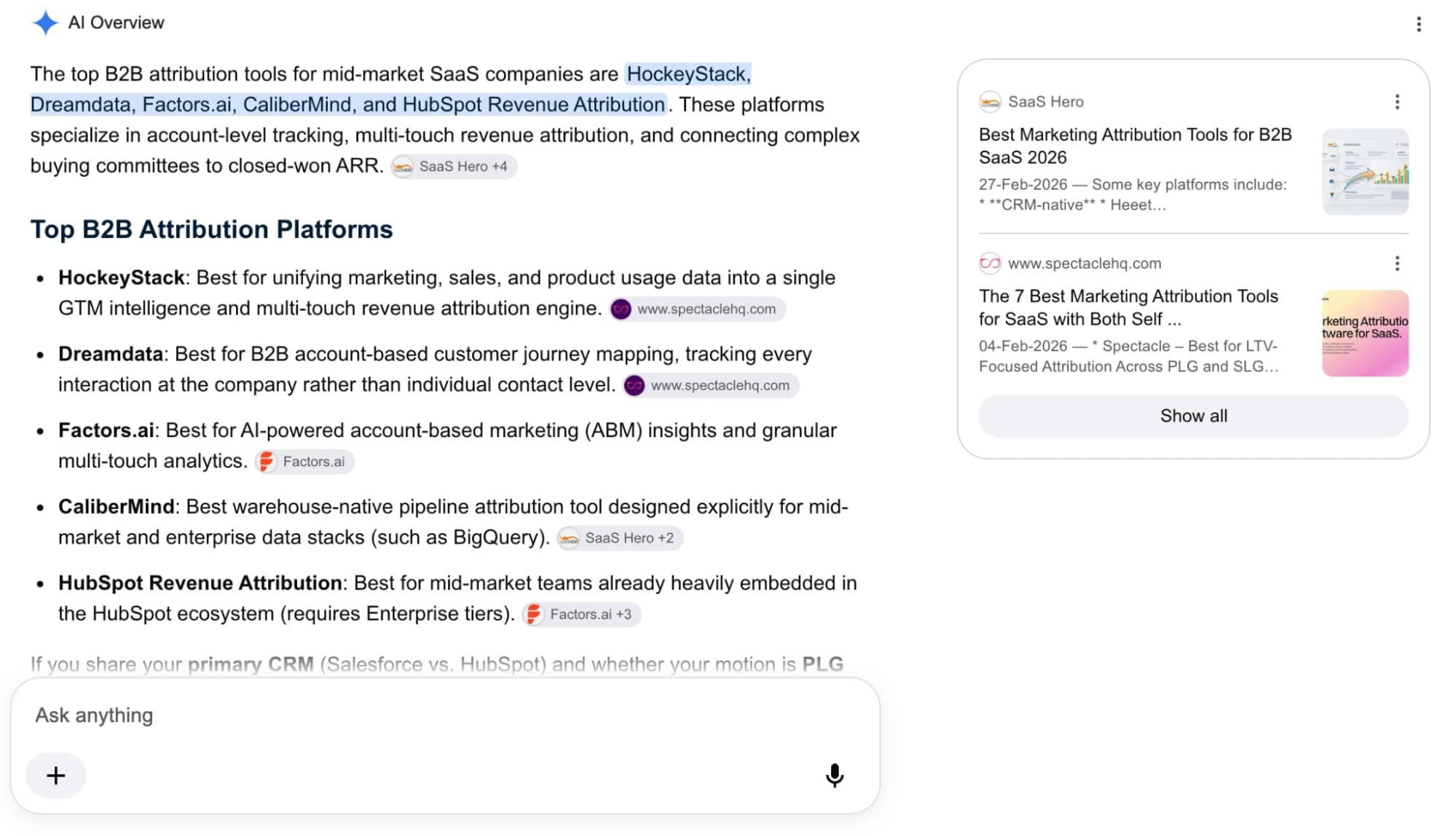
Note which domains the engines pull into their citation carousels and analyze which competitors show up in AI search.
Analyzing external trust signals exposes why certain competitors appear in AI summaries even if their traditional organic ranks lag.
Large language models generate probabilistic text, while AI search systems often pair them with retrieval systems that fetch relevant web information. If your content is vague, poorly structured, or buried in marketing jargon, retrieval systems may be less likely to surface or cite it.
To get cited, you must transform your standard landing pages into modular, reference-grade assets.
AI search crawlers favor content formats that present dense information cleanly. Focus your production pipeline on:
Comparison queries are becoming important in AI search. It’s one of the best ways to optimize content for AI search. Users often ask models to identify, evaluate, and compare companies within a category. To earn citations for a query such as the best monitoring companies, publishers must:
This gives AI systems structured evidence they can use instead of relying on vague promotional claims.
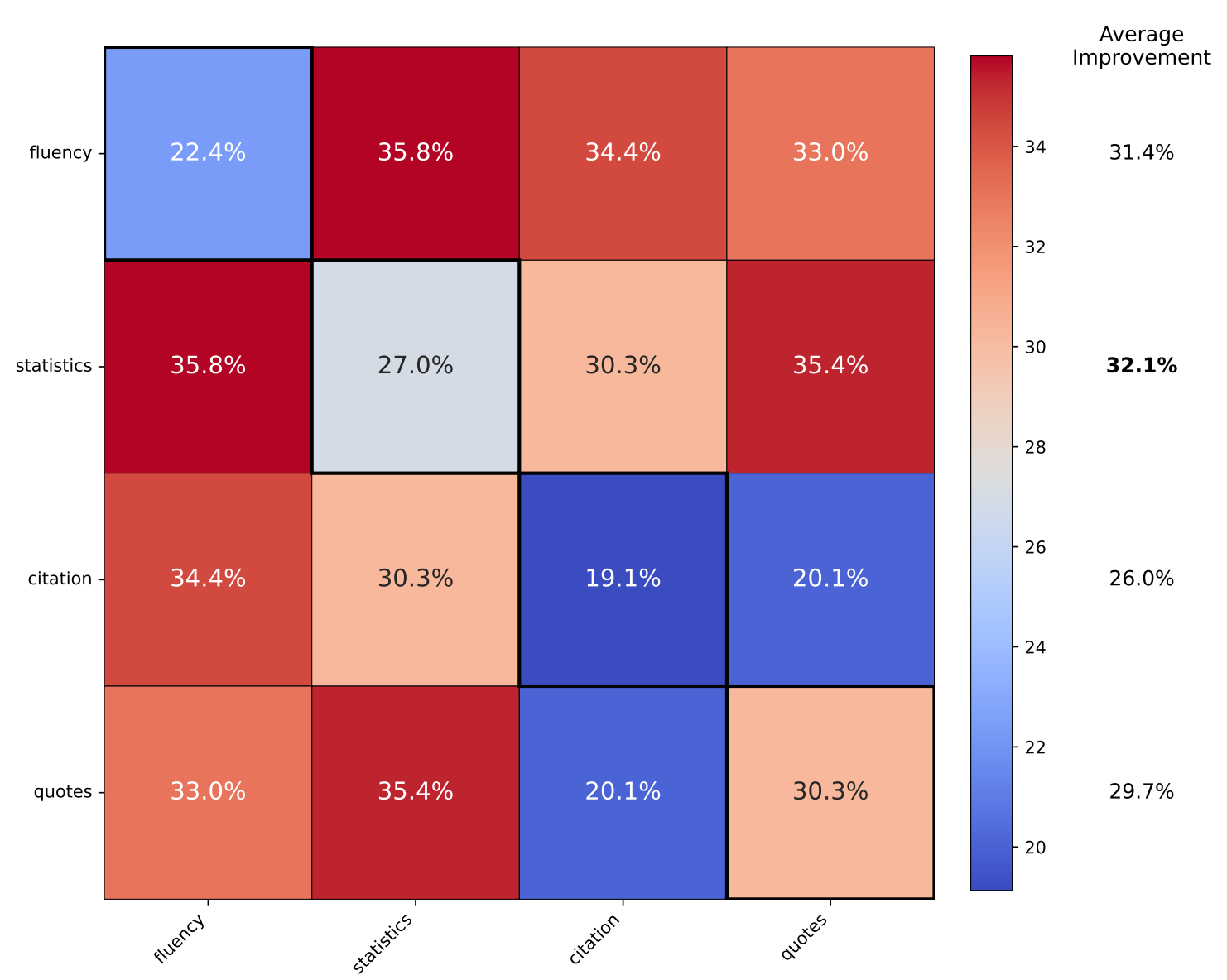
Verifiable claims are critical to boost visibility in AI search engines. Research by Princeton University and the IITD found that adding credible citations, quotations, and statistics produced some of the strongest visibility improvements in its GEO experiments. The top-performing methods improved position-adjusted visibility by roughly 30-40% and subjective impressions by 15-30%.
The push to put hard numbers in your content comes with a catch that few people discuss. A number is only useful if the condition attached to it travels with it. RAG systems often retrieve content in chunks that may exclude surrounding context. If a statistic relies on a condition stated in a separate paragraph, the AI will likely strip the context and misquote you.
Professional education illustrates this well: California CPAs renewing an active license generally need 80 hours of continuing education every two years. Within that total, licensees who plan, direct, perform substantial portions of, or report on audits, reviews, compilations, or attestation services must complete 24 hours in accounting and auditing.
A page that lists auditing CPE courses with credit values beside each module looks ideal to an automated retrieval system because it is concise and self-contained. However, take away the rule about who the numbers apply to, and a true sentence turns into a wrong answer for most of the people reading it.
If you're writing about a regulated subject, you should keep the qualifier in the same sentence as the figure, because the sentence after it might never get pulled at all.
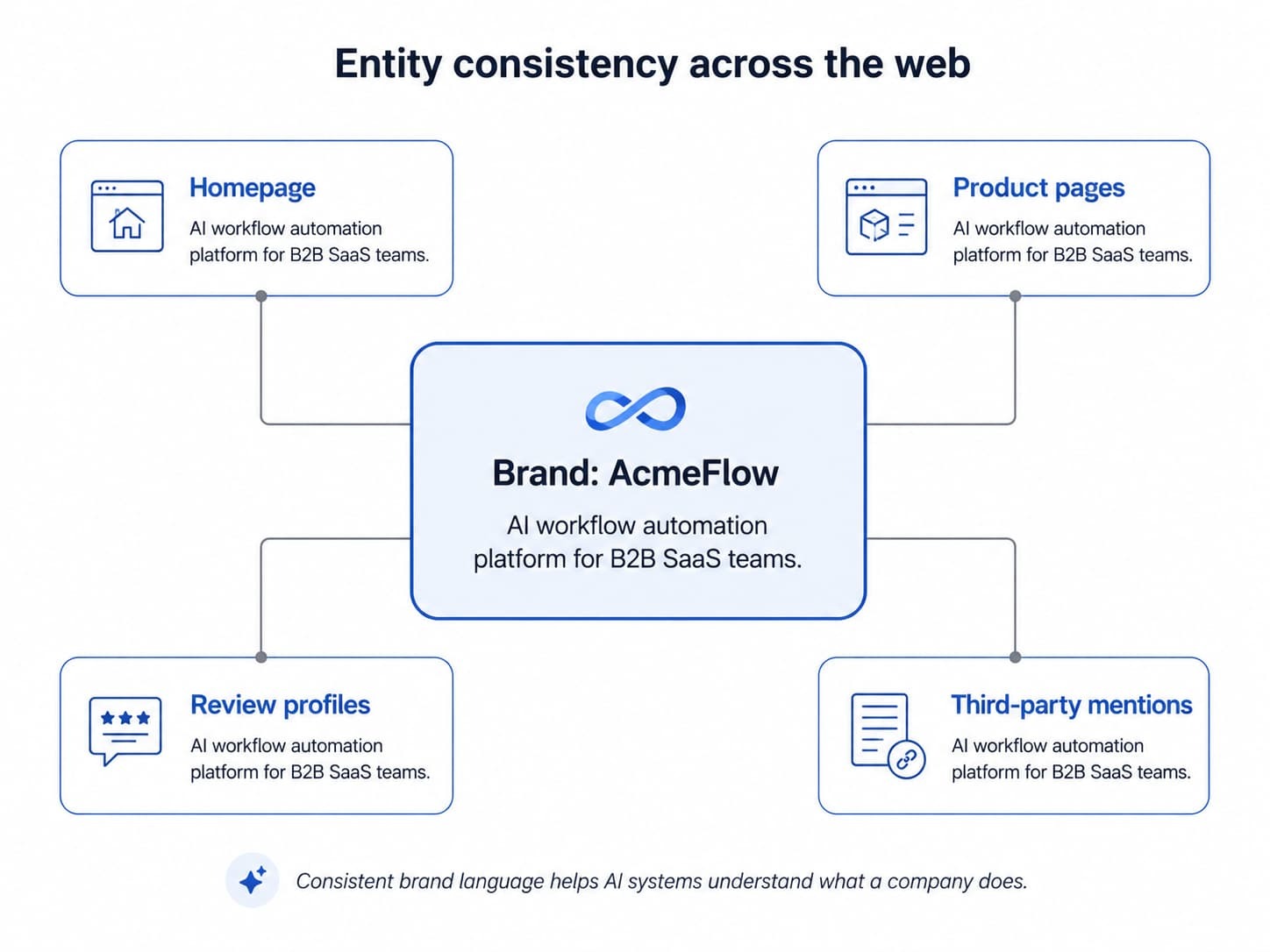
AI systems infer relationships among entities from information found across multiple sources. If your homepage labels your software as an "all-in-one workspace," your pricing page calls it a "project tracker," and your review profiles call it a "CRM," the engine struggles to categorize your solution.
For example, if you have a website for a business travel management software, you should consistently describe its core capabilities, such as booking flights and hotels, managing travel policies, and tracking travel spend, across its website, review profiles, and third-party listings. Consistent terminology helps AI systems connect the product to the right category and understand which buyer needs it serves.
Standardize your core positioning statement across your entire digital footprint. Use consistent terminology for your product tier names, primary capabilities, and target industry verticals.
No large language model relies entirely on on-page claims. AI search engines often draw on sources beyond a brand’s website, so independent third-party validation matters for visibility.
A study from researchers at the University of Toronto revealed that generative search engines display a strong structural preference for:
They prefer them over owned corporate blogs. That means that publishing great content yourself isn't enough for AI search. You need to get your name out there beyond your own website.
Using AEO optimization tools can also help you identify opportunities to strengthen your presence across third-party sources and improve your visibility in AI search.
Generative engines are built to avoid repeating unsubstantiated marketing claims. When an AI evaluates whether to recommend your software, it looks for consensus across independent third-party sources like:
This verification mechanism applies across every high-stakes industry. LLMs lean on trust signals that exist entirely outside the provider's own site:
The model needs external validation before it repeats a recommendation. Third-party directories provide that proof.
For B2B SaaS companies, this means your generative citation frequency depends on your presence on platforms like:
Securing unlinked brand mentions, executive quotes, and product inclusions on these authoritative domains can strengthen the third-party authority signals associated with your company.
The second part of the strategy comes straight out of traditional SEO and link-building tactics. Reputable publications cite resources that provide tangible evidence, exclusive benchmarks, or expert insights. For example, an agency specializing in digital marketing for HVAC companies can build topical authority by publishing original insights on how HVAC businesses attract customers, generate leads, and measure marketing performance. These specialized insights give third-party publishers and AI systems more specific, industry-relevant information to reference than generic marketing advice.
Publishing proprietary research based on your platform's anonymized product data can make your content a stronger reference point for external journalists.
LLMs favor long-form itinerary detail, historical accuracy, named guides or sources, and content that reads like it was written by someone who has actually run the tour repeatedly. This is closer to classic topical-authority SEO than to reputation aggregation. It's about comprehensive coverage of a narrow subject.
Unique domain depth helps third parties link to your platform as a trusted authority.
Content can't earn an AI citation if automated parsers can't extract its core semantic meaning. Certain website and content features can block generative crawlers from reading your best insights. These features include:
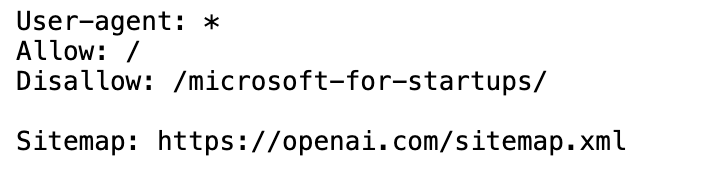
Ensure that all high-priority informational pages render clean HTML server-side. Also, maintain an up-to-date XML sitemap and check your robots.txt file to confirm that your public assets are accessible to user agents such as:
As management guru Peter Drucker famously said:
"An enterprise can't manage what it doesn't measure."
SEOs know this only too well. According to research by SparkToro and Datos, less than one-third of Google searches send a click to the open web. This underscores the dominance of zero-click SERPs. In that study, SparkToro CEO Rand Fishkin observed, regarding this structural transformation:
"Yes, the world of 0 clicks is here — but that doesn't mean all traffic is dead or all websites are useless. It means changing how we do things, not throwing in the towel."
In this scenario, tracking your AI search engine performance becomes more important than ever. This requires going beyond traditional rank tracking that monitors static position numbers.
Instead of relying on static rankings, track a fixed prompt set each month and calculate how often your brand is cited relative to key competitors.
Once you begin tracking your AI citations, it's time to assess which specific marketing initiatives yield measurable increases in those generative citations. Track whether an updated technical whitepaper or targeted PR placement coincides with new appearances in generative answers.
Documenting these patterns helps your team identify which tactics consistently drive stronger AI visibility.
Achieving sustainable visibility inside generative engines requires a systematic, recurring operational workflow. Disconnected, one-off optimizations rarely produce long-term citation stability as search systems, indexes, and source coverage change.
Adopt an agile four-week sprint cycle to systematically audit, optimize, and expand your generative search presence:
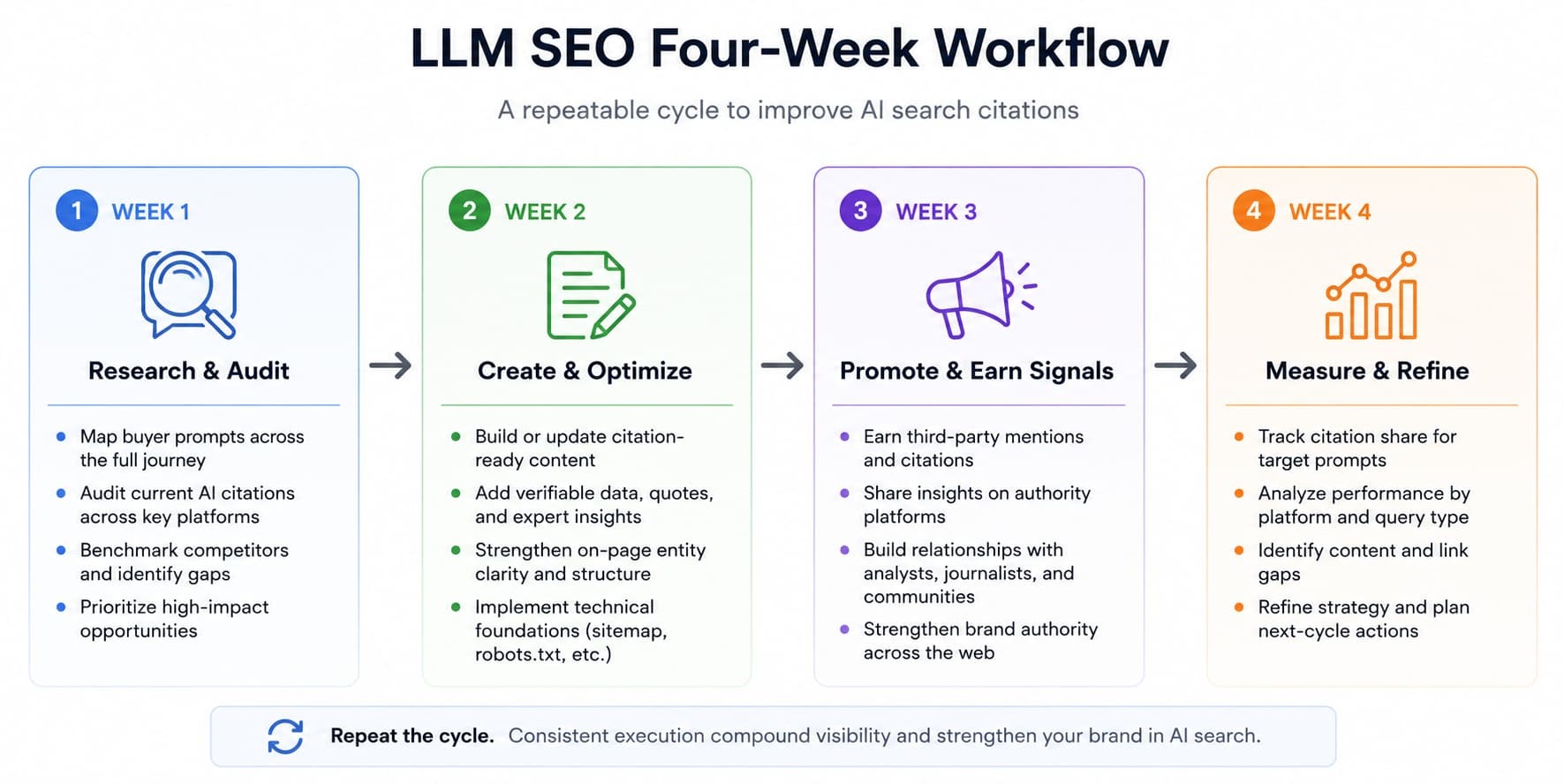
The transition from keyword-based indexing to AI-generated synthesis is changing how brands earn organic visibility. Traditional organic rankings alone can't protect your pipeline in an ecosystem dominated by zero-click interfaces and synthetic summaries.
The strongest approach to get your brands cited in AI search is covered throughout this guide:
AI search is still evolving, so there is no single optimization that guarantees consistent citations. But your goal is to become a source that AI systems can confidently use when your potential customers are researching a problem, comparing solutions, or deciding which vendors to consider.
Traditional SEO focuses on optimizing pages to rank in a list of web links based on keywords, backlinks, and technical site health. LLM SEO focuses on structuring information, establishing entity authority, and providing verifiable facts so conversational AI engines cite your brand inside generated responses.
AI search platforms such as Perplexity and ChatGPT Search can surface fresh web sources, but citation timing varies by platform, crawlability, indexing, query, and retrieval behavior. Foundational models without real-time browsing update their internal knowledge representations only when new training runs or retrieval indexes refresh.
Structured data can make information on a page more machine-readable and help search systems understand its entities and content. Still, it does not guarantee inclusion or citation in AI-generated answers.

Israel is an academic, chemist, applied AI practitioner and evangelist, technology writer, law student, and part-time marketer with almost ten years of experience in data-driven SEO content writing and copyediting. Currently the head scriptwriter for the engineering channel Two Bit da Vinci, he draws on a multidisciplinary background in the physical sciences, engineering, finance, and law to explore the practical realities of AI-assisted development, workflow automation, and the management of AI in enterprise environments.
.svg)
.svg)
.svg)
.svg)
.svg)