


Back to articles
5 Best AI Rank Trackers Reviewed: Find Out Where You Stand in AI Search
November 3, 2026
By
Irina Maltseva
Your brand might rank first on Google and not appear once in ChatGPT, Perplexity, or Google AI Overviews. That gap is what AI rank trackers exist to close.
Traditional rank trackers tell you where your pages sit in a list of blue links. AI rank trackers tell you whether your brand appears in synthesized answers, and if so, how often, in what context, and alongside which competitors. These are different signals, different tools, and different optimization strategies.
This guide reviews the 5 best AI rank trackers on the market: what each does well, where each falls short, and which one fits your team.
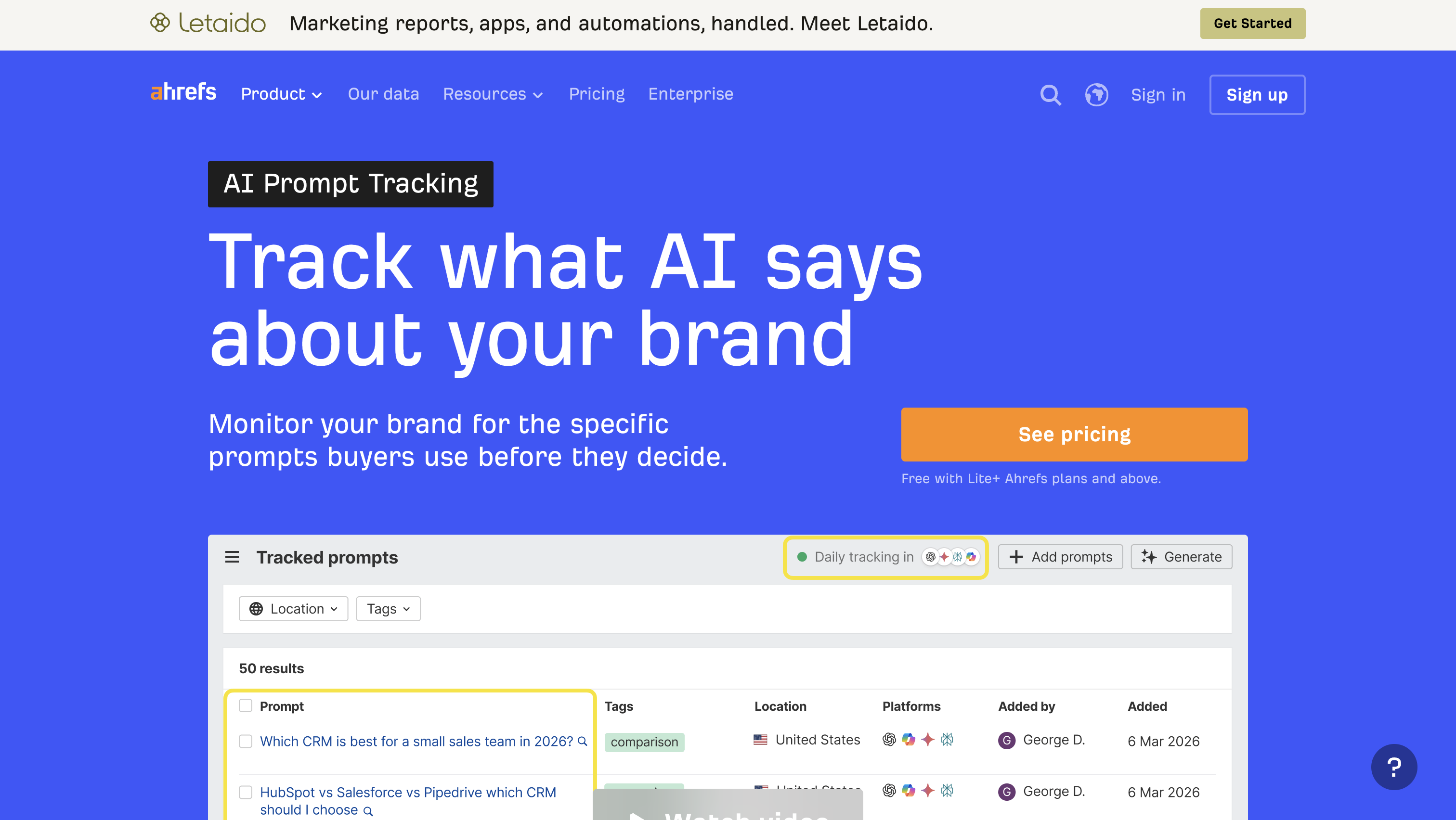
Ahrefs Brand Radar combines two approaches to AI visibility research: AI Prompt Tracking and the AI Visibility Index.
With AI Prompt Tracking, you can monitor the specific questions your buyers ask before choosing a product. Add your own prompts or use Ahrefs to generate relevant ones based on competitor comparisons, pricing data, and other research signals. You can then track brand mentions, citations, sentiment, and AI Share of Voice, while exploring the fanout queries AI generates behind the scenes to uncover content gaps.
For broader research, Brand Radar also gives you access to an extensive database of 500M+ AI prompts. This lets you explore how brands appear across AI search without having to build and manage your own prompt list.
The two approaches work well together: track the buyer-intent questions that matter most to your business, then use the broader database to understand your visibility across the wider market.
The AI Visibility Index covers 6 platforms: Google AI Overviews, Google AI Mode, ChatGPT, Perplexity, Microsoft Copilot, and Gemini.
AI Prompt Tracking supports these six platforms, with Claude also available. Claude uses eight checks per update.
Tracks brand mentions, cited website pages, and AI Share of Voice. You can also inspect fanout queries, monitor sentiment in AI responses, and organize prompts by topic, campaign, or buyer journey stage.
Ahrefs Brand Radar is available as a standalone product, so you don't need an existing Ahrefs SEO subscription.
AI Prompt Tracking starts at $50/month for 2,500 checks, with larger packages at $100/month for 7,000 checks and $250/month for 25,000 checks. Paid Ahrefs Lite plans and above also include a monthly allowance of custom prompt checks:
If you want broader market research, the AI Visibility Index starts at $199/month per index, or $699/month for all six indexes. The all-platform package also includes 2,500 custom prompt checks per month.
Existing Ahrefs subscribers get additional benefits, including Search Demand and Web Visibility data, depending on their subscription tier. However, an Ahrefs SEO subscription isn't required to purchase Brand Radar separately.
SEO teams that want to track specific buyer-intent prompts, understand how AI discusses their brand, and find content opportunities alongside their existing SEO research. It's also useful for teams that want to research competitors and broader market visibility without relying only on their own tracked prompts.
If you only need a simple overview of AI visibility and don't want to manage a custom prompt list, the AI Visibility Index may be more relevant than AI Prompt Tracking. If you need broader monitoring across many prompts and platforms, keep an eye on check consumption: each prompt-platform-location combination uses a check, and Claude uses eight checks per update.
SE Ranking is the only tool on this list under $110/mo that includes both traditional keyword rank tracking and AI visibility across five engines in the same plan without add-ons. AI Overviews, AI Mode, ChatGPT, Gemini, and Perplexity are all included in the Core plan alongside daily keyword rankings, site audit, backlink analysis, and competitor research.
The "No cited" feature is the AEO standout: it surfaces specific prompts where competitors appear in AI answers and your brand doesn't. That's a content gap list derived from actual AI engine behavior rather than keyword research assumptions. The AI Competitor Research module tracks any brand's AI presence across engines without setting up a separate project.
AI Overviews, AI Mode, ChatGPT, Gemini, Perplexity — all included in Core.
Yes, AI citation analysis included. "No cited" feature surfaces competitor AI mentions where your brand is absent.
Basic AI visibility signals included. Confirm sentiment granularity on SE Ranking's current pricing page before publishing.
Core plan from $103/mo billed annually. AI tracking included in Core, no add-on required.
Budget-conscious in-house teams and small agencies that want traditional rank tracking and AI visibility in one subscription without a budget conversation.
If you need deep citation mechanics, enterprise prompt volumes, or the most reliable AI visibility data methodology. SE Ranking's data depth reflects the price.
Semrush covers both traditional SEO and AI visibility in one subscription. For teams already running keyword research, rank tracking, and competitive analysis inside Semrush, that means no new login, no new vendor, and no separate data source to reconcile with existing reporting.
Position Tracking handles daily keyword rankings, SERP feature monitoring, and competitive visibility. The AI Visibility Toolkit handles AI presence: brand citations across Google AI Overviews, Google AI Mode, ChatGPT, Perplexity, and Gemini with share of voice, sentiment scores, and cited page tracking. The 289M+ AI query database for Prompt Research surfaces what your target audience is actually asking in AI engines, a more grounded starting point than building a prompt set from scratch. The MCP connector puts Semrush data inside ChatGPT, Claude, and Perplexity directly.
Google AI Overviews, Google AI Mode, ChatGPT, Perplexity, Gemini.
Yes, cited pages tracking with source attribution included.
Yes, share of voice and sentiment scores included across plans.
Pro $139.95/mo; AI Visibility Toolkit included in Semrush One Pro+ at no extra cost; standalone AI Toolkit $99/mo per domain; free AI visibility audit available without subscription.
In-house teams and agencies already standardized on Semrush who want AI visibility alongside traditional SEO without adding a new vendor.
If you're not on Semrush. The AI features integrate tightly with the rest of the platform and lose value as a standalone purchase.
Profound processes over 1 billion citations and 10 million prompts daily, the largest dataset in the category by a significant margin. The Conversation Explorer estimates the total volume of AI conversations happening around specific topics, giving you a sense of opportunity size before you decide where to focus. That's a meaningfully different output from tracking your own prompted queries — it surfaces the conversations you didn't know to look for.
Shopping Intelligence tracks how AI engines handle buying-intent queries and product recommendations, a capability unique to Profound in this category. SOC 2 Type II compliance and SSO/SAML make it viable for enterprise security reviews that smaller tools can't clear.
ChatGPT on Starter; ChatGPT, Perplexity, and AI Overviews on Growth; up to 9 on Enterprise.
Yes, your URLs and third-party source domains both included.
Yes, with narrative tracking included.
Starter $99/mo (ChatGPT only, 50 prompts); Growth $399/mo (3 engines, 100 prompts); Enterprise custom.
Large enterprises, e-commerce brands, and analytics-heavy teams that need the deepest AI monitoring dataset available and can justify the price.
If you're expecting the $99 Starter to give you meaningful multi-engine coverage. It's a single-engine entry point, not a full platform trial.
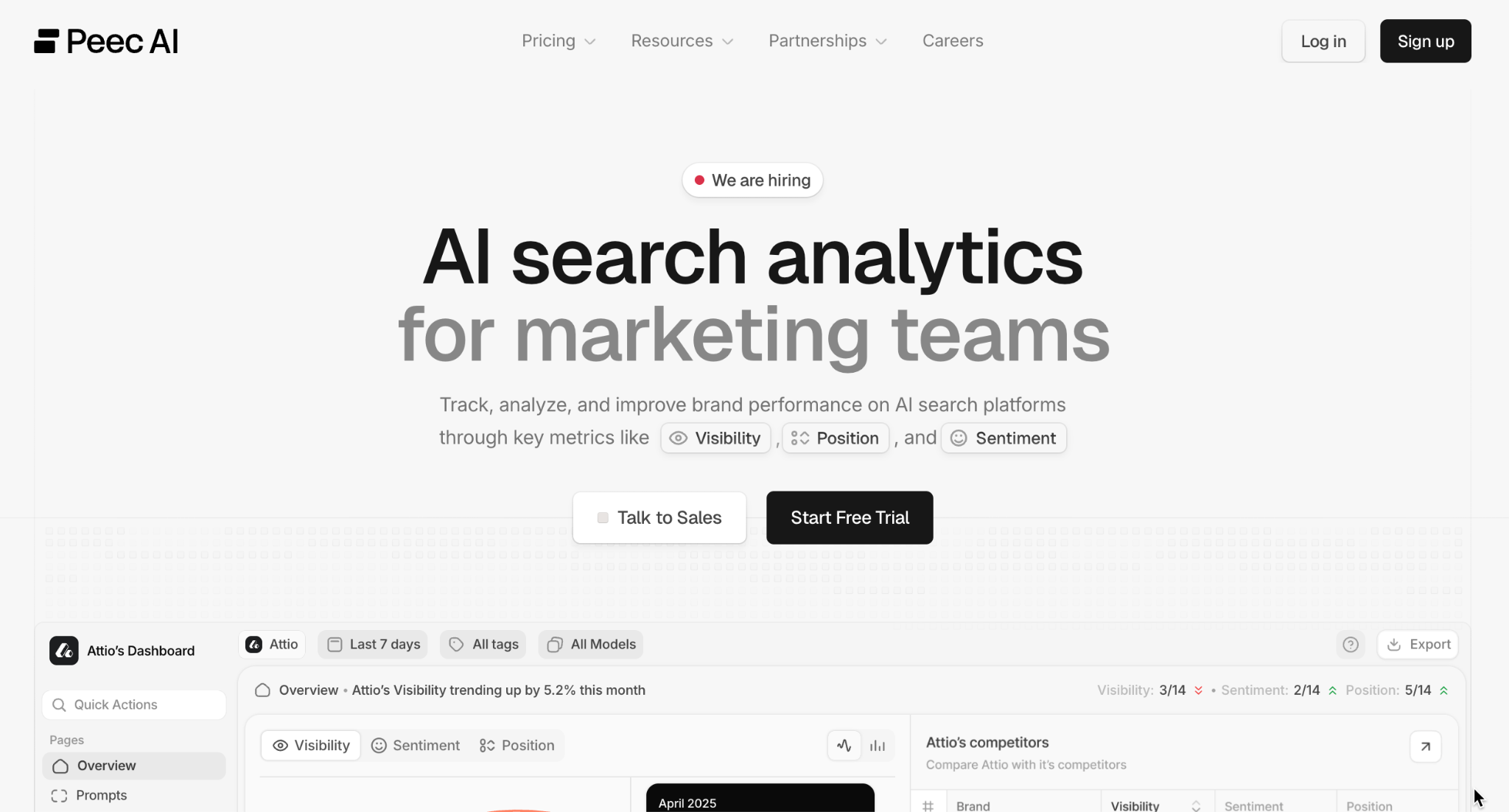
Peec's model differs from most tools in this category: instead of a fixed engine bundle, you choose which three of six available engines to track at entry tier, with additional engines available as add-ons. For brands whose buyers are concentrated on specific platforms, that flexibility avoids paying for coverage that doesn't match your audience.
Peec queries AI platforms by simulating real browser sessions rather than API calls, which means results reflect what actual users see rather than what an API endpoint returns. Sentiment tracking goes beyond whether you appeared: it tracks how AI frames your brand over time and against competitors, whether as a leader, an alternative, or a budget option.
Choose 3 of 6 on entry: ChatGPT, Perplexity, Gemini, AI Mode, AI Overviews, Copilot. Grok available as a paid add-on from $35/mo.
Yes, multi-layered citation decoding with entity checks and source categorization.
Yes, framing trends tracked over time and against competitors.
Starter $95/mo (50 prompts, 3 engines); Pro $245/mo; Advanced $495/mo; Enterprise custom. Additional engines from $35/mo.
Growing brands and analytically minded teams that want engine flexibility, real browser session data, and citation depth without enterprise pricing.
If you need a gentle onboarding experience. The interface rewards users who want to dig into data, and the per-engine add-on pricing model takes some getting used to.
You need a dedicated AI monitoring tool where traditional rank tracking is irrelevant or secondary.
Profound for enterprise citation depth and conversation volume estimation — the deepest dataset available, with Shopping Intelligence for e-commerce brands. Peec AI for engine flexibility, real browser sessions, and citation decoding without the enterprise price tag.
SE Ranking covers both at the lowest all-in price. Brand Radar paired with an existing Ahrefs plan covers both with the most reliable AI methodology. The choice between them is a budget decision, not a features decision.
Most teams don't need two separate subscriptions. They need one tool that's honest about which job it does best.
The market is converging. Right now the distinction between "rank tracker" and "AI visibility tool" still matters — and knowing which job you're hiring for is the only question that needs answering before you pick a tool.
A traditional rank tracker measures your page's position in search engine results for specific keywords. An AI rank tracker monitors whether your brand appears in AI-generated answers across platforms like ChatGPT, Perplexity, Gemini, and Google AI Overviews. No position exists in AI answers — only presence or absence, measured through share of voice, citation frequency, and sentiment across a defined set of prompts.
Both. Ahrefs Brand Radar tracks AI visibility across up to 6 platforms, including AI Overviews, AI Mode, ChatGPT, Perplexity, Copilot, and Gemini. The distinguishing feature is methodology: Brand Radar derives prompts from Ahrefs' real keyword database rather than generating synthetic queries, grounding the visibility data in documented user search behavior.
AI engines are non-deterministic — the same prompt returns different answers on different runs. Tools handle this by running high prompt volumes and aggregating results over time. Treat share-of-voice data as a directional trend metric rather than a precise daily number, and look for consistent patterns over weeks rather than point-in-time snapshots.
Start with ChatGPT and Google AI Overviews — they have the largest reach and clearest optimization signals. Add Perplexity for research-focused audiences and Gemini as Google's AI ecosystem expands. Microsoft Copilot matters for B2B and enterprise audiences. Prioritize the engines your buyers actually use rather than trying to cover all of them at once.
Yes. Semrush's free AI visibility audit covers 289M+ prompts with no subscription required. Ahrefs Free includes limited Brand Radar access for sites you own. Peec AI and Otterly AI both offer free trials. For a manual check, run your 10 most important buying-intent prompts in ChatGPT, Perplexity, and Google with AI Overviews enabled and note whether your brand appears before committing to a paid tool.

Irina is a Founder at ONSAAS, Growth Lead at Aura, and a SaaS marketing consultant. She helps companies to grow their revenue with SEO and inbound marketing. In her spare time, Irina entertains her cat Persie and collects airline miles.


