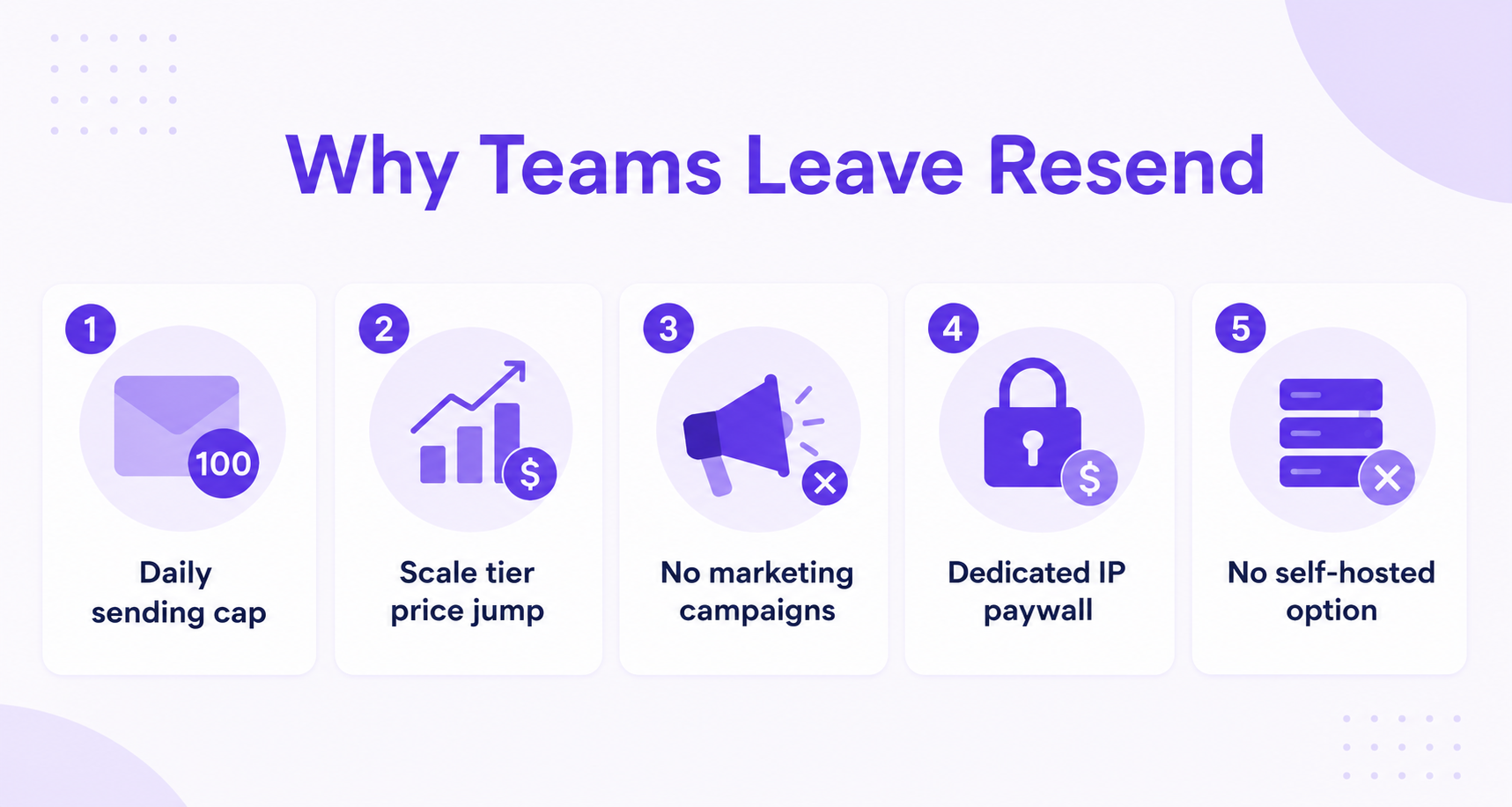
Resend earned its reputation on developer experience. The React Email integration is genuinely good, the API is clean, and onboarding is fast. But the limits show up quickly: a free tier with a 100-email daily cap that one busy day burns through, dedicated IPs locked behind the $90/month Scale tier, no marketing campaign functionality, and no self-hosted option for teams that need data control.
If you've outgrown Resend, or it was never the right fit, this guide compares 9 alternatives, normalizes pricing to cost per 1,000 emails, and routes you to the right pick based on use case, volume, and engineering capacity.
Resend is genuinely good at what it's designed for. This isn't about Resend being bad — it's about specific mismatches that push teams to look elsewhere.
The free tier covers 3,000 emails per month but caps at 100 per day. A single product launch or onboarding spike can burn through the daily limit before noon. The Scale tier doubled its prices in October 2024 and now sits at $90/month for 100,000 emails — a significant jump from the $20 Pro tier, with no middle ground.
Resend is a transactional API. There are no campaigns, no CRM, no automation sequences. Teams that want transactional and marketing email in one platform need to run a second tool alongside it, which adds cost and coordination overhead.
Teams with data residency requirements, compliance constraints, or a preference for infrastructure transparency have no Resend-native path to self-hosting.
You can't get a dedicated IP on the Pro plan at $20/month. It only becomes available on Scale ($90/month and above), which means smaller teams pay for shared IP pools they can't control.
On shared IP pools, one bad sender affects everyone's inbox placement — spam complaints and bounce rates from other accounts on the same IP bleed into your sender reputation with no recourse.
That risk compounds at scale: with nearly half of all 361 billion daily emails classified as spam in 2025, the risk of shared IP contamination isn't theoretical — you're competing for inbox placement with thousands of other senders on the same infrastructure.
Picks are organized into three buckets: developer-first transactional APIs, combined transactional + marketing platforms, and open-source self-hosted options. Each entry covers strengths, pricing normalized to cost per 1,000 emails where possible, best fit, and honest weaknesses.
Maileroo is the closest direct replacement for teams that want to consolidate transactional sending and email marketing in one platform without the pricing unpredictability of Resend at scale.
Free plan at 5,000 emails/month. Paid plans scale by volume on a pay-as-you-go basis — competitive per-1,000 cost versus Resend at equivalent tiers, with no surprise price doubling mid-year.
Teams migrating off Resend that need both transactional reliability and marketing functionality, without managing two separate platforms.
Smaller community and ecosystem than Mailgun or Resend; fewer third-party integration tutorials and community-written guides available.
Postmark is purpose-built for transactional email and doesn't pretend to be anything else. If inbox placement speed is non-negotiable — password resets, authentication emails, order confirmations — nothing on this list beats it.
Industry-leading inbox placement speed, specialized transactional analytics, message streams that separate transactional and broadcast traffic, inbound email parsing, clean UI that non-developers can navigate.
Volume-based from $15/month for 10,000 emails. Higher per-1,000 cost than Amazon SES but includes analytics, deliverability monitoring, and responsive support.
SaaS apps where a delayed authentication email means a lost user.
Transactional-only by design — no marketing campaigns, no automation sequences. If you need both, you're running a second tool.
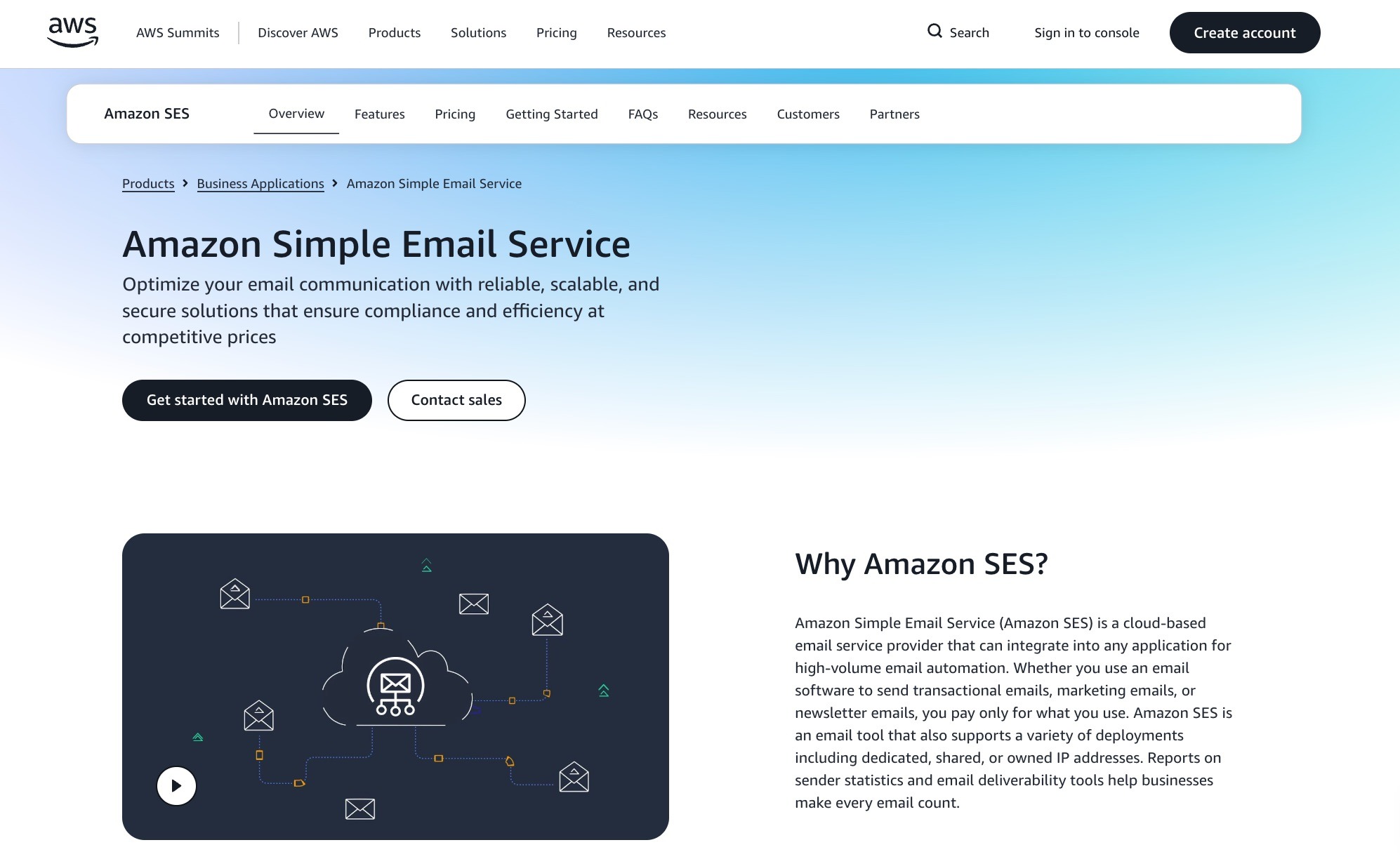
At $0.10 per 1,000 emails, Amazon SES is the cheapest sending infrastructure available. For high-volume technical teams already inside the AWS ecosystem, the math is hard to argue with.
~$0.10/1,000 emails — lowest raw cost on this list, effectively unlimited scale, pay only for what you send, deep AWS integration, full SMTP and API access.
Pay-as-you-go. The headline number is accurate — but the true cost rises once you account for the engineering work to build your own templating, analytics, and observability layers that every other provider includes out of the box.
High-volume senders with engineering resources to build and maintain the surrounding infrastructure. Not a good fit if you want a managed product.
No UI, no built-in analytics, no support without an AWS support plan. The cheap headline price hides real operational overhead.
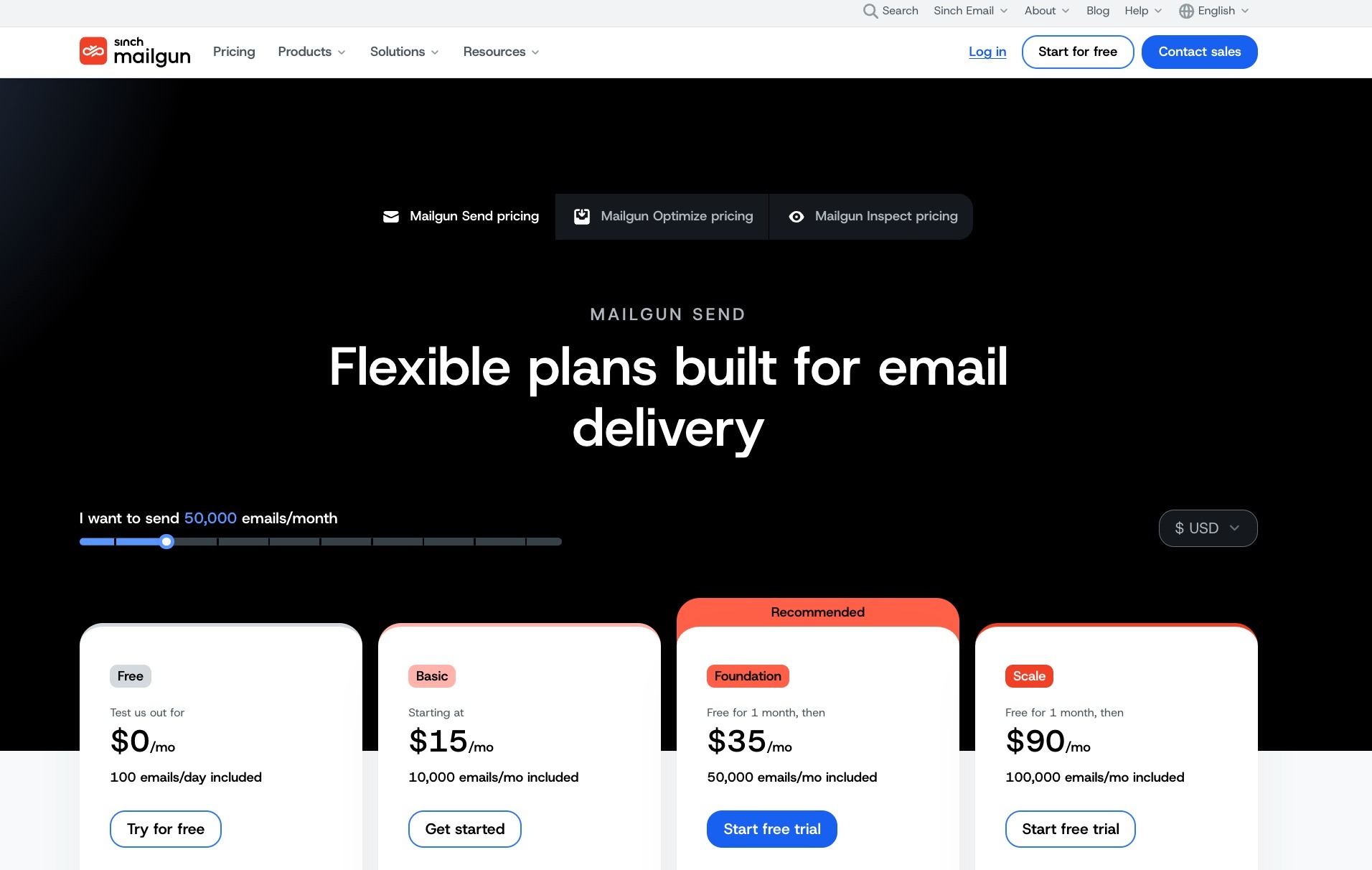
Mailgun is the developer-first alternative with the deepest routing capabilities on this list. If you need fine-grained control over how email gets classified, routed, and tracked, Mailgun has the most configuration surface area available.
Advanced routing and suppression management, data-rich delivery analytics, strong SDKs across major languages, inbound email parsing, reliable API with extensive documentation.
Flex plan at $1.00/1,000 emails; Foundation at $35/month for 50,000. Dedicated IP is an add-on — factor this in when modeling costs at scale.
Dev teams building complex email infrastructure that requires routing logic, suppression management, and delivery diagnostics.
Cost creep at higher volumes once you add dedicated IPs; more complexity than most teams with simple transactional needs actually require.

Mailtrap is an email delivery platform for product and dev teams, with transactional and bulk sending on isolated IP pools by default, plus an official MCP server, CLI, and Agent Skills for teams that build with coding agents.
Transactional and bulk email on isolated IP pools, Automatic SPF, DKIM, and DMARC setup with monthly DKIM rotation. Stats by mailbox provider and stream, with spam complaint data from 20+ ISPs and Official MCP server, CLI, and Agent Skills for working with coding agents
Free plan: 4,000 emails/month (150/day). Paid plans start at $15/month for 10,000 emails. Business starts at $85/month for 100,000 emails and includes a dedicated IP.
Product and dev teams that want sending reputation protected from day one and an email stack their coding agents can operate directly from the editor or terminal.
Log retention runs from 3 days on Free to 30 days on Enterprise (15 on Business). Click tracking starts on Basic, and Email Marketing is a separate product with its own billing. Dedicated IP and reputation monitoring start on Business.

Mailjet covers both transactional API sending and marketing campaigns in one platform, which is the use case Resend specifically doesn't serve.
Transactional and marketing campaigns in one platform, collaborative drag-and-drop template editor, API and SMTP relay, list segmentation and automation.
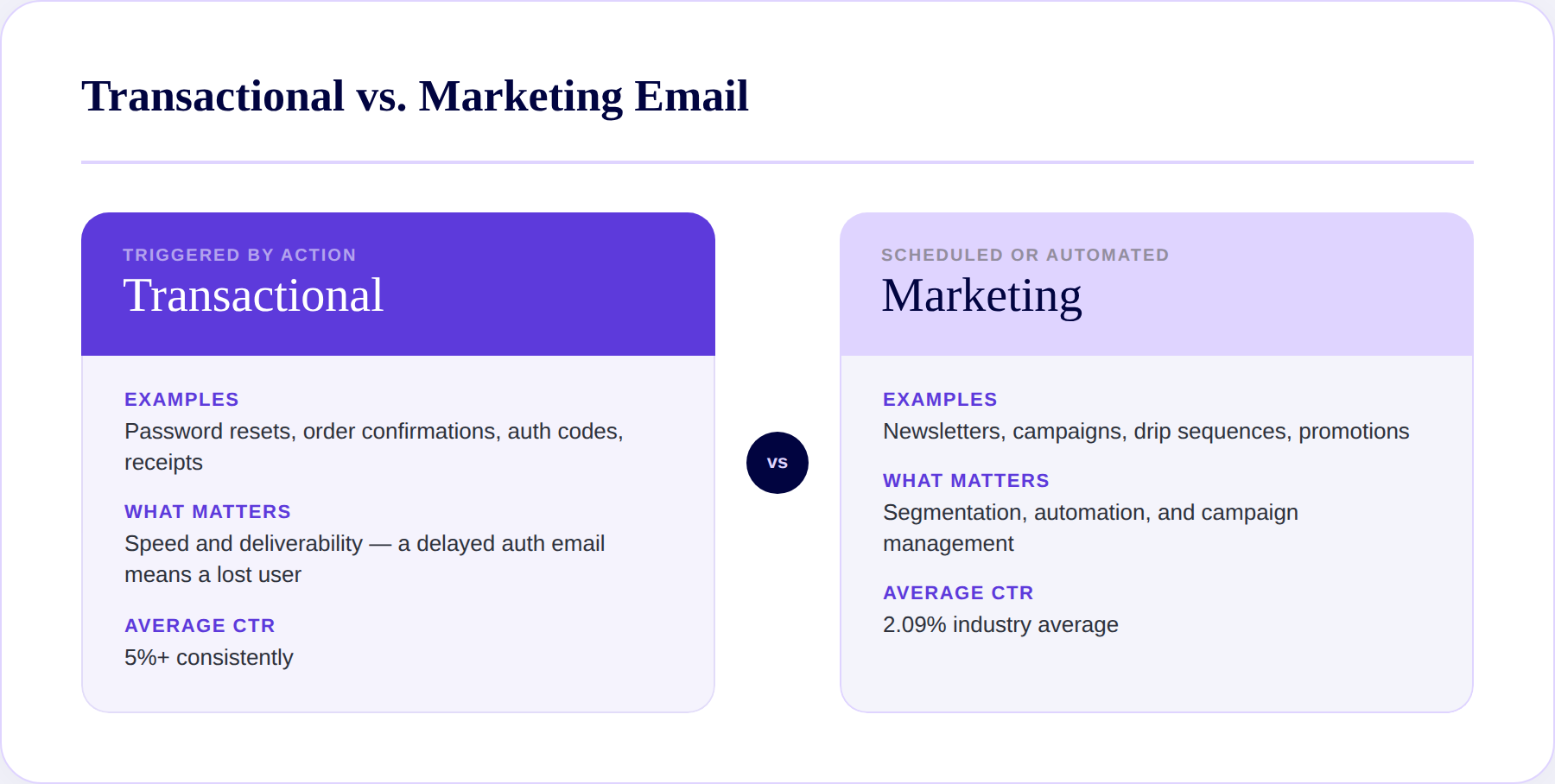
Transactional emails consistently outperform marketing campaigns on CTR — transactional CTR regularly exceeds 5% compared to the 2.09% average for standard campaigns — which means the two use cases reward different infrastructure choices.
Free tier available. Volume-based paid plans from $15/month.
Teams that want to replace Resend and a separate marketing tool with a single platform, without prioritizing best-in-class transactional deliverability.
Transactional deliverability and developer experience don't match specialized providers like Postmark or Maileroo. The all-in-one nature involves trade-offs on both ends.
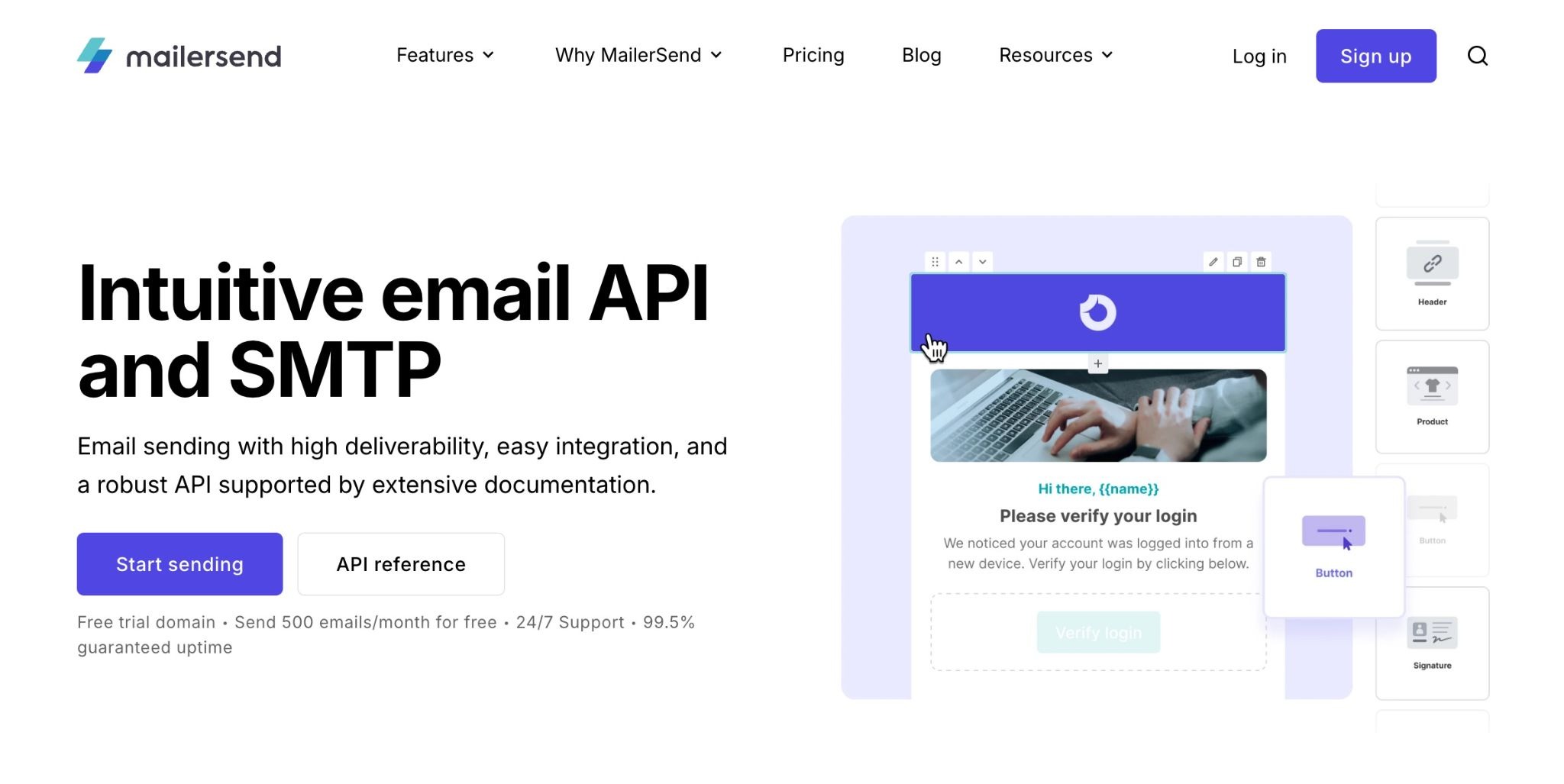
MailerSend is built on the same infrastructure as Mailgun but with a more accessible interface — the right choice when non-developers need to manage email templates without touching code.
Drag-and-drop template builder, transactional API and SMTP relay, inbound email routing, real-time analytics, generous free tier.
Free plan at 3,000 emails/month. Paid from $30/month for higher volumes.
Teams where designers or marketers manage email templates independently of engineering.
Less feature depth than Mailgun for complex routing scenarios; smaller ecosystem and fewer community resources.
Sequenzy is the most differentiated pick on this list for a specific use case: SaaS teams that need transactional and marketing email tied directly to subscription billing events.
Marketing and transactional email in one platform, AI-powered sequence generation from plain English descriptions, native Stripe and Paddle integration for billing-triggered automations (dunning sequences, trial conversions, subscription lifecycle emails), all features included at every price tier, React Email support.
Automated emails drive 37% of all email-generated sales while representing just 2% of volume — which makes billing-triggered automation a direct revenue lever, not just an ops convenience
Free tier at 2,500 emails/month. Paid plans from $19/month (1,000 subscribers), scaling by subscriber count with a published pricing table and no hidden feature tiers.
SaaS founders who want billing-triggered email automation — trial conversions, failed payment recovery, subscription lifecycle sequences — without the integration overhead of connecting a separate email tool to Stripe.
Email-only platform — no SMS, no landing pages, no multi-channel. Fewer native third-party integrations than established platforms; relies on Zapier and webhooks for many connections.
Plunk is for developers who want full control: self-host the infrastructure, own the data, inspect the code. It's the only option on this list that's both open-source and self-hostable.
Open-source codebase, modern API, self-hostable on your own infrastructure, full transparency, developer-friendly design.
Free if self-hosted. Managed plan pricing available for teams that want the open-source model without managing the infrastructure.
Developers with data residency requirements, compliance constraints, or a philosophical preference for open-source over managed SaaS.
Self-hosting requires infrastructure overhead — you own the setup, the maintenance, and the scaling. Smaller community and fewer integrations than managed alternatives.
SaaS companies average 80.9% inbox placement — below most other industries. Your ESP choice is one of the few infrastructure levers you fully control.
These three criteria determine your shortlist:
The three axes that determine your pick: use case (transactional-only vs. combined platform), cost tolerance (managed service vs. SES-level DIY), and infrastructure preference (managed vs. self-hosted open-source). No single tool wins across all three — that's the point of this list.
For most teams switching off Resend, Maileroo is the pragmatic answer. It's the only option here that covers transactional delivery, email marketing, and a free Email Verification API in one platform — without the pricing unpredictability that pushed you off Resend in the first place. The free tier starts at 5,000 emails per month, dedicated IPs kick in at scale, and support quality on free plans is something most competitors reserve for paying customers. If you're evaluating one tool before committing to a migration, start here.
If deliverability is the only metric that matters, Postmark. If you're scaling past 500,000 emails per month and have engineering resources, Amazon SES. If you're a SaaS founder whose entire email strategy is billing-triggered, Sequenzy. If you need your code running on your infrastructure, Plunk.
Most tools on this list have free tiers — run your actual workflow through your top pick before committing to a migration. And one practical note on switching friction: if you're using React Email for templates, most alternatives here accept it as the rendering layer. The send call is usually the only thing in your codebase that changes.
Amazon SES at $0.10/1,000 emails is the lowest unit cost available. For teams that want a managed alternative without building their own infrastructure, Maileroo is the most cost-effective option — it starts free at 5,000 emails/month, scales on a pay-as-you-go basis, and includes Email Verification API at no extra cost, which most competitors charge separately for.
Maileroo for a full replacement covering both transactional and marketing at a lower price point, with a free tier that's more generous than Resend's. Postmark if maximum inbox placement speed and specialized transactional analytics are the only things that matter.
Yes — Plunk is the cleanest open-source, self-hostable option on this list. Listmonk and Postal are also worth evaluating if newsletter functionality matters.
Maileroo (from 250k/mo), Mailgun (as an add-on), Postmark, and Amazon SES all support dedicated IPs. Most managed providers handle IP warmup automatically; SES requires you to manage it manually.
Yes — Maileroo, Mailgun, MailerSend, Amazon SES, and Sequenzy all accept React Email as the rendering layer. You're swapping the send call, not rewriting your templates.
Maileroo, Mailjet, and Sequenzy all cover both in one platform. Maileroo leads on transactional reliability; Sequenzy leads on SaaS billing automation; Mailjet and Brevo lead on marketing campaign depth.
A useful benchmark: Europe consistently achieves 91% inbox placement — the highest globally — largely attributed to GDPR's consent requirements producing genuinely permission-based lists. Your list quality matters as much as your ESP choice.

Irina is a Founder at ONSAAS, Growth Lead at Aura, and a SaaS marketing consultant. She helps companies to grow their revenue with SEO and inbound marketing. In her spare time, Irina entertains her cat Persie and collects airline miles.
.svg)
.svg)
.svg)

.svg)
%20(1).svg)
%20(3).svg)
.svg)
.svg)