


Back to articles
The Modern Outbound Sales Playbook (Email + LinkedIn + Cold Calling)
November 27, 2026
By
Cindy Graciella
Sentences like “cold calling is dead” or “nobody replies to cold email” are things that you might have heard in circles of people who aren’t actually in the trenches of modern outbound. These things aren’t dead; they are just no longer working as independent channels.
Outbound sales means proactively reaching out to prospects who don't yet know about you, instead of waiting for them to find you on their own. Modern outbound requires more than just an old-fashioned cold email, LinkedIn DM, or cold call. It requires discipline, time, and specific tools that connect these channels into one coordinated, multichannel process.
perlyThose who know how to set outbound systems proerly, own the biggest portion of the market.
This playbook covers how modern outbound sales work today, including the processes and tools that support your work around cold calling, emailing, and LinkedIn outreach.
Outbound sales is when a prospect is approached by your team, and inbound sales is when a buyer is coming to you. However, it doesn’t mean that inbound sales are happening out of nowhere. Inbound sales is a sales methodology that brings in leads through content, webinars, and lead magnets.
Outbound sales is when your team approaches a prospect. Inbound sales is when a buyer comes to you. That doesn’t mean inbound sales happen out of nowhere. Inbound is a sales methodology that brings in leads through content, SEO, webinars, and lead magnets, so the buyer raises their hand first.
The takeaway: most mature GTM motions use both. Inbound captures the demand that already exists, while outbound creates demand with buyers who aren’t looking yet. It isn’t an either/or decision.
Think of email, LinkedIn, and cold calling as players on the same team. Each has a position, and the sequence only works when they pass to each other.
Email is the backbone of most outbound sequences. It scales, it’s asynchronous, and it can carry more detail than any other channel, such as a case study, a short video, or a link to a relevant resource.
Use email for your first written touch when you have a verified address, and for structured follow-ups that add new value each time. Keep every email short, focus it on one problem, and end with one clear ask.
The biggest risk with email is not copy but deliverability. If your domain isn’t authenticated (SPF, DKIM, DMARC), your inboxes aren’t warmed up, or you send too much too fast, your emails land in spam and nobody sees them. Before you scale, read our guide on how to avoid spam and improve cold email deliverability.
LinkedIn is the relationship layer of outbound. Before a prospect replies, they can see your face, your role, your mutual connections, and what you post. That context builds trust in a way an email from an unknown sender can’t.
LinkedIn complements email rather than replacing it. A profile view or connection request before your first email makes your name familiar when it shows up in their inbox. When emails go unanswered in a crowded inbox, a LinkedIn message often reaches the same person in a less noisy place.
The data backs up how predictable this channel is. A typical campaign gets about one accepted connection for every five requests sent. The bigger challenge comes after acceptance, which we cover in the metrics section below.
A few best practices:
Cold calling is still relevant, but its role has changed. It works best as a warm-ish call that follows a digital touch, not as a first interruption out of nowhere.
Cold calling is best used for high-value deals where one meeting justifies the effort, prospects who already engaged with your email or accepted your LinkedIn request, and time-sensitive triggers like a new funding round or leadership change.
A few best practices:
Every outbound result starts here. Your ideal customer profile (ICP) describes the companies you should target: industry, size, region, tech stack, and the triggers that make them likely to buy now, such as hiring, funding, or a new leader. Buyer personas describe the people inside those companies: their role, KPIs, pain points, and common objections.
Write both down, including disqualifiers. When outbound underperforms, the problem is usually a loose ICP, not the copy.
Once you know who to target, build a list from sources like LinkedIn Sales Navigator, B2B databases, and buying signals such as job changes or engagement with relevant posts.
A list of names isn’t enough for multichannel outreach. You need work emails, phone numbers, and LinkedIn profile URLs for every prospect. This is where data enrichment comes in. Waterfall enrichment queries several data providers in sequence until it finds a valid result, which gives you much better coverage than any single source.
Tools like Apollo, Loopster, Clay find prospects’ emails, LinkedIn profiles, and phone numbers with waterfall enrichment, on flat pricing that never charges you twice for the same email. Whatever tool you use, verify emails before sending to protect your deliverability.
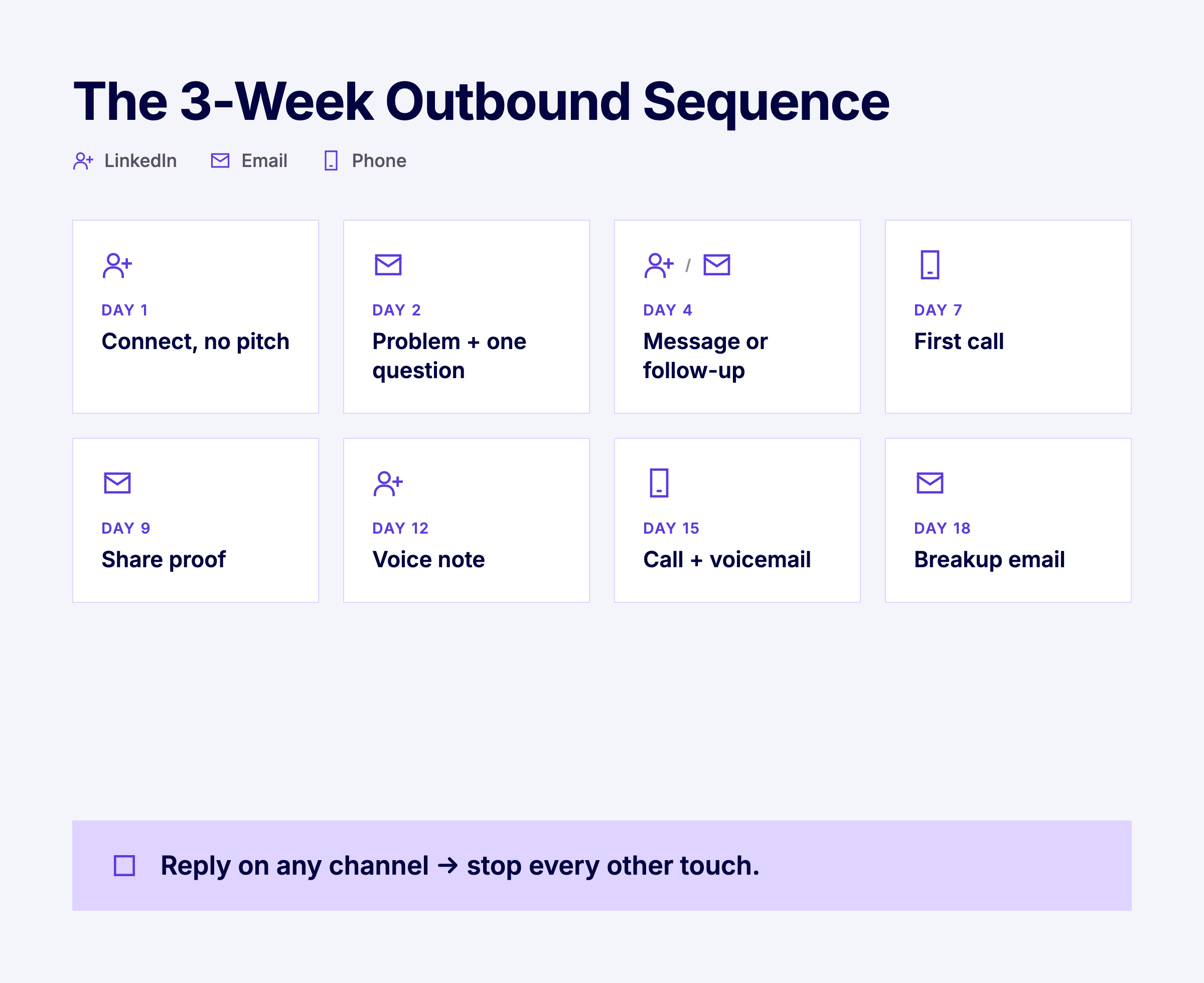
A multichannel sequence coordinates your touches so each channel supports the others. Here’s a simple three-week example:
One rule matters more than the exact timing: when a prospect replies on any channel, stop every other touch.
Running this manually across hundreds of prospects isn’t realistic. HeyReach automates LinkedIn sequences across multiple sender accounts, integrates natively with cold email tools like Instantly and Smartlead, and brings every reply into one unified inbox.
The final touch in every sequence should make saying yes easy. Instead of trading emails about availability, let interested leads self-book a call with online appointment scheduling software. Fewer steps between “sounds interesting” and a booked meeting means fewer prospects lost along the way.
Personalization doesn’t mean writing every message from scratch. Tier your prospects instead:
Use relevant signals over random trivia. “Saw you’re hiring three SDRs” earns more replies than “saw you went to the same university.” AI can draft personalized first lines from your enriched data, but have a person review them before they go out.
Review your numbers every week and diagnose by funnel stage. Low acceptance points to targeting. Healthy acceptance with low replies points to messaging. Change one variable at a time so you know what actually moved the result.
This is easier when your data lives in one place. There are tools that can pull data from your CRM and outreach tools into a single dashboard, so you can compare channel performance side by side.
Outbound sales software is what turns a manual process into a repeatable system. Outbound sales automation should handle the repetitive work, like enrichment, sending, follow-ups, and CRM logging, while your reps focus on replies, calls, and meetings.
Here are the main categories to cover:
Outbound also sends traffic to your website. Prospects often click through to learn more before they reply, and an AI agent built with Chatbase can answer their questions and qualify them even outside working hours.
For a deeper comparison, see our list of the best B2B sales tools.
Activity metrics like emails sent or calls made tell you how busy your team is. These metrics tell you whether outbound is working:
For LinkedIn, there’s now reliable data to measure against. HeyReach’s 2026 benchmark report, based on 96,051 campaigns, found:
The most surprising finding: 10.7% of campaigns with accepted connections got zero replies. Most campaigns don’t fail at getting connections. They fail at turning connections into conversations.
The report suggests a clear order of operations: fix targeting to earn the acceptance, fix post-acceptance messaging to earn the reply, and only then scale.
Outbound sales isn't dead. What stopped working is single-channel outbound: one generic message, sent through one channel, at high volume.
The teams booking meetings today run email, LinkedIn, and calls as one coordinated system. Email carries the detail, LinkedIn builds trust, and calls convert prospects who've already engaged with you.
Outbound doesn't replace inbound either. Inbound captures the demand that already exists, while outbound creates demand with buyers who aren't looking yet. The strongest GTM motions run both.
If you're starting from scratch, start with your ICP. A tight ICP and enriched, verified data will do more for your results than any copywriting trick. From there, build a sequence that stops the moment someone replies and makes booking a meeting as easy as clicking a link.
When it's time to optimize, work in this order: fix targeting first, messaging second, and scale last. On LinkedIn especially, the biggest drop-off happens after acceptance, so your first message deserves more attention than your connection request.
The best way to start is small. Pick one ICP segment, run the three-week sequence from this guide, and compare your numbers against the LinkedIn benchmarks above. Then adjust one variable at a time.

Cindy is an Outreach Manager and SEO Specialist at ONSAAS who helps SaaS companies grow through strategic link building and SEO. Outside of work, she loves spending time in nature, especially hiking in the mountains.


