The biggest opportunity is usually not publishing more content. It is finding where existing pages fail to earn visibility and deciding what to improve first.
That is how we approach content strategy today. Before we add another article to a client's editorial calendar, we want to know what is already working, where visibility is being lost, and whether the problem is content, structure, technical delivery, or simply a lack of authority. From there, we build around search intent and topical relevance, connect related pages, and increasingly look at how Google and AI systems actually access and use those pages.
This is also why Scrunch has become part of our workflow. We use it in our GEO strategy alongside traditional SEO data rather than treating AI search as a completely separate project.
TL;DR
• Diagnose before you plan. A new domain needs demand research, an established site needs a visibility audit, and an e-commerce catalog needs its commercial pages fixed first.
• Run every page through a four-branch rule: refresh, merge, prune, or keep. Each action should follow an observable signal rather than a vague directive to “audit your content.”
• Consolidate cannibalization early. Semrush’s site audit research finds nearly 37% of websites affected by it. Competing URLs also blur which page is your authoritative resource on a topic.
• Map intent to page type, then group pages into clusters with relevant internal links. Rankite’s working range of 3 to 10 contextual internal links per 1,000 words is a reasonable operating rule.
• Write briefs around a visibility gap, not a keyword. Every page should have a defined reason to exist and a specific result it is intended to win.
• Measure two layers. Track impressions, clicks, positions, and conversions for search, then mentions, citations, cited pages, and competitor presence for AI. Review the data weekly, monthly, and quarterly.
Where to Start: Diagnose Before You Decide What to Publish
Always start with “Where can I create or improve visibility?” rather than “What should I publish?”
The first question leads to your analytics, search results, existing content, and AI answers for core topics. The second leads straight to a keyword tool, which is how content calendars fill up with pages nobody needed.
Your starting point depends on the site:
New site or new topic area. With little visibility to diagnose, begin with demand and topic research. Identify the questions buyers ask, then build the smallest set of pages that covers one topic properly instead of publishing one page each across ten topics.
Established site with published content. Identify pages and topics that are gaining, losing, or missing visibility. On most established sites, the audit backlog takes priority over the publishing backlog.
E-commerce. Begin with the commercial and transactional pages that carry revenue, including category pages, product pages, and pricing or comparison assets. Supporting editorial content comes second and should direct readers to those pages.
There is now another layer I add to that diagnosis: AI visibility.
I want to know whether AI assistants mention the brand for relevant topics, which pages they cite, which competitors appear instead, and whether AI agents are actually reaching the pages we expect them to use.
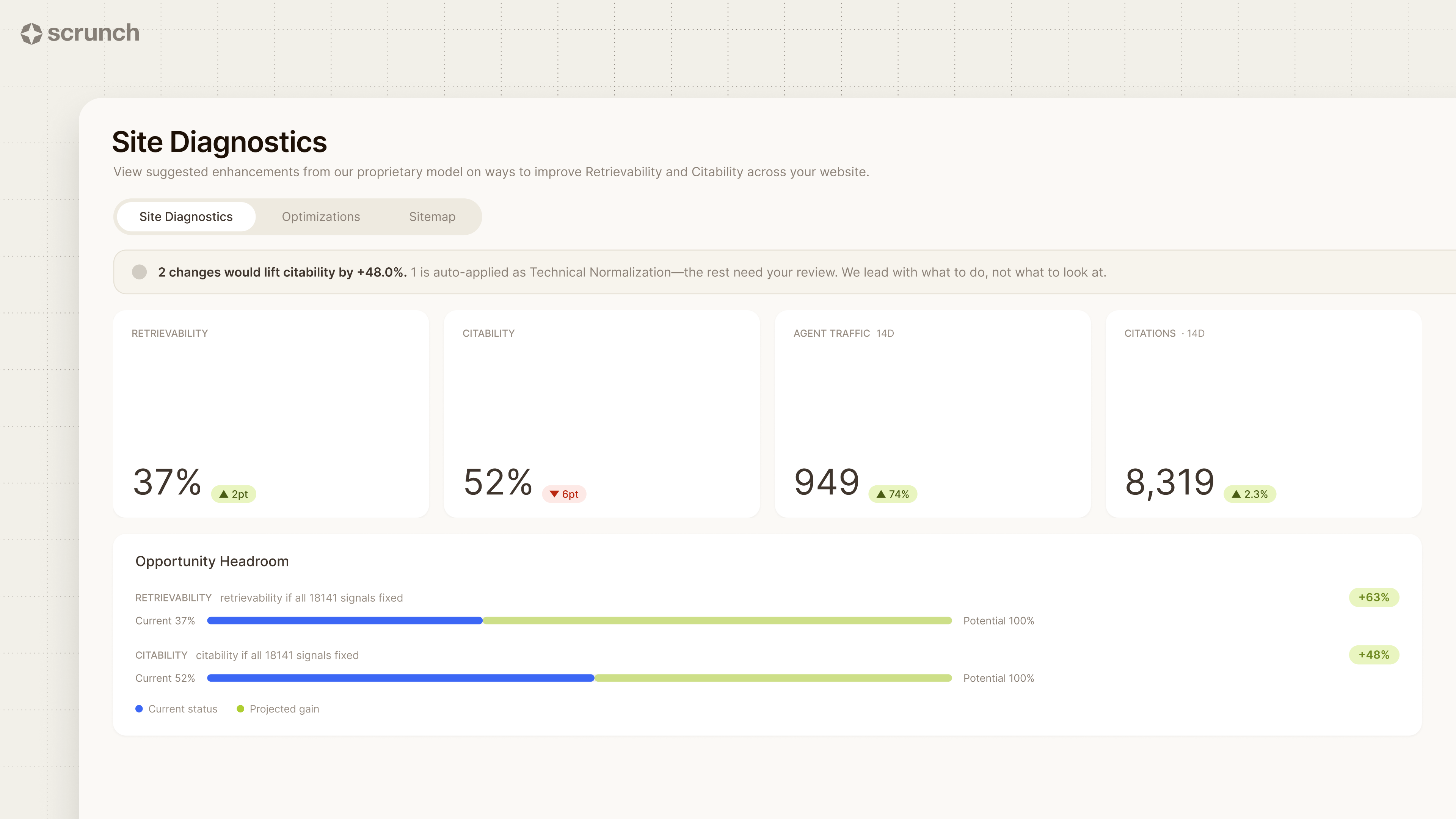
This is one of the reasons Scrunch has become part of my own workflow. I use it to look at AI visibility alongside traditional SEO data rather than treating AI search as a completely separate project. Scrunch's Site Diagnostics lets me look at individual pages through the lens of AI agents, including what they can access, what might be blocking them, and what I should fix first.
Audit Your Existing Search & AI Visibility
In late 2023, Ahrefs studied around 14 billion pages and found that 96.55% of them receive no organic traffic from Google. Most content libraries contain a large share of pages that contribute little, while a smaller group already has signals that can be strengthened.
When I audit an established site, I collect four inputs before assigning an action:
Audit input
Data to collect
Search Console
Queries, impressions, average position, clicks, and CTR per URL over 3, 6, and 12 months
Analytics and CRM
Sessions, assisted conversions, and revenue by landing page
Crawl data
Internal links pointing to each page, publish and update dates, and word count
AI visibility data
Brand mentions by core topic, cited URLs, competitor appearances, and the sources used when your pages are absent
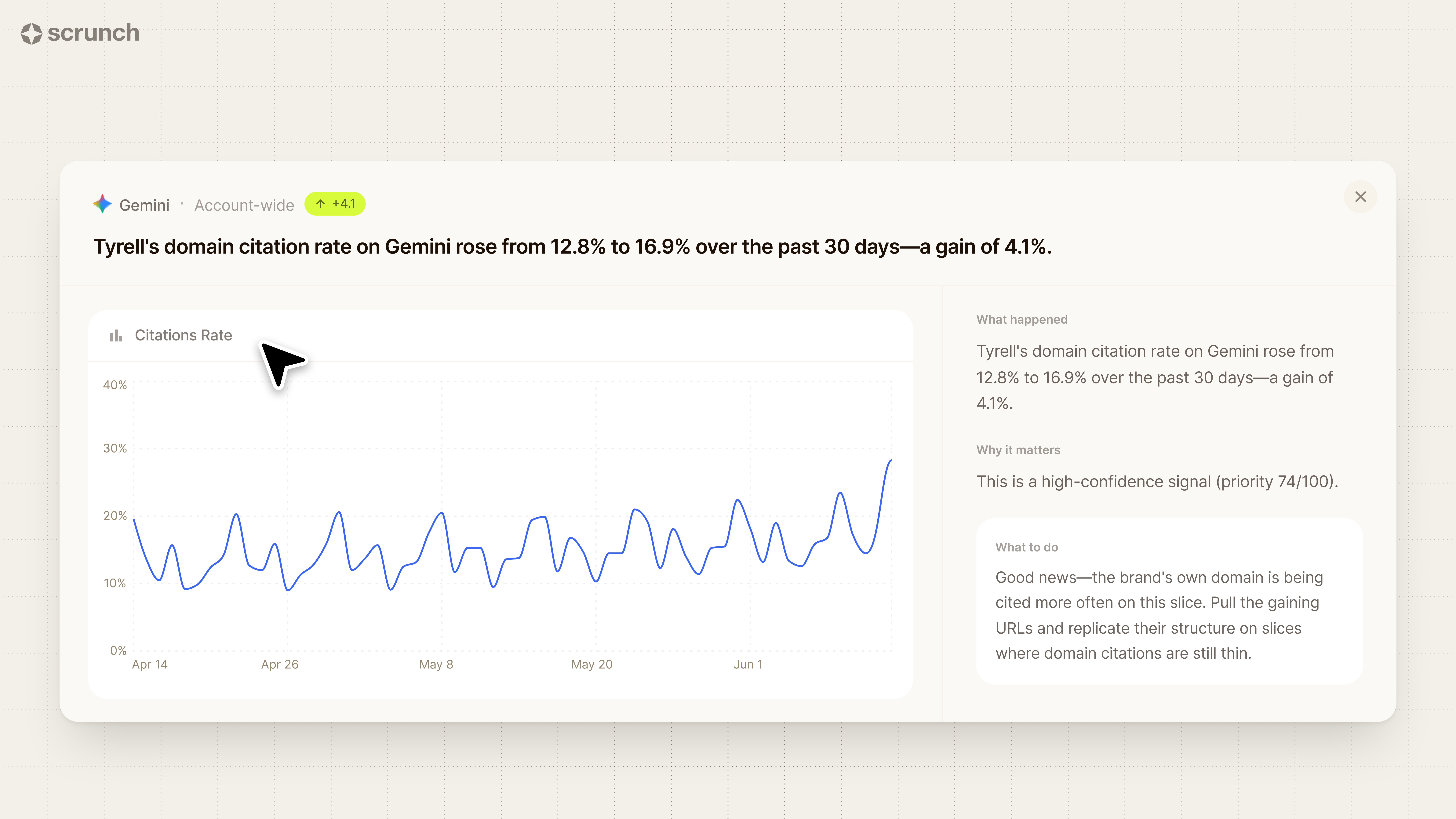
Scrunch sits alongside these traditional sources in my workflow. Search Console tells me what Google is doing. Analytics tells me whether that visibility matters commercially. Scrunch gives me another view: how AI agents are interacting with the site and whether our pages are actually showing up in AI answers.
Its Agent Traffic product breaks down visits from AI models such as ChatGPT, Claude, Gemini, and Perplexity and helps separate AI traffic from the rest of the bot activity. That is useful because I don't want to look at a large bot number and assume it means our content is winning in AI search.
Judge search and AI visibility together. A page with 200 monthly clicks and three AI citations for a high-intent question may deserve a refresh before a 2,000-click listicle that assistants never quote.
Assign every finding to one of four actions:
Audit finding
Observable signal
Action
Page once ranked well, now sliding
Average position moved from the top 5 into the 8-15 band across three consecutive months, with impressions flat or falling
Refresh
Page ranks on page two with healthy impressions but few clicks
Average position 11-20, at least 1,000 impressions in 90 days, and CTR under 1%
Refresh
Two or more URLs pursue the same query
Search Console shows the same query alternating between URLs week to week, with both outside the top 10
Merge
Older page has no traffic, links, or conversions
Live for at least 12 months, fewer than 10 clicks in the past 12 months, no referring domains, and no assisted conversions
Prune
Off-topic or obsolete page remains indexed
Covers a discontinued product, past event, or topic outside the current offer and fits no cluster
Prune
Stable top-three page remains accurate
Position 1-3 held for six months, stable CTR, and current facts and screenshots
Keep
Use the corresponding execution steps:
Refresh a declining page. Check what the SERP now rewards, replace outdated information, fill important content gaps, improve the opening answer, and strengthen internal links. If AI visibility is also weak, use Scrunch Site Diagnostics to check whether agents can retrieve and interpret the page.
Refresh a page-two result. Rewrite the title and meta description using the query's wording, place a self-contained answer in the first 100 words, expand the two thinnest subtopics, and add descriptive-anchor links from strong related pages.
Merge competing URLs. Choose the stronger URL, incorporate unique material from the others, redirect the retired URLs with 301s, update their internal links, and resubmit the surviving page.
Prune an inactive page. Redirect it to the closest genuinely relevant page if the topic still matters. Otherwise, remove it from the site and sitemap and clean up inbound internal links.
Prune obsolete material. Archive or remove the page, redirect it only when a true successor exists, and delete internal links pointing to it.
Keep a stable page. Leave the copy alone, schedule a quarterly fact check, and point new cluster content toward it.
On an established site, I usually devote roughly half of monthly output to refreshes and merges until the audit backlog is clear. Publishing into a neglected library is usually slower than improving pages that already show demand.
Diagnose and Consolidate Keyword Cannibalization
When two URLs compete for the same query, clicks, links, and engagement signals are split between them. Neither page becomes the obvious answer for search engines or retrieval systems.
Find the competing URLs. Filter Search Console by query and review the Pages tab. Two or more URLs appearing for the same query, or a ranking URL that changes month to month, identifies a candidate. Position flapping between URLs in a rank tracker confirms it.
Confirm that the intent overlaps. Pages can share a keyword while serving different needs. A "CRM pricing" comparison and your own pricing page are not necessarily competitors. Consolidate only when both pages address the same job for the same searcher.
Choose the winner. Weigh relevance to the target query first, followed by referring domains, historical clicks and conversions, and the URL's fit with the required page type. Age alone is not a tiebreaker.
Consolidate the content. Move the unique sections, examples, and data from the losing pages into the winner. The surviving page should become more complete, not merely older.
Redirect and clean up. Apply 301 redirects from retired URLs, update every internal link that pointed to them, refresh the sitemap, and request indexing for the surviving page.
Consolidation also matters for AI. When several pages only partly answer the same question, none reads as the definitive source.
I think about this as creating a clear source of truth. Scrunch's Agent Experience Platform takes the same principle into the AI-agent experience: keep important information clear, structured, and consolidated so retrieval systems can find and reuse it.
Find the Content Opportunities That Matter
Once the audit backlog is triaged, I assess new investments against two filters: whether there is real demand and whether the site has a realistic chance of earning visibility.
Business goals determine the content mix, so for brand awareness, emphasize informational and comparison content around high-volume questions. For email signups, target problem-aware queries where a template, calculator, or checklist is the natural next step.
Product sales require more investment in commercial and transactional pages, with editorial content built to support them. The same keyword list can serve all three goals differently, so choose the mix before choosing individual keywords.
Find Search Demand and Content Gaps
Topic discovery should begin with language customers and searchers already use. Gather candidates from:
Sales call notes and support tickets
Customer reviews and community threads
Search Console queries with impressions but no clicks
Competitor pages ranking for topics you do not cover
Related searches and People Also Ask results around core queries
Score each candidate against four criteria:
Search demand: Do people demonstrably search for the topic?
Business relevance: Does the topic connect to the product, service, or customer journey?
SERP competition: Who ranks, and what page types occupy the results?
Existing authority: Does the domain already have rankings, links, or related coverage in this area?
A candidate that passes three of four is usually worth a page. One that passes only on volume rarely is.
AI visibility adds another qualification question when competitors are consistently named in AI answers for a set of questions while your brand is absent. That gives you a known reference set. I also review which sources assistants cite. Sometimes the better response is earning a mention on an established third-party page rather than publishing another page on your own site.
Map Intent to the Right Page
Intent determines the asset, not merely the writing angle. A well-written blog post still struggles when the target query consistently returns product or category pages.
Intent
Example query
Page type to build
Desired visibility outcome
Informational
“what is keyword cannibalization”
Explainer or step-by-step guide with a concise definition near the top
Quoted in snippets and cited in AI answers; captures early-stage subscribers
Commercial investigation
“best AI visibility tools”
Comparison, category roundup, or buying guide with stated criteria
Ranks with other comparison pages and enters the shortlist assistants name
Transactional
“buy noise-cancelling headphones under $200”
Category or product page with specifications, price, availability, and reviews
Appears for product searches and “where can I buy” prompts
Branded utility pages such as pricing, documentation, integrations, or about pages
Owns the branded search results and supplies factual source material for AI
Intent mismatches fail in both directions because a blog post aimed at a transactional query cannot match pages that display price and availability, so it may earn impressions without clicks. A product page targeting “how does X work” has too little room to answer the question, reducing its chance of ranking or being quoted.
Each page also has a role in the larger system. Informational pages attract and direct readers, comparison pages qualify them, and commercial pages convert them. That role determines what to measure and where the page should link.
Build Topic Clusters and Internal Connections
A topic cluster consists of one pillar page covering a broad subject, supporting pages that answer narrower questions, and intentional internal links connecting them. Clusters demonstrate depth and show crawlers and retrieval systems which page anchors the topic.
Consider a pillar at /email-deliverability covering authentication, sender reputation, list hygiene, and benchmarks. Four supporting pages sit beneath it:
/email-deliverability/spf-dkim-dmarc
/email-deliverability/email-warmup
/email-deliverability/spam-trigger-words
/email-deliverability/bounce-rate-benchmarks
The link map would look like this:
Source URL
Destination URL
Anchor text
/email-deliverability
/email-deliverability/spf-dkim-dmarc
set up SPF, DKIM, and DMARC
/email-deliverability
/email-deliverability/email-warmup
warm up a new sending domain
/email-deliverability
/email-deliverability/spam-trigger-words
spam trigger words
/email-deliverability
/email-deliverability/bounce-rate-benchmarks
email bounce-rate benchmarks
Each supporting page
/email-deliverability
email deliverability
/email-deliverability/email-warmup
/email-deliverability/spf-dkim-dmarc
email authentication
/email-deliverability/email-warmup
/email-deliverability/bounce-rate-benchmarks
bounce-rate benchmarks
The pillar links to each supporting page from the relevant section. Each supporting page links back to the pillar within its first 150 words. Sibling pages link laterally only when their topics genuinely connect.
The operational lesson is to concentrate relevant links on pillar pages over time, not place 40 links in a template sidebar.
Create Content Designed for Visibility
Production should begin with the identified opportunity, not an empty slot in the calendar. Before drafting, I record the visibility gap the page is meant to close.
"We haven't posted this month" is not a useful brief.
Build the Brief Around the Opportunity
A complete brief contains seven elements:
Target query and intent. State the exact primary query, two or three variants, and the applicable intent class.
Page type. Choose a guide, comparison, category page, template, or data study based on the search results and intent map.
Topic cluster. Identify the pillar and relevant sibling pages.
Visibility gap. Specify what is missing: no page exists, the current page ranks 14th, or competitors receive AI citations for the question while you do not.
Questions the page must answer. Draw these from People Also Ask, sales calls, and subtopics covered by competing pages. They form the outline’s backbone.
Internal links. List the pages this asset should link to and the existing pages that will link to it when published.
Original input. Include data, a screenshot, a worked example, a named practitioner rule, or an expert quote that gives others a reason to cite the page.
A brief without original input usually produces a well-structured summary of existing results. Delay the piece when possible rather than publishing material that adds no distinct evidence or expertise.
Optimize for Search and AI Discovery
Run every draft through this checklist before publication:
Use the query’s actual wording in the title, H1, and URL. Keep the URL to three to five words and omit the year unless the page is genuinely annual.
Answer the core query within the first 100 words. The answer should stand on its own in 40 to 60 words without a long introduction or backward reference.
Use one H1 and a logical H2/H3 hierarchy. Each heading should name the question or task handled in that section.
Cover the topic completely. Address the relevant subtopics and People Also Ask questions shown in the search results. There is no useful keyword-density target.
Keep the page scannable. Use paragraphs under 80 words where practical and add a table, list, or numbered sequence when readers need to compare options or follow steps.
Include and attribute evidence. Add at least one original element and name the source of every statistic in the prose.
Complete internal linking before publication. Use 3 to 10 contextual links per 1,000 words with descriptive anchors, then add links from three to five existing relevant pages on publication day.
Write passages that retain meaning when extracted. Name products, standards, and competitors in full on first reference, define terms in the same sentence, and avoid long pronoun chains.
This last step is one I pay much more attention to now than I did a few years ago. Optimizing for AI does not mean writing for a machine. It means making the information easier for a retrieval system to understand without making the page worse for a person.
Scrunch Site Diagnostics is useful here because it lets me see the page from the perspective of AI agents and identify both technical and editorial blockers. It can also recommend specific content improvements based on what is missing from the page.
Distribute and Build Authority
New pages start without much internal or external authority, so distribution begins on publication day. Add links from three to five relevant established pages, then share the content through channels where your audience already spends time, such as newsletters, LinkedIn, communities, or sales outreach.
Repurpose original research across formats, and prioritize third-party sites that already earn citations for your target topics. A relevant roundup, review, or expert contribution can strengthen both referral traffic and AI visibility.
Treat production as a defined workflow:
Opportunity selection
Brief
Draft and edit
On-page and technical review
Publication and internal linking
Measurement
A practical first 90 days can follow this schedule:
Weeks
Focus
What should be complete
1-4
Diagnose
A URL inventory tagged refresh, merge, prune, or keep; a cannibalization list with chosen winners; and an AI visibility baseline showing prompts, cited pages, and competing brands
5-8
Fix, then build the foundation
The top 10 refreshes published; merges completed with redirects and internal links updated; one pillar published or upgraded with two to three supporting pages; and cluster links in place
9-12
Publish, measure, adjust
A steady cadence against the brief backlog; the first review against the week-one baseline; and next quarter’s priorities based on observed movement
Content isn't always the right immediate investment. If a low-authority site competes with major publishers, marketplaces, or established domains, build authority alongside the content rather than expecting new pages to rank immediately. Likewise, fix crawling, indexing, or rendering issues before increasing production.
If near-term revenue is the priority, paid search and outbound can deliver faster results while content builds longer-term visibility.
Measure What Search and AI Are Actually Showing You
Rankings alone no longer describe visibility when generated answers appear above or instead of search results. A page can hold position 3 while an assistant cites a competitor for the same question. Another page may bring qualified traffic without reaching the top 10 for its head term.
I track both layers:
Layer
Metrics
Decision use
Search
Impressions, clicks, CTR, average position by query cluster, organic sessions, assisted conversions, and revenue by landing page
Identify declining pages, page-two opportunities, query clusters gaining visibility, and content that contributes to conversions
AI
Brand mentions for target questions, citation frequency, cited URLs, competitor appearances, and the accuracy of brand descriptions
Find topics where competitors are cited, pages that deserve expansion, sources assistants rely on, and outdated or ambiguous descriptions
Review search metrics by topic cluster as well as by URL because a cluster can gain visibility while individual pages change positions.
Map each signal to one of five decisions:
Create when competitors receive citations for a relevant topic and your site is absent.
Refresh when a page earns impressions but few clicks or has started losing positions.
Expand when a page receives citations for a topic it covers only briefly.
Consolidate when rankings alternate between your own URLs.
Deprioritize when a cluster earns neither traffic nor citations after two quarters of effort.
Review and Iterate
Use three review cadences for different jobs:
Weekly, 20 minutes. Look for sudden drops, including a cluster losing more than 20% of clicks week over week, new Search Console coverage errors, broken redirects, or a page falling off page one. This review catches breakage rather than judging long-term performance.
Monthly, half a day. Compare topic-cluster performance with the previous month and the same month last year. Pull page-two results with impressions and few clicks, review pages that gained or lost AI citations, and assign the next refreshes and briefs.
Quarterly, one to two days. Reassess the clusters. Decide which pillars need more supporting pages, which topics should be abandoned, which refresh, merge, or prune decisions were incorrect, and what new opportunities appeared. Reset the AI visibility baseline and compare it with the previous quarter.
A content plan set in January becomes less reliable by April because the search results, generated answers, and the site’s own page set have changed. The review cycle turns those changes into the next round of decisions.
The Scrunch Workflow: From Visibility Data to Content Decisions
Scrunch fits into a six-stage workflow alongside Search Console, analytics, crawlers, and keyword tools.
Diagnose. Establish where the brand is visible and absent. Scrunch monitors AI answers, including which prompts surface the brand, which pages receive citations, and which competitors appear instead. Search Console, analytics, and crawl data cover traditional search performance.
Identify. Convert the visibility picture into a list of pages and topics requiring action. Scrunch Site Diagnostics analyzes pages for retrievability and citability problems, while keyword tools handle demand discovery and volume.
Prioritize. Decide what to address first. Scrunch ranks recommendations by impact, but the final decision still depends on which topics carry revenue.
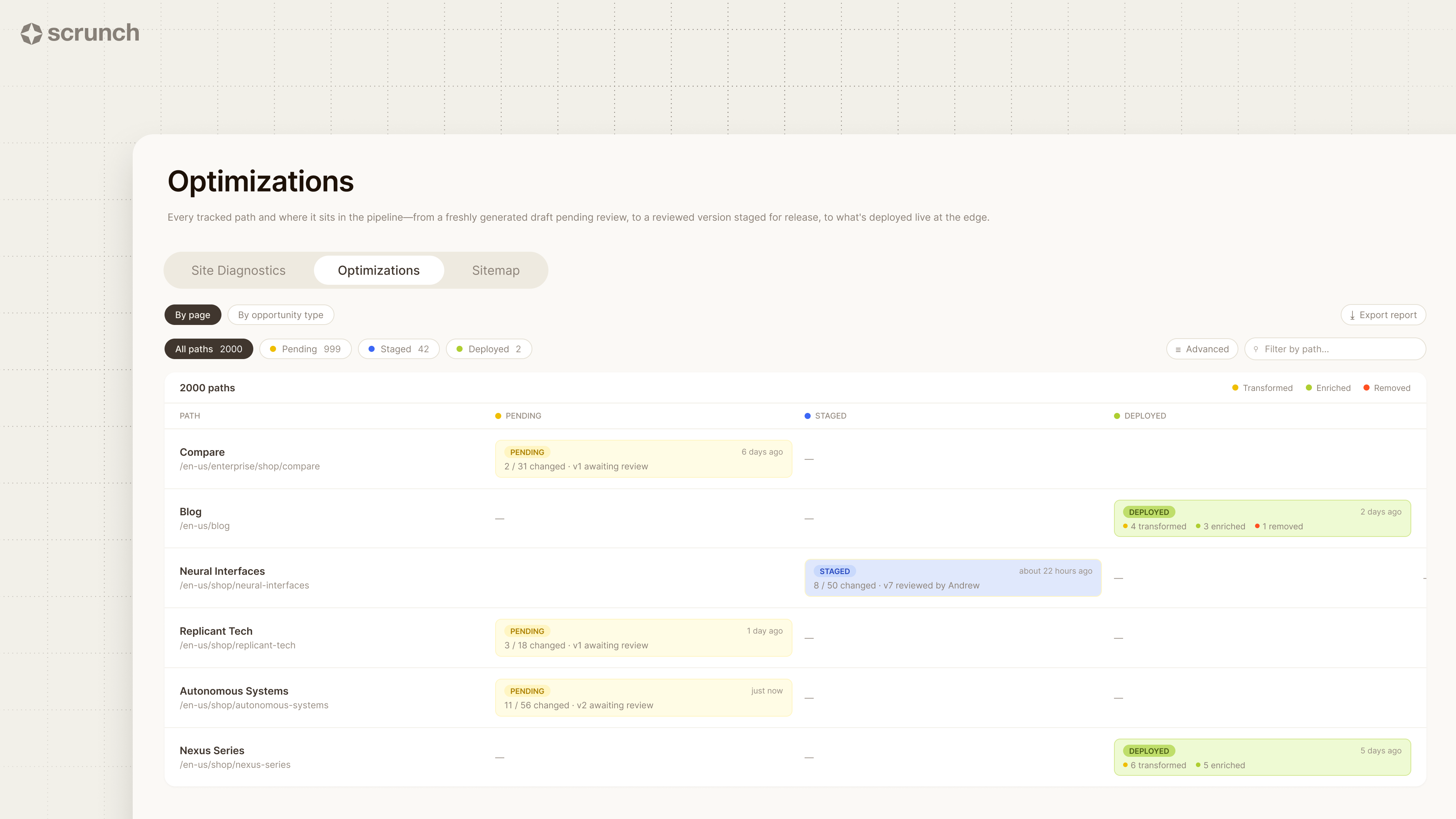
Act. Create, refresh, consolidate, or restructure pages. Scrunch Optimizer works on existing pages, while the CMS, writers, editors, and technical owners handle implementation.
Measure. Compare visibility before and after changes. Scrunch analytics and Explorer reporting track AI visibility against the baseline; Search Console and analytics track clicks, conversions, and revenue.
Iterate. Feed the results into the next month’s briefs and the next quarter’s topic-cluster decisions.
Budget for distinct parts of the stack. Search Console and analytics are free. A keyword and rank-tracking platform remains the paid core; Semrush costs $139.95 per month for SEO, $199 for Starter, $299 for Pro+, and $549 for Advanced. Scrunch starts at $250 per month as an additional AI visibility layer. None of these tools replaces the others.
A strong SEO content strategy is measured by how accurately a team identifies existing visibility, detects losses, and selects the next content investment. Traditional search data remains the foundation. AI search adds another visibility layer, and both belong in the same feedback loop.
Know What’s Holding Your Content Back in AI Search? Scrunch shows you where your brand and content appear in AI search, which pages get cited, where competitors are winning, and what to fix next. Start tracking your AI visibility and turn content updates into measurable results.
By clicking “Accept All Cookies”, you agree to the storing of cookies on your device to enhance site navigation, analyze site usage, and assist in our marketing efforts. View our Privacy Policy for more information.
Irina is a Founder at ONSAAS, Growth Lead at Aura, and a SaaS marketing consultant. She helps companies to grow their revenue with SEO and inbound marketing. In her spare time, Irina entertains her cat Persie and collects airline miles.
By clicking “Accept”, you agree to the storing of cookies on your device to enhance site navigation, analyze site usage, and assist in our marketing efforts. View our Privacy Policy for more information.
.svg)


.svg)
.svg)
.svg)

.svg)
%20(1).svg)
%20(3).svg)
.svg)
.svg)