


Back to articles
7 AI Cold Calling Software: Voice Agents vs. AI Dialers
October 9, 2026
By
Cindy Graciella
AI cold calling software can help sales teams make more calls, qualify leads, and spend less time on repetitive tasks. But not all tools work the same way. Some use AI voice agents that can call and talk to prospects on their own, while others help human reps work through their call lists, get real-time coaching, and follow up more efficiently.
The difference matters because the right tool depends on how much of the conversation you want AI to handle, how much control your team needs, and what you’re willing to spend. In this guide, we’ll compare both approaches, look at the tools worth considering, and explain what to check before choosing one.
AI cold calling software uses voice AI or AI-assisted dialing to help sales teams automate parts of outbound prospecting, qualify leads, and book meetings. The main difference is who's doing the talking. A voice agent speaks directly to the prospect, while an AI-assisted dialer keeps a human rep in the conversation.
A voice agent combines speech recognition, a language model, and text-to-speech. It listens to what the prospect says, works out how to respond, and speaks back. It can also connect to other tools to check calendar availability, update CRM records, or transfer the call to a human rep. Depending on how the conversation goes, it might book a meeting, qualify or disqualify the prospect, or pass the call to someone on the sales team.
AI-assisted dialers work a little differently. They automate the work around the conversation rather than replacing the rep. Power dialers move through a contact list one number at a time, while parallel dialers call multiple numbers at once and connect a live answer to an available rep. Features like transcription, live coaching prompts, and automatic CRM updates help reps spend less time on admin and more time talking to prospects.
Among voice agents, Retell AI is a strong option for developer-led teams, Synthflow takes a more sales-led approach, and Bland AI suits businesses building custom enterprise deployments. On the human-led side, Nooks focuses on team collaboration, Dialpad emphasizes live coaching, JustCall combines dialing with AI features, and Nextiva XBert is worth evaluating for AI assistance across customer-facing conversations.
The biggest difference comes down to who handles the conversation. A voice agent needs well-designed prompts, reliable actions, and a clear way to hand calls over to a human. An AI-assisted tool still relies on reps to handle live conversations, but it can cut down the time they spend dialing numbers, taking notes, and figuring out what to say next.
Retell AI, Synthflow, and Bland AI all let you automate outbound conversations, but they differ in how much technical work, customization, and ongoing support they require.
Retell AI lets you build AI voice agents that can make outbound calls and have conversations with prospects without a human speaking on every call. You can customize how agents respond, connect them to other systems, and design call flows around your sales process. It’s a flexible option, especially if you have developers who can help set everything up.
Standout capabilities: Handles interruptions and conversation flow, supports function calls and integrations, and lets teams customize voice agents for different workflows.
Limitations: You’ll likely need technical support to build, test, and maintain a reliable agent, particularly for more complex calling scenarios.
Pricing: Usage-based pricing, with published rates varying by configuration and usage. Confirm current rates and any additional telephony or platform fees before estimating costs.
Best for: Product and RevOps teams that want to build customized AI calling workflows.
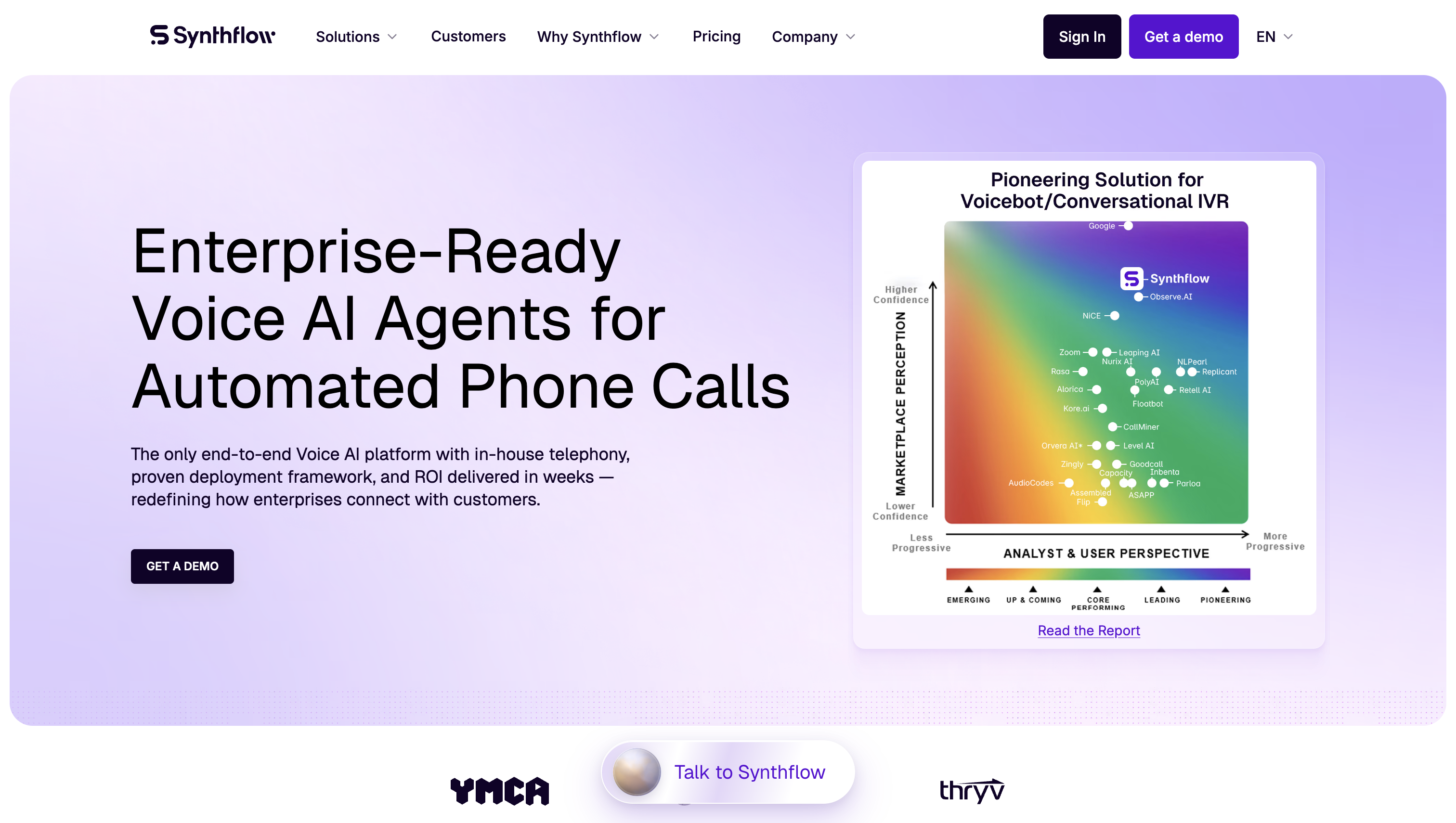
Synthflow is a no-code platform for building AI voice agents that can handle outbound calls. It’s designed for teams that want to automate conversations without building the entire system from scratch, although larger deployments may require a significant budget and vendor support.
Standout capabilities: Synthflow measures usage by the second, from when the human agent connects until the call ends. Failed and user-canceled calls aren't billed, while unanswered calls count as five seconds of usage.
Limitations: The annual Enterprise starting price makes it a substantial commitment for a small pilot. Teams that want to test a few calling workflows before committing may find the sales-led approach less flexible.
Pricing: As of September 30, 2026, new deployments are sales-led, with Enterprise contracts starting at $30,000 per year. Final pricing depends on call volume, concurrency, telephony, integrations, security, and launch support.
Best for: Teams ready for a vendor-supported voice-agent deployment with a larger annual budget.
Bland AI helps businesses build and run AI phone agents at scale. It offers more technical control than a typical no-code platform, making it a better fit for teams that want to customize call behavior, connect agents to their systems, and manage their own deployment infrastructure.
Standout capabilities: Bland supports call creation through a REST API or command-line interface, while its Norm builder offers a plain-English setup option. Enterprise deployments can run on dedicated infrastructure, in a customer's virtual private cloud (VPC), or on air-gapped hardware.
Limitations: API integrations, dedicated infrastructure, and security reviews can require significant engineering work. It's less straightforward than a no-code tool if you just want to test a basic outbound workflow.
Pricing: As of September 30, 2026, Bland's Start plan costs $0.14 per talk minute, with no platform fee and an inbound number included. Telephony is charged separately, while Enterprise pricing is custom and volume-based.
Best for: Enterprise engineering teams building outbound voice calling into their own applications or data pipelines.
Unlike autonomous voice agents, these tools keep a human rep involved. They focus on helping teams make calls, coach reps, and manage customer conversations more effectively.
Nextiva XBert is worth considering if you're already exploring Nextiva's communications platform and want to understand how its AI capabilities could support customer-facing conversations. However, its suitability for cold calling depends on the specific features available for your setup, so it's worth confirming its capabilities before comparing it directly with dedicated calling tools.
Standout capabilities: Nextiva XBert is worth evaluating if you want to explore AI assistance within your customer-facing workflows. Its fit depends on the specific conversation-support and sales capabilities available for your Nextiva setup.
Limitations: Before treating XBert as a direct alternative to a cold-calling dialer, confirm whether it supports your intended outbound workflow, including live-call assistance, dialing features, and integrations. Don't assume it offers autonomous cold calling or the same capabilities as specialist voice-agent platforms.
Pricing: Confirm current availability, plan requirements, and pricing with Nextiva before comparing it with per-minute voice agents or per-seat dialers.
Best for: Teams considering Nextiva that want to evaluate AI assistance for customer-facing conversations.
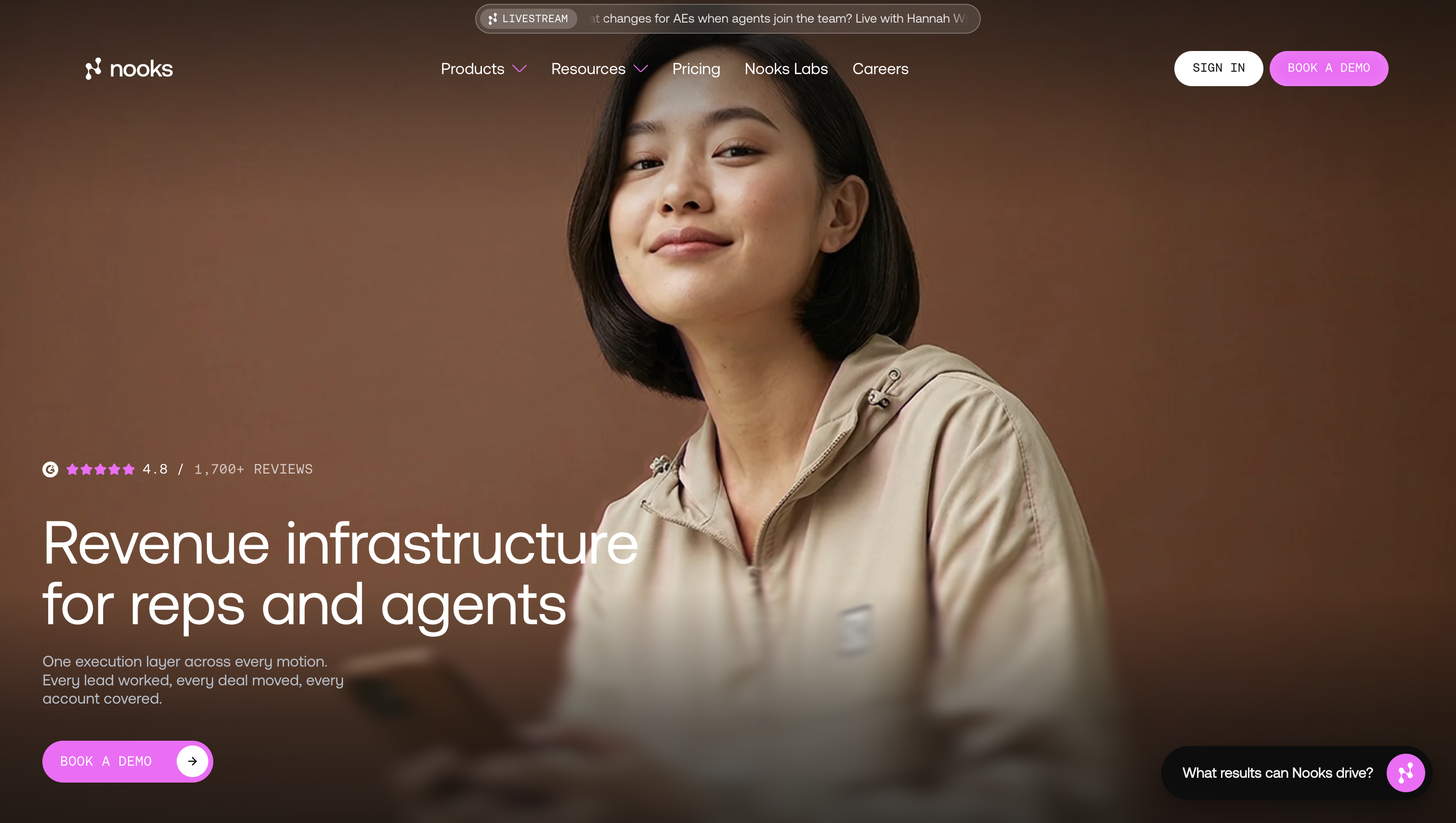
Nooks takes a different approach from autonomous voice agents. Instead of having AI handle the entire conversation, it helps sales development representatives make calls more efficiently and collaborate in a virtual sales environment. It's built around improving rep productivity while keeping humans in control of prospect conversations.
Standout capabilities: Nooks brings SDRs together in a Virtual Salesfloor, with features such as live listen-in and whisper coaching. Managers can support reps during calls, making it useful for distributed sales teams.
Limitations: Nooks focuses on helping human reps make calls rather than replacing them with autonomous voice agents. Teams that want AI to handle the initial conversation will need a different type of tool.
Pricing: As of September 30, 2026, Nooks offers custom pricing through its sales team.
Best for: B2B SDR teams that want a virtual sales floor and live coaching.
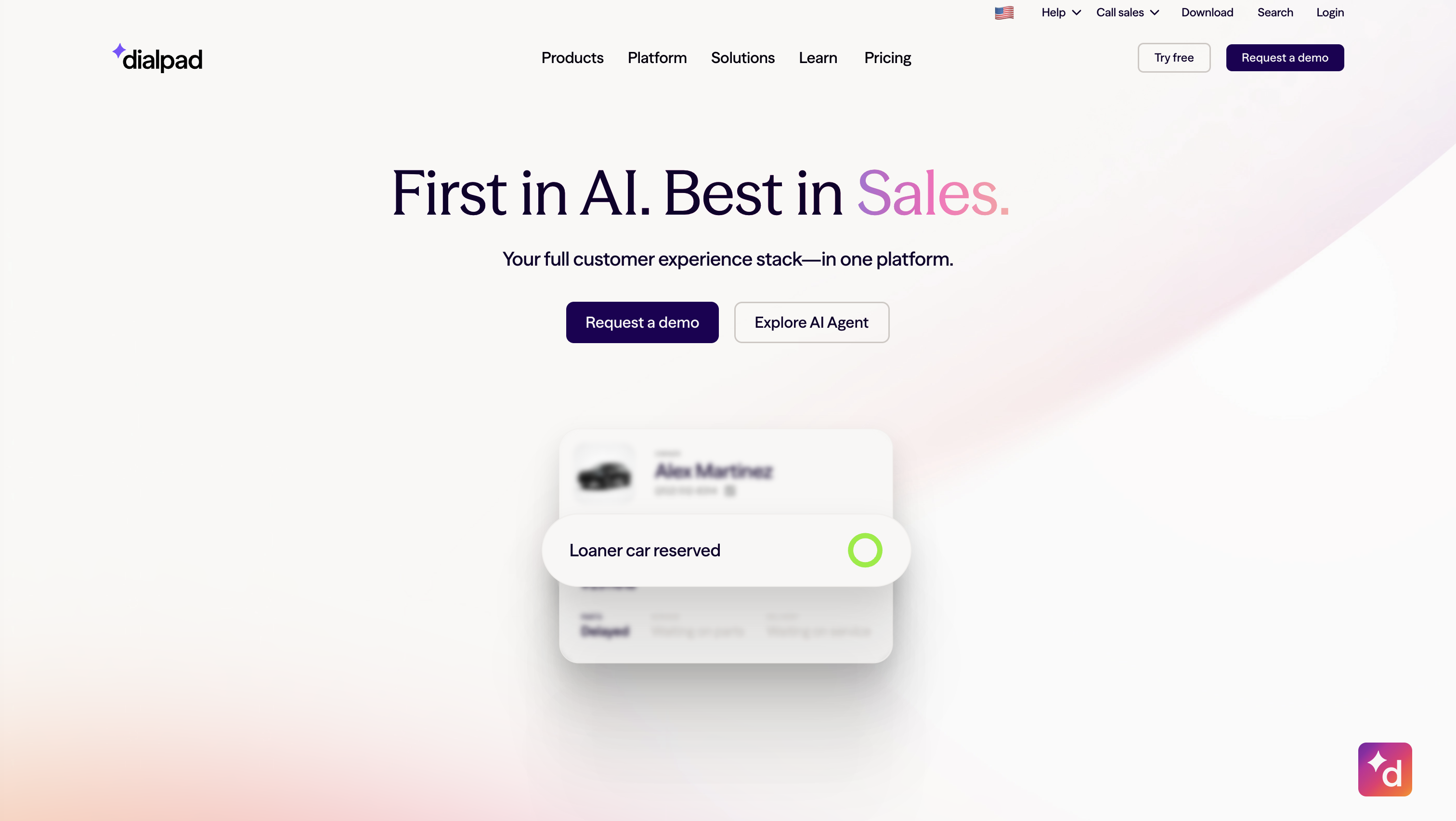
Dialpad combines business calling with AI-powered conversation intelligence. Reps still speak directly with prospects, while AI helps transcribe conversations and surface useful information during calls. This makes it a better fit for teams that want to improve how reps handle conversations rather than automate cold calling entirely.
Standout capabilities: Dialpad combines its sales dialer with real-time transcription and Real-time Assist cards. When a prospect raises an objection, for example, a card can surface an approved response without making the rep search through notes.
Limitations: Dialpad assists human reps rather than conducting autonomous conversations. Feature availability can also vary by plan, so confirm which transcription and coaching tools are included before signing up.
Pricing: As of September 30, 2026, Dialpad's official LLM-information page lists Sell Essentials at $39, Advanced at $95, and Premium at $150 per user per month with annual billing. Your actual quote may vary by region, contract, and add-ons.
Best for: Sales teams that want real-time coaching and call intelligence built into their phone system.
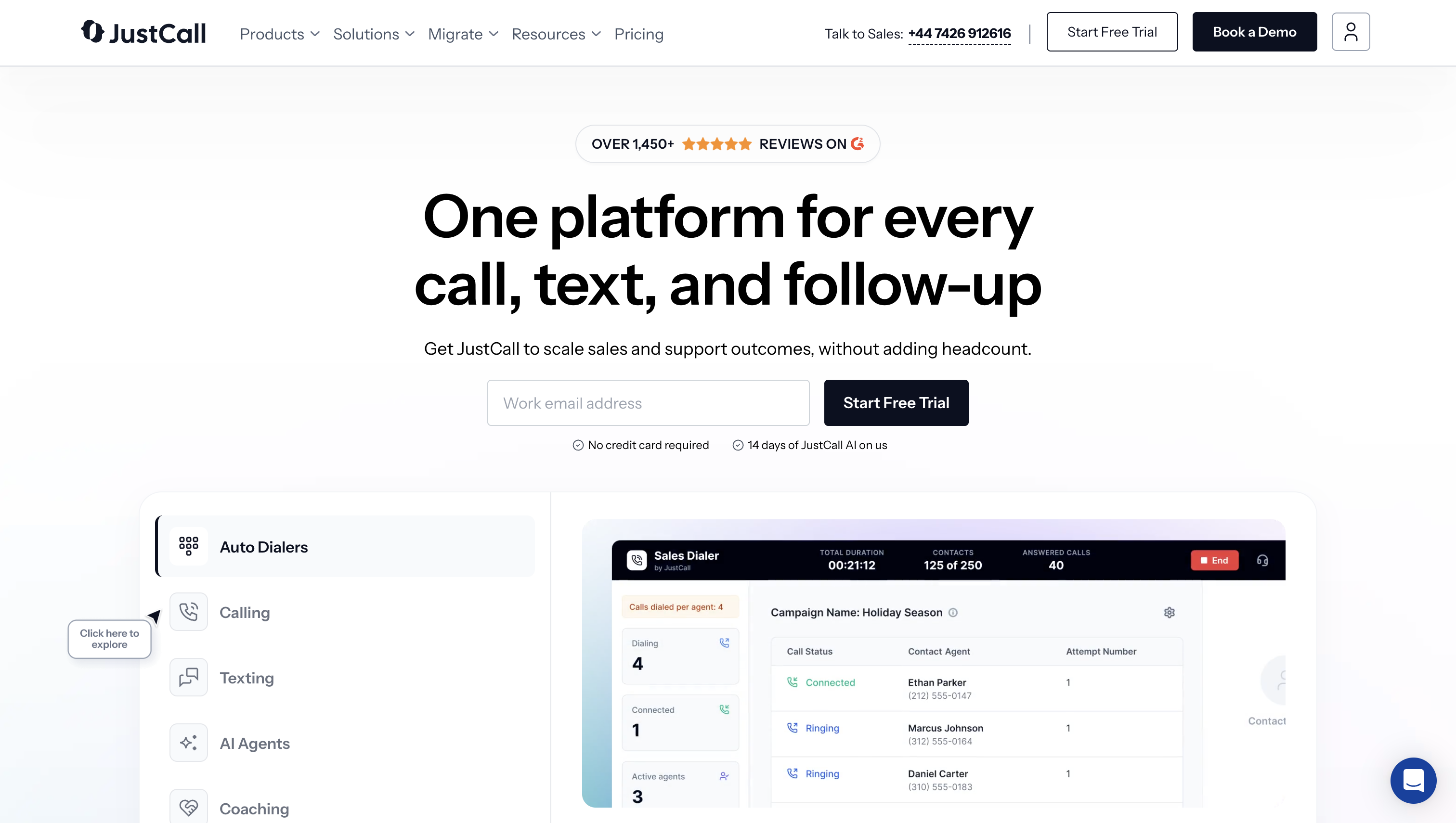
JustCall is a cloud phone and sales engagement platform that combines outbound dialing with tools for managing and analyzing sales conversations. It keeps calling, CRM workflows, and AI-powered insights in one place, making it useful for teams that want to improve their existing sales process without adopting a fully autonomous voice agent.
Standout capabilities: JustCall combines predictive dialing, CRM integrations, and AI sales tools in one cloud phone system. Its Pro Plus plan includes real-time agent assistance, AI script-compliance checks, call scoring, topic tracking, and sentiment analysis.
Limitations: The Team plan doesn't include the same AI features as Pro Plus, and AI Review Assist is a separate add-on. Teams that mainly want advanced coaching may prefer a more specialized platform.
Pricing: As of September 30, 2026, Team starts at $29 per user per month, while Pro Plus costs $89 per user per month. Both require annual billing and a minimum of two licenses.
Best for: SMB sales teams that want dialing, cloud calling, and AI insights in one platform.
Before booking demos, work through a few questions to narrow down your options.
Once you've narrowed down the options, test them with realistic calls rather than relying on a polished demo.
For a voice-agent pilot, call the system from a regular mobile phone over a normal carrier. Interrupt it near the beginning and middle of a sentence to see how well it handles interruptions. It should stop, process what you've said, and respond to the new point instead of finishing its original line.
You can also use call timestamps to measure how long the agent takes to respond after you finish speaking. Repeat the test with a calendar lookup, a common objection, an unexpected question, an opt-out request, and a request to speak to a human.
For an AI-dialer pilot, pay attention to what happens when someone answers. Is there awkward dead air before the rep starts speaking? Are the live coaching prompts actually helpful, or do they repeat information the rep already knows?
Finally, check what happens after the call ends. A warm transfer should give the rep the prospect's identity, relevant conversation history, and reason for the handoff. Don't assume the CRM integration captures everything, either. Check that the transcript, sentiment, call outcome, next steps, notes, and transfer context reach the right fields in HubSpot or Salesforce.
Whether AI cold calling is legal depends on what you're calling about, who you're contacting, the type of number, the technology you're using, the permission you have, and the jurisdiction. Autonomous AI-voice calls and calls made by human reps using AI-assisted dialers need to be assessed separately. State laws and industry-specific rules may also be stricter than the federal requirements in the US.
In its February 2024 declaratory ruling, the FCC confirmed that AI-generated voices fall under the TCPA's rules for artificial or prerecorded voices. For telemarketing calls using an artificial or prerecorded voice, federal rules generally require prior express written consent that clearly authorizes those calls to the specified number, subject to applicable exceptions.
Whether a particular system also qualifies as an autodialer is a separate, technology-specific question. Federal rules also prohibit residential telephone solicitations before 8 a.m. or after 9 p.m. in the recipient's local time zone. State laws may impose stricter calling hours, consent requirements, and recordkeeping obligations.
Artificial or prerecorded messages must identify the entity responsible for initiating the call. The cited federal rule doesn't prescribe a universal opening line that says the caller is AI. Still, it's worth checking how the system handles caller identification, opt-out requests during a call, and immediate suppression of numbers that shouldn't be contacted again.
Human-led dialers aren't exempt from Do-Not-Call rules, either. The FTC's safe-harbor process requires using a version of the National Do Not Call Registry downloaded no more than 31 days before the call, alongside an internal suppression list. Your system should also keep records of where consent came from, what it covers, the call outcome, and any opt-out request.
Under the FTC's rules, an established business relationship can support some live-agent telemarketing calls, but not automated calls or robocalls.
Don't assume that B2B outreach, a recent form submission, or a reactivation list automatically gives you permission to use any calling method. In the EU, GDPR's lawful-basis requirements are only one part of the picture. National ePrivacy rules can impose additional consent requirements, including for professional marketing./
The software can help enforce calling hours, suppress numbers, record opt-outs, and store consent evidence. But the business making the calls is still responsible for where its lists came from and whether the permission covers the technology being used.
Permissioned speed-to-lead and reactivation campaigns may be better candidates for autonomous agents than cold calls to unverified consumer lists. Even then, you need to check the applicable rules before launching.
One of the easiest ways to compare AI cold calling tools is to look at how they charge. Voice agents typically bill by usage, while AI-assisted dialers usually charge per seat. But the advertised rate doesn't always tell you what the whole setup will cost.
Retell charges for connected calls and stops billing its agent fee after a transfer, although telephony charges continue. Synthflow measures connected calls by the second and records five seconds of usage for an unanswered call. Bland charges per talk minute but bills telephony separately.
Dialer subscriptions work differently. You pay for each rep, and you may need a higher-tier plan or an add-on to get advanced coaching and AI features. For tools like Nextiva XBert, confirm the available plans and billing model before comparing costs.
When comparing quotes, make sure you account for these costs separately:
Let's put that into context with a hypothetical campaign. Say you have 10,000 leads, make two attempts per lead, connect with 5% of attempts, and average three minutes per connected call. Your team has three reps.
That works out to 20,000 call attempts, 1,000 connections, and 3,000 connected minutes. Using the prices listed, here's how two setups compare:
The JustCall estimate covers three licenses and meets its two-license minimum. Synthflow's annual Enterprise starting price of $30,000 is a much bigger commitment for a small pilot, regardless of the usage calculation.
The takeaway? Compare the full cost of running the system, not just the advertised price per minute or per user.
An outbound call using an AI-generated voice falls under the TCPA's artificial-voice rules. A human rep using an AI-assisted dialer isn't making an AI-voice call, but the campaign may still need to comply with telemarketing, consent, and Do-Not-Call requirements.
Not always. Some prospects will notice the pacing or wording, while others may not realize they're speaking to an AI agent. Federal rules require the message to identify the entity responsible for an artificial-voice call, but the cited rule doesn't require a specific script saying, "I'm an AI." Being transparent early in the conversation can also make a later handoff to a human less confusing.
Yes, as long as the agent has been designed and tested to handle those objections. For example, Retell advertises interruption handling, but an unexpected question still needs a sensible fallback, such as asking for clarification or transferring the call to a human.
Voice agents can take on tasks like permissioned lead qualification, meeting booking, and reactivation. Human reps are still valuable when a prospect raises an unusual objection, a deal requires a more nuanced conversation, or a qualified lead needs a handoff. AI-assisted dialers take a different approach: they help SDRs work more efficiently while keeping the rep in every conversation.
Prices range from Retell AI's usage-based rate of $0.07–$0.31 per minute to JustCall Team at $29 per user per month with annual billing and a two-license minimum. Nextiva XBert starts at $99 per month for 100 interactions, with additional interactions costing $0.99 each. Your total cost can be higher once you factor in telephony, phone numbers, add-ons, implementation, and advanced AI features, so compare each tool's pricing model against your expected call volume.

Cindy is an Outreach Manager and SEO Specialist at ONSAAS who helps SaaS companies grow through strategic link building and SEO. Outside of work, she loves spending time in nature, especially hiking in the mountains.


