Your buyers no longer search the same way. They open ChatGPT, type a question, and get a single answer. There is no Google tab, no click, and no visit to your website.
If your brand is missing from that answer, you do not exist to that buyer. Traditional SEO playbooks are blind to this shift. They leave companies watching their organic traffic vanish without knowing how to fix it.
This guide breaks down four best GEO agencies. We evaluated them on B2B SaaS focus, AI search optimization skills, and real pipeline impact.
The old deal between brands and search engines—rank well, get traffic—is falling apart. A 2026 field study from researchers at Carnegie Mellon and the Institute for Studies in Business found that Google AI Overviews cut clicks to regular web links by 38%. And a SparkToro study found that 68% of all Google searches now end without a single click to any website.
Buyers don't want ten blue links anymore. They want answers. This shift has created a new "AI citation economy," where old tricks like keyword stuffing no longer work. Research from OtterlyAI's June 2026 index shows that good copy isn't enough on its own—technical problems can stop AI models from finding your company's data at all. Keeping up means understanding how SEO and AEO differ.
This is the exact problem GEO agencies solve. If you do not structure your data so that large language models can read, understand, and cite it, buyers will simply go to your competitors.
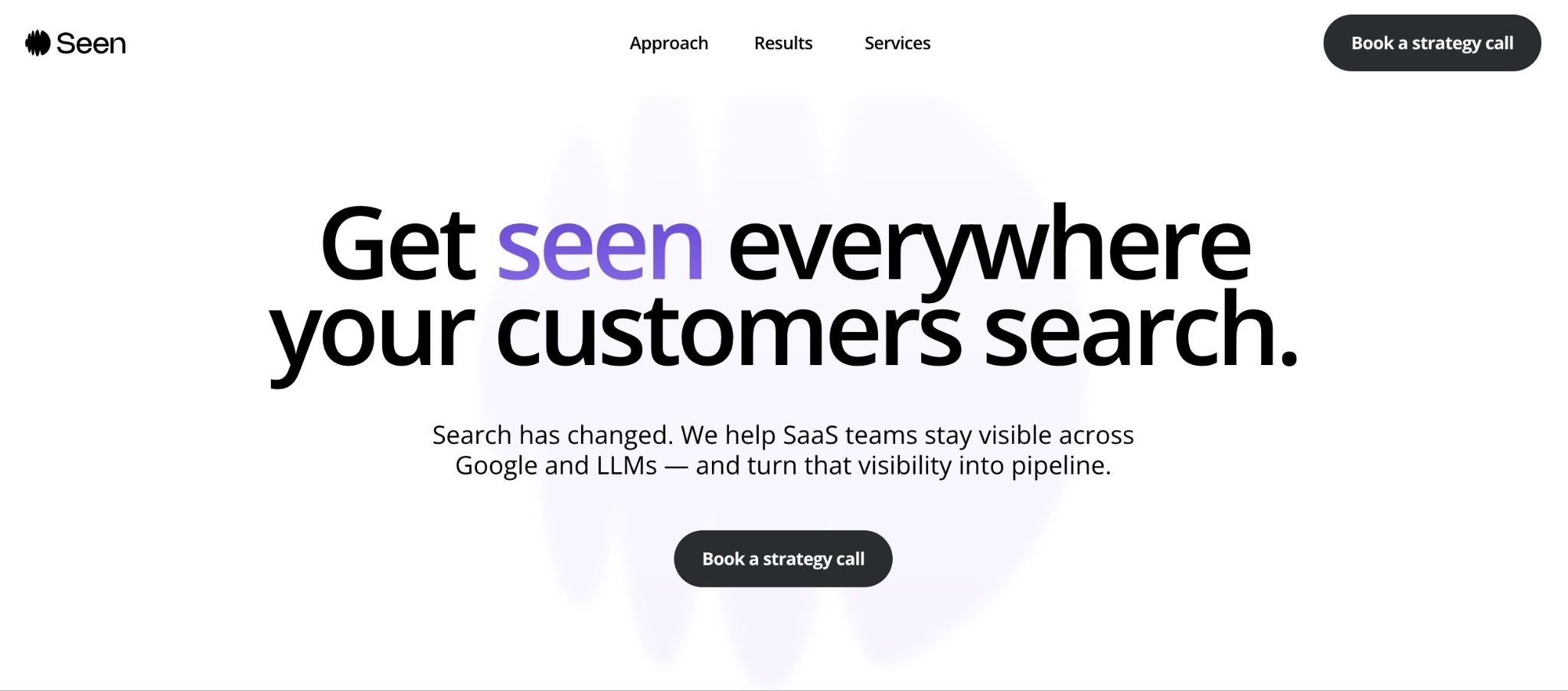
Seen is an AI SEO and GEO agency built specifically to help B2B SaaS companies get found across Google and AI search. Their operational thesis is straightforward: make your brand visible everywhere your customers are looking.
Buyers increasingly research and shortlist products inside large language models. Seen builds the data and authority your software needs to get recommended in those answers.
Three reasons B2B SaaS companies choose Seen:
Traditional SEO agencies rely on generic keyword spreadsheets. Seen avoids this by working exclusively with B2B SaaS companies and building custom strategies focused on revenue, not vanity metrics. Every playbook is designed to protect and grow real business numbers like Monthly Recurring Revenue (MRR) and lower Customer Acquisition Cost (CAC). Their custom strategies optimize across four distinct surfaces simultaneously:
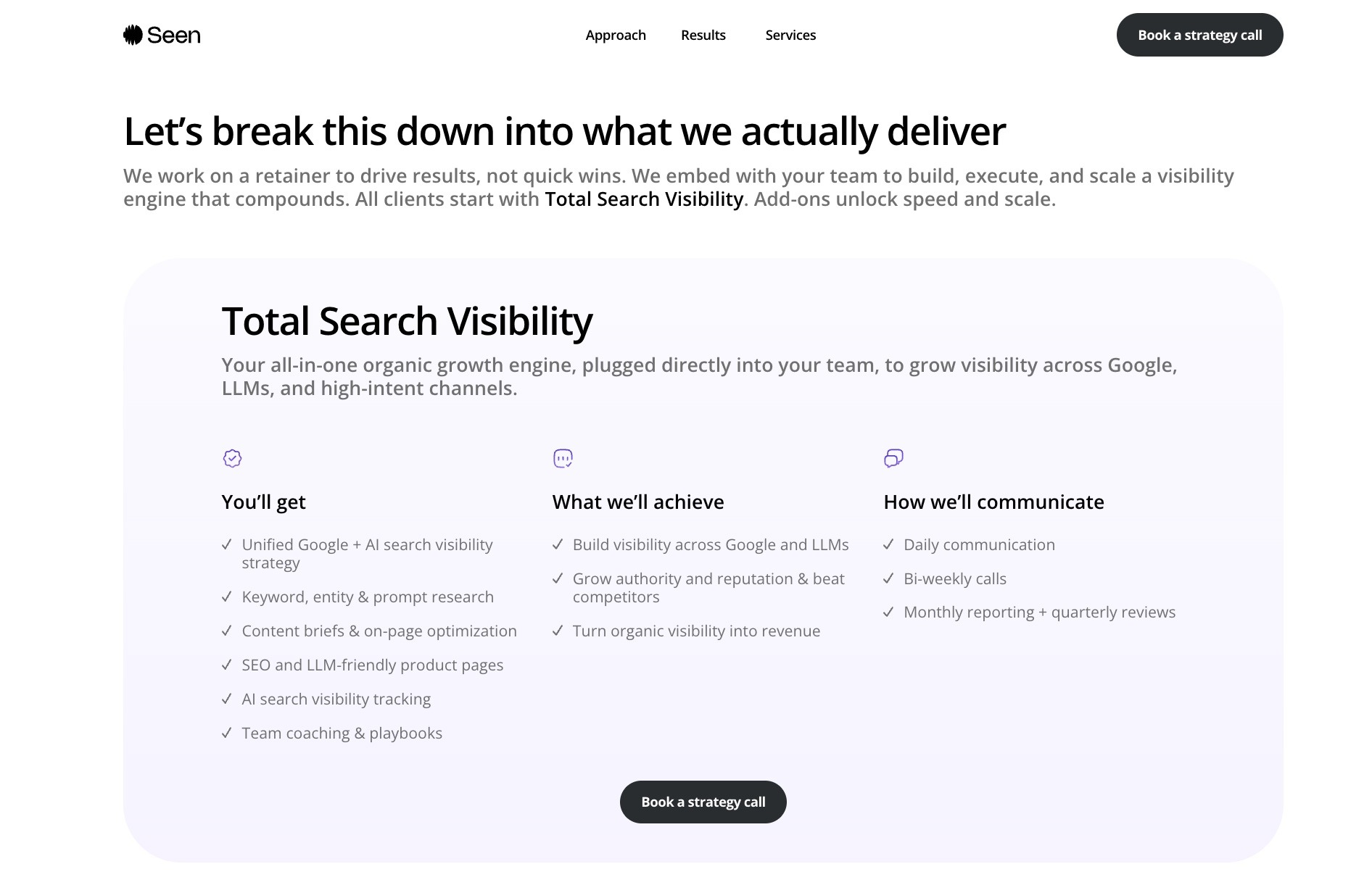
Instead of splitting focus across random marketing tasks, Seen sticks to three core services:
Seen skips the slow management layers, junior handoffs, and rigid reporting of older agencies. The team works directly in your day-to-day operations through email and project management tools. By working closely with your product and marketing leaders, they adjust the strategy as algorithms shift and your product evolves.
Seen works only with software companies, and typically with two types:
Early-stage startups and YC alumni (Seed/Series A+) building organic visibility from zero, plus scaling SaaS teams that publish content but see little pipeline from it.
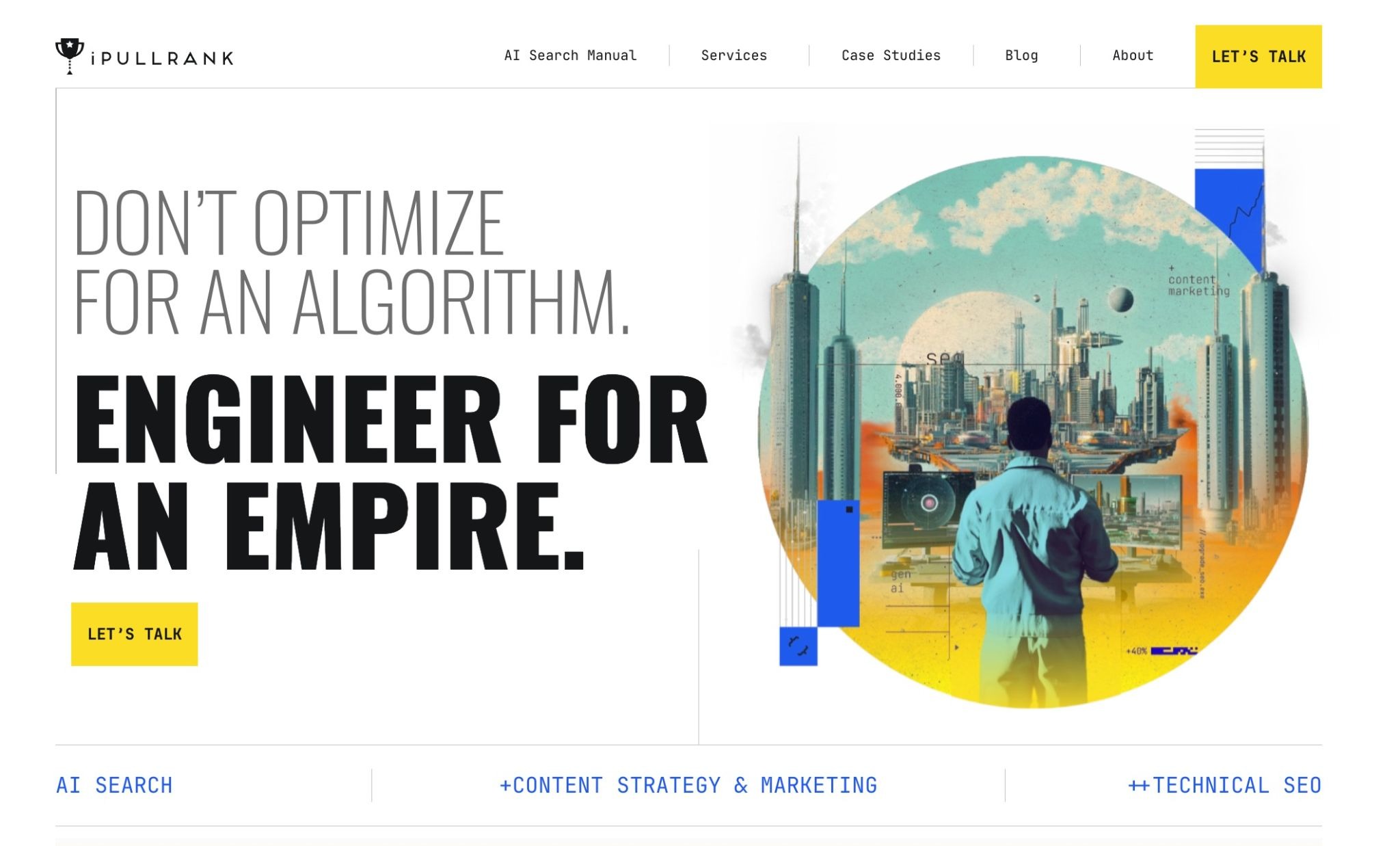
iPullRank treats AI search as an engineering problem. Instead of generic content checklists, they rebuild large corporate websites from the code up so AI can crawl them easily.
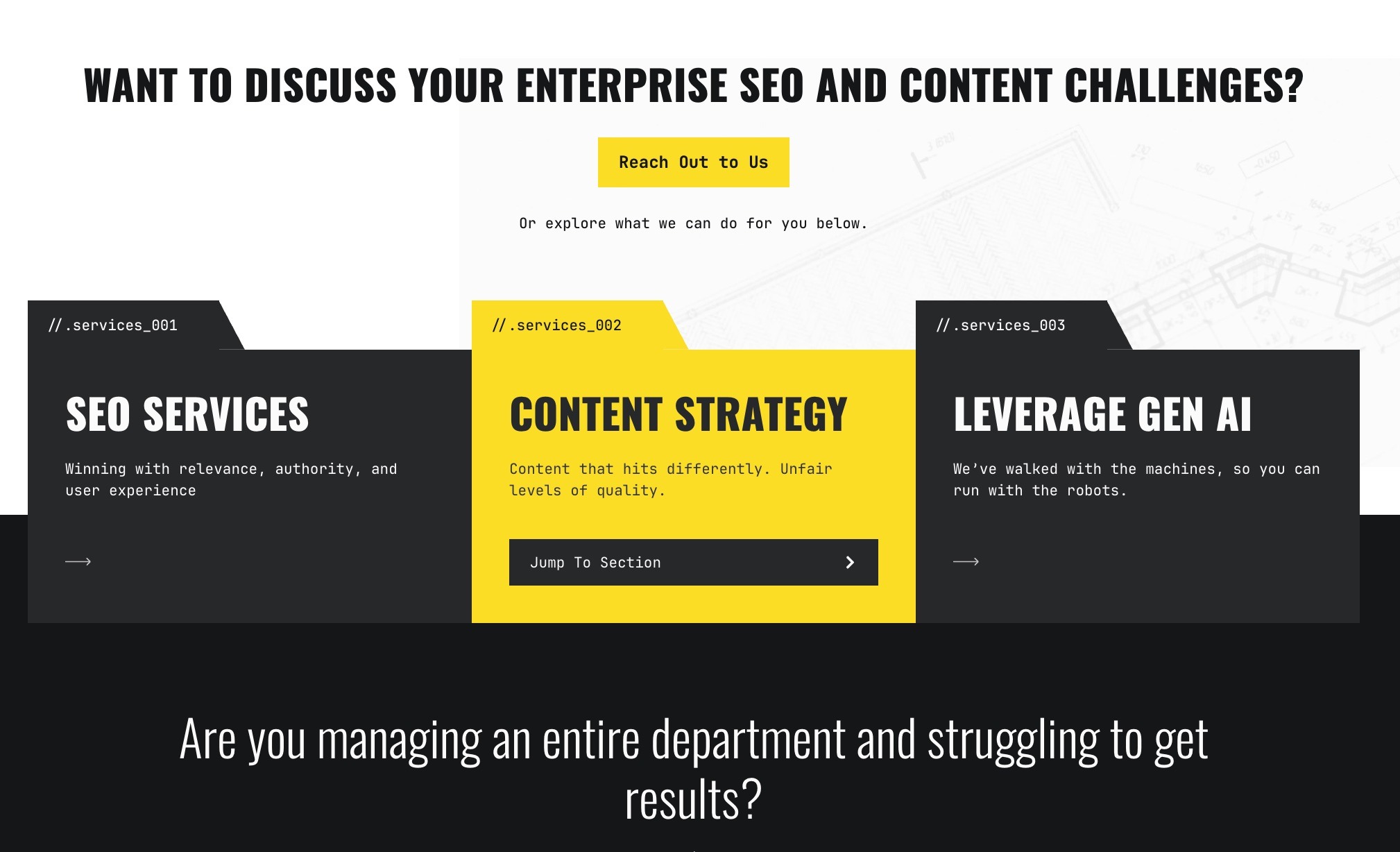
Led by recognized search technologist Mike King, iPullRank works directly with vector embeddings, query fan-out, and passage retrieval. Their focus is on structuring large enterprise content libraries so that LLMs can crawl, understand, and pull answers from them.
Relevance engineering for AI search and Google AI Overviews, analysis of how AI reads your content, fixes for JavaScript rendering issues, and digital PR.
Fortune 500 companies with deep technical debt and complex, high-volume indexing requirements.
Siege Media is a large content marketing agency built on one idea: large language models build their knowledge and back up their answers by pulling from trusted news publications and original research.
Siege Media runs large creative campaigns built around data journalism and original market research. By getting a brand featured on top-tier media outlets and other trusted sites, they earn the trust signals that make AI assistants more likely to cite you.
Content-led GEO and SEO strategy, original data journalism, high-tier earned media outreach, and content asset management through DataFlywheel.
Mid-market and enterprise brands whose main growth levers are original research, visual storytelling, and large-scale digital PR.
Graphite sits where product-led growth (PLG) meets automation. They build large, data-driven content libraries for fast-growing tech and software brands.
Graphite skips slow, manual page-by-page writing models in favor of highly scalable, programmatic landing page systems. Their systems are built to turn AI citations and comparison-query traffic into actual product signups.
Programmatic SEO and AEO content systems, growth design, conversion rate optimization, and cross-model visibility tracking through a proprietary platform.
Scaling product-led (PLG) tech companies and software platforms that need to capture AI-referral traffic across thousands of automated landing pages.
The right choice comes down to your current stage and your core bottleneck:
Any professional AI SEO roadmap in 2026 must focus on clear technical signals rather than vague content updates. Expect a real strategy to include:
The shift to generative search is already costing static brands their pipeline. Picking an agency that treats AI SEO as some separate, magical service — cut off from real business results — is a fast way to burn budget. The agencies listed above succeed because they focus on the underlying technical signals that make AI engines cite your brand.
.webp)
With 10 years of writing experience and a deep interest in SEO, AI, and content management, Anna’s here to break down big ideas and translate them into plain English for readers of all levels. She's got a Master's Degree in International Information and is a lifelong learner of writing and storytelling. Outside of work, she’s on the yoga mat, in a good book, or planning her next adventure with family and friends.
.svg)
.svg)
.svg)

.svg)
%20(1).svg)
%20(3).svg)
.svg)
.svg)