
.svg)
%20(1).svg)
%20(3).svg)
Back to articles
Server-Side Tagging: What It Is, Why It Matters, And How To Get Started
June 25, 2026
By
Thierry Maout
If your conversion numbers have been looking shakier lately, you’re not alone. Ad blockers now reach nearly 1 in 3 internet users globally, browsers have been quietly tightening restrictions on tracking scripts and shortening cookie lifetimes for years, and privacy regulations keep raising the bar for what data you are allowed to collect in the first place.
As a result, the attribution signals and performance data that marketing teams depend on are becoming less complete, less reliable, and harder to act on.
Server-side tagging is one of the most effective technical responses to this problem. In this article, we explore how it works, its key benefits, the tools available on the market, and how to pair it with a comprehensive privacy strategy to achieve both measurement quality and regulatory confidence.
In a classic client-side setup, a tag management system like Google Tag Manager loads inside the visitor's browser. When a user completes an action, tags fire and send event data directly to Google Analytics, Meta Pixel, or whichever platforms are configured. Each of those platforms receives data independently, meaning multiple third-party scripts run on your page simultaneously.
With server-side tagging, you add a layer in between. A lightweight first-party script on your page sends event data to a server container you control, hosted on your own subdomain. That server then validates, filters, and forwards the data to your third-party vendors. The browser only ever talks to your own infrastructure.
It is worth noting that server-side tagging is not necessarily a full replacement for client-side tracking. Certain types of real-time user data, such as precise on-page behavior or interactive events, still rely on what the browser can capture directly. For most organizations, the strongest setup combines both approaches, with server-side handling of the data flows that matter most for attribution and compliance.
You can go deeper on the technical distinctions in this comparison of server-side vs client-side tagging, or explore key terminology in this complete server-side tracking glossary.
The shift in where data processing happens unlocks several structural advantages for marketing and analytics teams.
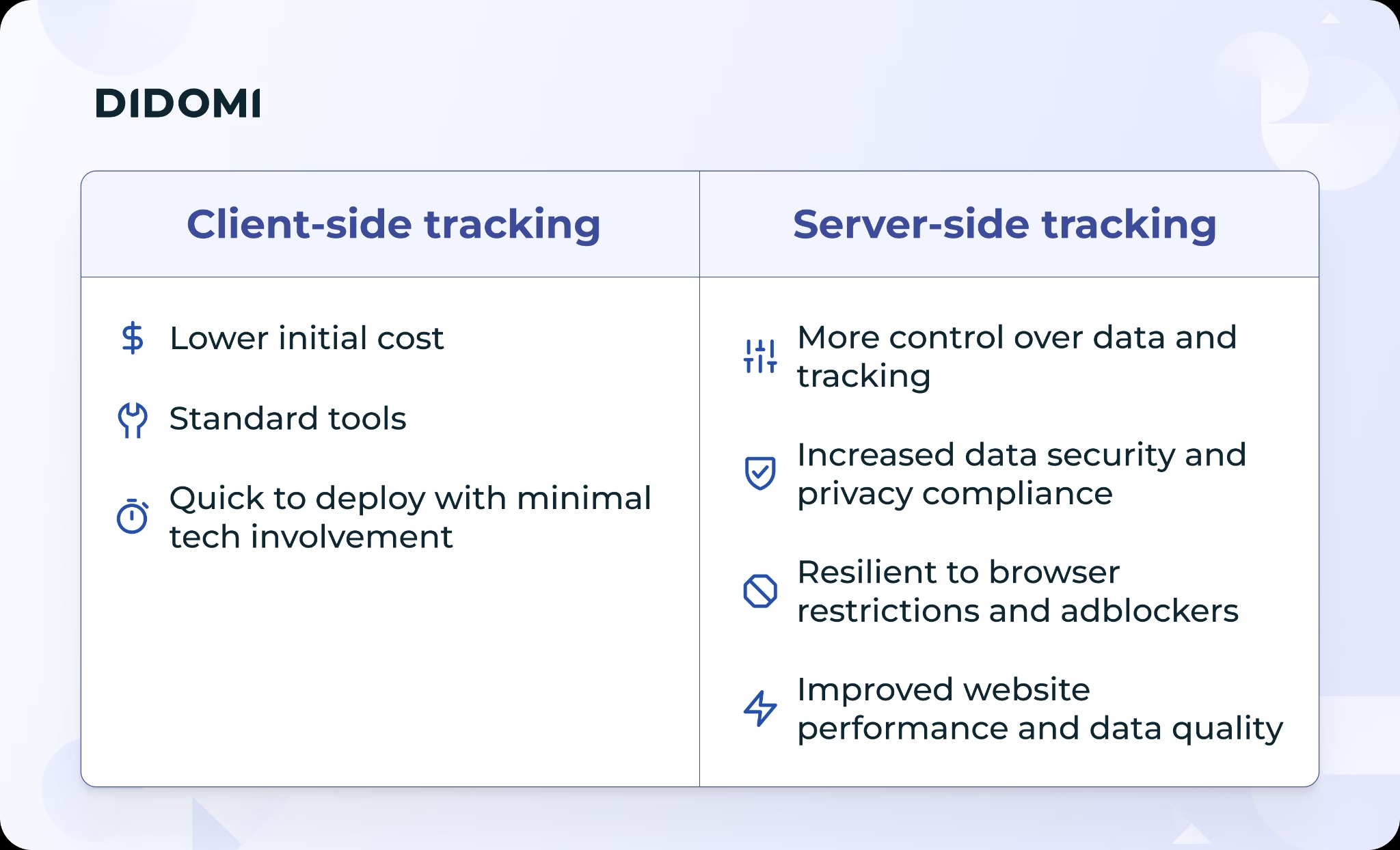
Among all the benefits, 4 stand out for marketing teams in particular:
Browser-based tracking faces two distinct threats: ad blockers and tools that block tracking requests outright, cutting off data at the source; and browser-level restrictions like Safari's Intelligent Tracking Prevention and Firefox's Enhanced Tracking Protection, which cap first-party cookie lifetimes and delete third-party cookies, degrading data quality over time even when requests do go through.
Server-side tagging helps recover part of that lost data by sending events from a first-party server environment instead, making conversion tracking and attribution more reliable across the board.
Instead of each third-party tag collecting data independently from the browser, server-side lets you filter and shape data before it leaves your infrastructure. You decide what gets forwarded, to whom, and in what form.
This improves transparency and makes it easier to ensure your tracking practices stay aligned with privacy regulations.
Client-side tagging often means loading many third-party scripts in the browser, each of which can slow page load times and hurt user experience.
Moving most tag execution server-side reduces the number of scripts running in the browser, which can meaningfully improve page speed and Core Web Vitals scores.
Ad platform algorithms depend on the quality of the conversion signals they receive to optimize bids, audiences, and attribution models. When you send more complete and accurate data, those algorithms work more effectively. Better signals translate directly into better campaign performance.
There is a broader argument for getting your data infrastructure right beyond just fixing attribution gaps. As Romain Baert, Managing Director for Server-Side at Didomi, writes in a recent piece on AI and marketing data:
"You don't build an AI strategy; you build the conditions that make AI possible by collecting properly, guaranteeing data quality, understanding it, then automating intelligently. In that order."
Server-side tagging is one part of the answer to that structural problem. A well-configured server-side setup, combined with a solid Consent Management Platform (CMP), means your CMP determines what data you are allowed to collect, and your server-side infrastructure ensures those signals are respected and enforced at every point in the data flow.
The two are increasingly inseparable for teams serious about both measurement quality and regulatory confidence.
The performance gains from server-side migration are tangible. Based on internal data from Addingwell (a server-side tagging platform acquired by Didomi in April 2025, where I work), server-side adoption is now estimated at 30-40% among the top 1,000 websites in major markets, with consistent growth over the past 12 months.
Below are a few real-world examples from brands that have switched to server-side tagging with Addingwell.
Outdoor hospitality brand Sandaya implemented server-side tracking to improve both marketing performance and website experience ahead of its high-traffic summer season.
By leveraging Addingwell’s infrastructure and Meta Conversion API integrations, the company improved the reliability of its conversion tracking and campaign performance. The results included:
Read the full case study here.
Travel brand Decathlon Travel adopted server-side tracking to strengthen campaign measurement. With more reliable conversion signals and improved data quality, the company was able to significantly improve advertising performance:
Read their testimony here.
Retail brand Damart migrated to a server-side architecture to regain control over its digital measurement strategy. By moving to server-side tracking, the company was able to:
Read more on the Addingwell website.
Moving to server-side tagging does not have to be a full infrastructure project, but it does require some planning. A realistic five-step approach:
The market for server-side tagging platforms has grown considerably. Options range from fully managed solutions to developer-oriented self-hosted setups. For a detailed breakdown of features, pricing, and best-fit profiles, see this complete server-side tagging tools guide we put together.
Here is a comparative overview of the main options.
Note for transparency: Didomi, my employer, acquired Addingwell in 2025. I tried to present all options as fairly as possible, but you should factor that context in when considering your options.
The conditions driving server-side adoption are not going away. Browser privacy restrictions are tightening with each release cycle, regulatory requirements are expanding across more jurisdictions, and third-party signals are becoming less available and less trustworthy. And as AI-driven marketing tools become more central to how campaigns are planned and optimized, the quality of the data feeding those systems matters more than ever.
Client-side tracking was built for a web that no longer exists, where third-party cookies flowed freely, browsers were permissive, and privacy was an afterthought. The infrastructure replacing it needs to be more deliberate, with first-party data and privacy at its core, and future-proof as the environment continues to change.
Jeff Wheeler, VP of Product at Didomi, summed it up in an opinion piece on the topic published recently by the IAB Tech Lab:
The organizations that will be best positioned in the next three to five years are those building data infrastructure today that doesn’t depend on third-party browser mechanisms, isn’t vulnerable to platform policy changes, and can demonstrate compliance to regulators without scrambling.
Server-side tagging is not a silver bullet, and implementing it well takes real planning. But for teams serious about data quality, marketing performance, and regulatory confidence, it has moved from a competitive advantage to a baseline requirement.
The organizations that invest in getting their data infrastructure right now will be the ones best positioned to act on it, whatever tools and channels come next.

Thierry Maout is the Content Manager at Didomi, a leading data privacy solutions provider. An experienced SaaS marketer and writer, he focuses on making complex privacy topics accessible and engaging for global audiences.
.svg)
.svg)
.svg)
.svg)
.svg)